• Fri frakt över 249 kr
  • •
  • Snabba leveranser
  • •
  • Billiga böcker
Kundservice

Du är på sajten för privatpersoner.

Företag, bibliotek eller offentlig verksamhet?

Du handlar på classic.bokus.com, där alla dina funktioner finns intakta.
Till classic.bokus.com
Bokus logotyp. Gå till startsidan.
  • Erbjudanden
  • Nyheter
  • Student
  • Topplistor
  • Barn & ungdom
  • Bokus Play
  • E-böcker
  • Pocketböcker
  • Spel & pussel

10% rabatt på allt med kod: NYSTART10 →

Sidfot

Mina sidor

    Hjälp

    • Kundservice
    • Vanliga frågor och svar
    • Frakt och leverans
    • Retur vid ångerrätt
    • Reklamera vara
    • Betalning
    • Köpvillkor
    • Allmänna villkor
    • Information om webbplatsens tillgänglighet

    Om Bokus

    • Om oss
    • Pressrum
    • För studenter
    • För företag
    • För bibliotek och offentlig verksamhet
    • För leverantörer
    • Hållbarhet

    Populärt

    • Aktuella erbjudanden
    • Presentkort
    • Studentlitteratur
    • Nya böcker
    • Topplistor
    • Signerade böcker
    • Engelska böcker

    Inspiration

    • Boktips
    • BookTok
    • Populära bokserier
    • Barnbokskaraktärer
    • Populära författare
    Logotyp för Bokus
    Följ oss på Facebook (extern länk)Följ oss på Instagram (extern länk)Följ oss på YouTube (extern länk)Följ oss på TikTok (extern länk)
    bokus @ CookiesAnpassa cookiesIntegritetspolicyKöpvillkor
    Till Citymail hemsida (extern länk)Till Budbee hemsida (extern länk)Till Postnord hemsida (extern länk)Till Schenker hemsida (extern länk)Till Early Bird hemsida (extern länk)Till Walleys hemsida (extern länk)
    1. Samhälle och politik
    2. Samhälle och kultur
    3. Sociala och etiska frågor

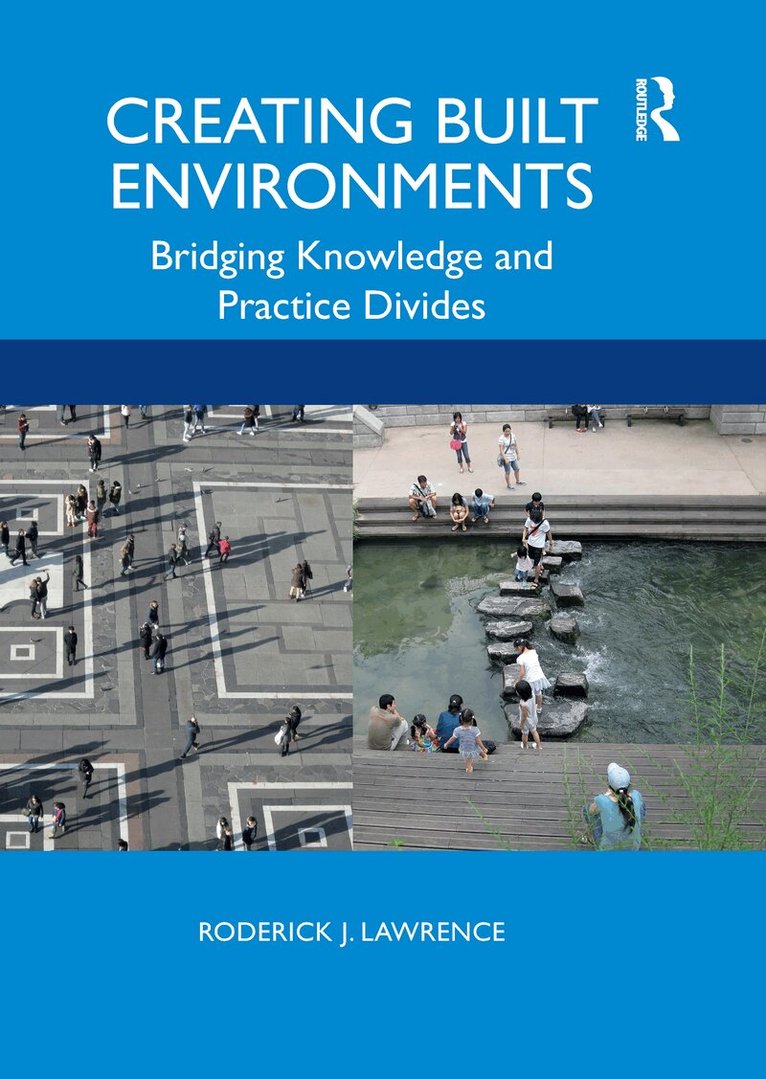
    Creating Built Environments

    Bridging Knowledge and Practice Divides

    AvRoderick Lawrence

    Inbunden, Engelska, 2020

    2 495 kr

    Beställningsvara. Skickas inom 10-15 vardagar. Fri frakt över 249 kr.

    Fler format och utgåvor

    Häftad

    615 kr

    E-bok

    725 kr

    E-bok

    727 kr

    Beskrivning

    Built environments are complex, emergent, systemic, and require contextual analysis. They should be understood before reconsidering how professionals and researchers of the built environment are educated and trained to reduce the gap between knowledge, practice and real-world circumstances. There is an urgent need to rethink the role of policy makers, researchers, practitioners and laypeople in the construction, renovation and reuse of the built environment in order to deal with numerous environmental/ecological, economic/financial and social/ethical challenges of providing a habitat for current and future generations in a world of continual change. These challenges are too complex to be dealt with only by one discipline or profession. Combinations of different types of knowledge, knowing in praxis and tacit knowledge are needed.This book presents and illustrates recent innovative contributions with case studies focusing on five strategic domains and the interrelations between them. These transdisciplinary contributions apply concepts, methods and tools that facilitate convergence and concerted action between participants collaborating in policy definition and project implementation. The methods and tools include experiments in living-labs, prototypes on site and virtual simulations, as well as participatory approaches including citizen science, the development of alternative scenarios, and visioning plausible futures.

    Produktinformation

    • Utgivningsdatum:2020-07-23
    • Mått:178 x 254 x 19 mm
    • Vikt:635 g
    • Format:Inbunden
    • Språk:Engelska
    • Antal sidor:266
    • Förlag:Taylor & Francis Inc
    • ISBN:9780815385387

    Utforska kategorier

    • Sociala och etiska frågor inom Samhälle och politik
    • Landskapsarkitektur inom Kultur
    • Regional planering inom Naturvetenskap och teknik

    Mer om författaren

    Roderick J. Lawrence, B. Arch (Hons), MLitt, DSc, has been Honorary Professor at the Geneva School of Social Sciences (G3S) at the University of Geneva since 2015. He is a member of the scientific advisory board of the Swiss Academies of Arts and Sciences' 'Network for transdisciplinary research' since 2009. He was the founding Director of the Certificate of Advanced Studies in Sustainable Development at the University of Geneva from 2003 to 2015.

    Recensioner i media

    "In Creating Built Environments, Lawrence presents a lucid, authoritative and comprehensive narrative on the co-creation of urban environments within which humans might flourish. Balancing systems-based transdisciplinary frameworks with applied empirical examples, the work is a compelling evidence-based argument for the imperative of transforming approaches to urban design for just and sustainable futures". ⁠Dr Robert Dyball, Australian National University, Past President of the Society for Human Ecology (SHE), Australia"Roderick Lawrence takes us on a journey from philosophical foundations to contemporary inter- and trans-disciplinary approaches of the planning of the future of the urban built environement, the place where the majority of humans live. He offers food for thought for urban planning involving all actors in a participatory way".Jakob Zinsstag, President TD-net, Swiss Academies of Sciences, Switzerland"Our health is inextricably entwined with our environment, and yet we continue to devolve responsibility to the confines of biomedical care. This work on urban development is a stark demonstration of the inter- and trans-disciplinary approaches across both the Global South and North necessary for a holistic, just, and sustainable approach toward health and wellbeing".Dr Pascale Allotey, Director of the United Nations University International Institute for Global Health (UNU-IIGH) "Sometimes a book is perfectly timed, and this is one of them. The sun is setting on a scientific era defined by disciplinary silos. We need to fix the way built environments are planned. This book explains how researchers and practitioners can work together to be joint agents of change".Dr Tony Craig, The James Hutton Institute, President of the International Association of People-Environment Studies (IAPS)"The challenges of health and well-being in urban environments, for people and the planet, emerge from social, technological and ecological systems which are complex. Solving them requires overcoming the barriers of thinking and working together. In his book, Roderick Lawrence makes important contributions to bridging barriers and tackling those challenges".Dr Franz W. Gatzweiler, Professor, Executive Director of Urban Health and Well-Being: A Systems Approach, a global interdisciplinary programme of the International Science Council"This book is timely, aimed at a very broad readership, comprehensive in its coverage and provides optimism and realism in confronting the global and local challenges and the geopolitics we now face. I positively endorse its approach and message".Colin Fudge, Professor of Urban Futures and Design, Chalmers University, Sweden"Lawrence’s book is also a feat of organization and clarity. Ideas are systematically explained and illustrated with real-world examples that are compelling and convincing, making this ideal course material every student, teacher and practitioner in the built environment ought to read."Roberto Rocco, review in Housing, Theory and Society"Creating Built Environments: Bridging Knowledge and Practical Divides (2020) is a highly practical and theoretically innovative work by renowned author, Roderick J. Lawrence. [The book] articulates, explores, and demonstrates an approach that aims at problem-centric, data-driven, synthesis in thinking, which promotes action and practicality of outcome as the most desirable results."Dr Ian Fookes, Lecturer, University of Auckland, New Zealand, review in Ekistics and the New Habitat

    Innehållsförteckning

    • IntroductionPART 1 : STRATEGIC DOMAINSChapter 1: Constructing with Nature in MindChapter 2: Planning for Health and Well-Being Chapter 3: Food for ThoughtChapter 4: Housing Matters for AllChapter 5: Creating Incremental and Radical ChangePART 2: CONCEPTUAL & METHODOLOGICAL FOUNDATIONSChapter 6: Conceptual FoundationsChapter 7: Methodological Approaches