• Fri frakt över 249 kr
  • •
  • Snabba leveranser
  • •
  • Billiga böcker
Kundservice

Du är på sajten för privatpersoner.

Företag, bibliotek eller offentlig verksamhet?

Du handlar på classic.bokus.com, där alla dina funktioner finns intakta.
Till classic.bokus.com
Bokus logotyp. Gå till startsidan.
  • Erbjudanden
  • Nyheter
  • Student
  • Topplistor
  • Barn & ungdom
  • Bokus Play
  • E-böcker
  • Pocketböcker
  • Spel & pussel

10% rabatt på allt med kod NYSTART10 →

Sidfot

Mina sidor

    Hjälp

    • Kundservice
    • Vanliga frågor och svar
    • Frakt och leverans
    • Retur vid ångerrätt
    • Reklamera vara
    • Betalning
    • Köpvillkor
    • Allmänna villkor
    • Information om webbplatsens tillgänglighet

    Om Bokus

    • Om oss
    • Pressrum
    • För studenter
    • För företag
    • För bibliotek och offentlig verksamhet
    • För leverantörer
    • Hållbarhet

    Populärt

    • Aktuella erbjudanden
    • Presentkort
    • Studentlitteratur
    • Nya böcker
    • Topplistor
    • Signerade böcker
    • Engelska böcker

    Inspiration

    • Boktips
    • BookTok
    • Populära bokserier
    • Barnbokskaraktärer
    • Populära författare
    Logotyp för Bokus
    Följ oss på Facebook (extern länk)Följ oss på Instagram (extern länk)Följ oss på YouTube (extern länk)Följ oss på TikTok (extern länk)
    bokus @ CookiesAnpassa cookiesIntegritetspolicyKöpvillkor
    Till Citymail hemsida (extern länk)Till Budbee hemsida (extern länk)Till Postnord hemsida (extern länk)Till Schenker hemsida (extern länk)Till Early Bird hemsida (extern länk)Till Walleys hemsida (extern länk)
    1. Medicin
    2. Andra medicinska specialiteter
    3. Klinisk psykologi
    4. Psykoterapi som behandlingsmetod

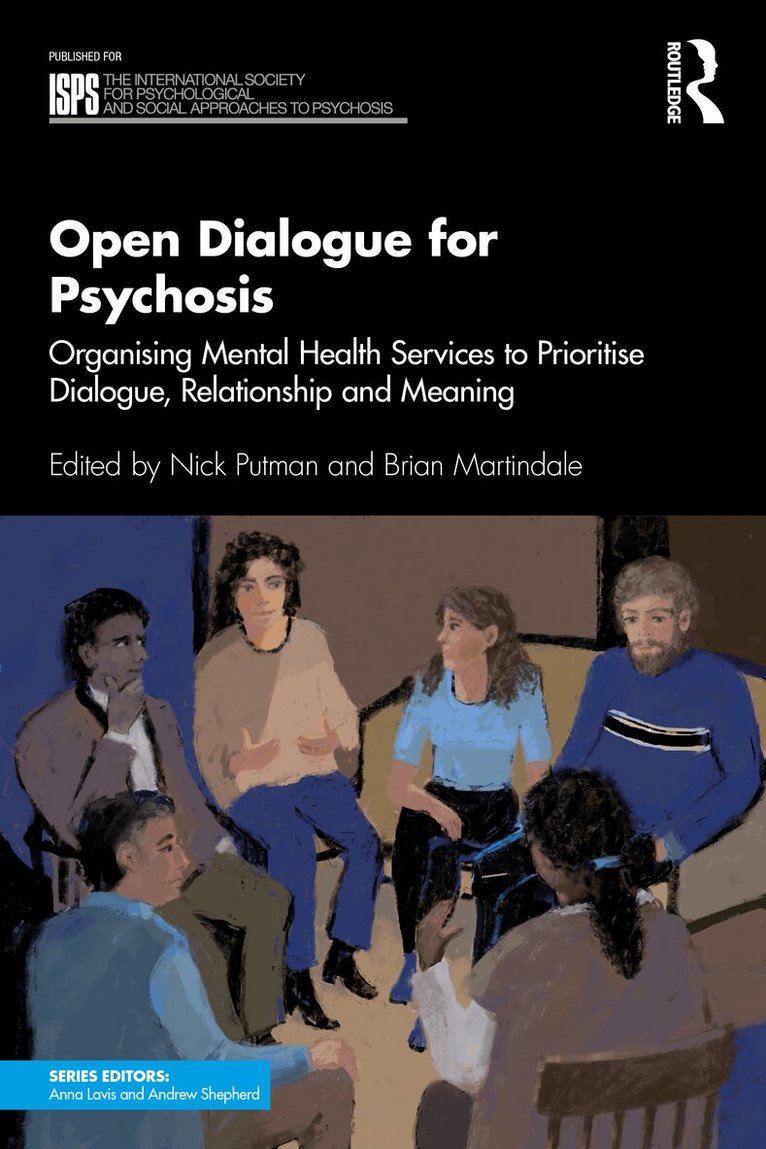
    Open Dialogue for Psychosis

    Organising Mental Health Services to Prioritise Dialogue, Relationship and Meaning

    AvNick Putman,Brian Martindale

    Häftad, Engelska, 2021

    Del i serien International Society for Psychological and Social Approaches to Psychosis Book Series

    542 kr

    Beställningsvara. Skickas inom 10-15 vardagar. Fri frakt över 249 kr.

    Beskrivning

    This highly readable book provides a comprehensive examination of the use of Open Dialogue as a treatment for psychosis. It presents the basic principles and practice of Open Dialogue, explains the training needed to practice and explores how it is being developed internationally.Open Dialogue for Psychosis includes first-hand accounts of the process by people receiving services due to having psychotic experiences, their family members and professionals who work with them. It explains how aspects of Open Dialogue have been introduced in services around the world, its overlap with and differentiation from other psychological approaches and its potential integration with biological and pharmacological considerations. The book concludes with a substantive section on the research available and its limitations.Open Dialogue for Psychosis will be a key text for clinicians and administrators interested in this unique approach, particularly those who recognise that services need to change for the better and are seeking guidance on how this can be achieved. It will also be suitable for people who have experienced psychosis and members of their families and networks.See the below link to the dedicated book webpage:https://opendialogueforpsychosis.com/

    Produktinformation

    • Utgivningsdatum:2021-07-30
    • Mått:156 x 234 x 21 mm
    • Vikt:490 g
    • Format:Häftad
    • Språk:Engelska
    • Serie:International Society for Psychological and Social Approaches to Psychosis Book Series
    • Antal sidor:314
    • Förlag:Taylor & Francis Inc
    • ISBN:9780815392323

    Utforska kategorier

    • Psykoterapi som behandlingsmetod inom Medicin

    Mer om författaren

    Nick Putman is a psychotherapist and practitioner, supervisor and trainer in Open Dialogue. He is the founder of Open Dialogue UK.Brian Martindale is a psychiatrist and psychoanalyst based in the UK. He is past Chair of the International Society for Psychological and Social Approaches to Psychosis (ISPS) and co-founder of the European Federation of Psychoanalytic Psychotherapy (EFPP).

    Recensioner i media

    "This is a much needed, timely book that provides the first account of the international implementation and adaptation of the Open Dialogue approach to promoting recovery among persons experiencing psychosis. Spanning theoretical, training, and research perspectives - with the welcome addition of first person accounts from providers, persons in recovery, and their loved ones - this comprehensive introduction is sure to hasten the spread of the first radically new approach to psychosis the field has seen in decades." – Professor Larry Davidson, Yale University, USA"Open Dialogue is one of the most optimistic developments in the care of people with mental illness in the last three decades… This book is vital in explaining what it is, what training is necessary, the experience of service users and the key research related to this approach. I recommend it to all mental health practitioners and those with lived experience." – Adrian James, President, Royal College of Psychiatrists, UK"This book is the most complete description available of Open Dialogue… The authors convincingly illustrate that Open Dialogue should play an essential role in any treatment for psychosis and the organisation of services. I heartily recommend this book." - Ludi Van Bouwel, Chair, ISPS"With this book Putman and Martindale aimed to create a comprehensive and thoughtful exploration of the Open Dialogue approach to psychosis and its wider application within mental health services - and they have delivered spectacularly... For the Family Therapy field, this book will make its mark as an excellent resource for practitioners, researchers, clinical training programmes and service commissioners." – Monica Whyte, President, EFTA

    Innehållsförteckning

    • Prologue SECTION 1: Introducing Open Dialogue 1. What is Open Dialogue? 2. The historical development of Open Dialogue in Western Lapland 3. Psychosis is not an illness but a response to extreme stress – dialogue is a cure for it SECTION 2: Personal, family and professional experiences of Open Dialogue Editors’ introduction 4. Our son is ‘coming back’: a dialogical-network approach to a young adult diagnosed with schizoaffective disorder 5. The experience of a family Open Dialogue approach – a sister and practitioner refl ect one year after discharge from services 6. Psychotic behaviour: symptom of a (brain) disease or an attempt at adjustment? 7. The stress of tolerating uncertainty: emails can help! 8. Rooted in love – a journey through a dark time with a teenager and his family 9. Open Dialogue as a point of entry to reconnect to the real world of relationships 10. Permission to speak! SECTION 3: Open Dialogue training, including refl ections from trainers and participants and adaptations in different settings Editors’ introduction 11. Introducing Open Dialogue training 12. Reflections on the dialogical design of the three/ four-year Open Dialogue training 13. Reflections on participating in the three-year Open Dialogue training 14. Thirteen years of running Open Dialogue foundation training programmes 15. Reflections from participants on an Open Dialogue foundation training 16. Being ‘in rhythm’ with participants during dialogical training 17. Personal refl ections on the Italian Open Dialogue training 18. UK NHS Peer- supported Open Dialogue training SECTION 4: Introducing Open Dialogue in different contexts in various countries Editors’ introduction 19. Open Dialogue in Germany – opportunities and challenges 20. Open Dialogue in the Italian national health service: a view from the borderland 21. The challenges of introducing Open Dialogue into a UK Early Intervention in Psychosis Service 22. Two Open Dialogue programmes at Advocates, Framingham, Massachusetts, USA 23. Implementing Open Dialogue- informed practices at the counselling service of Addison County in Vermont, USA 24. Migrant families: experiences using the Open Dialogue approach 25. Peer workers in Open Dialogue 26. The challenge of developing Open Dialogue in hospital settings 27. Open Dialogue behind ‘closed doors’ (a locked ward) SECTION 5: Opening the dialogue with other approaches Editors’ introduction 28. Working with Open Dialogue within the neurobiological model – challenges and opportunities 29. Systemic therapy and Open Dialogue 30. Open Dialogue and cognitive behavioural therapy (CBT) 31. Extending need- adapted interventions in a contemporary Open Dialogue service in Helsinki 32. Interfamily therapy: application of dialogical practices in the multifamily group 33. Psychoanalysis and Open Dialogue 34. The affinities between therapeutic communities and Open Dialogue 35. Open Dialogue and music therapy SECTION 6: Research into Open Dialogue Editors’ introduction 36. Research into the need- adapted treatment approach to psychosis 37. Research from Western Lapland of Open Dialogue for psychosis 38. Open Dialogue adherence and fidelity tools 39. The UK ODDESSI trial 40. Research into a Peer-supported Open Dialogue service in the UK 41. Open Dialogue for psychosis in five Danish municipalities – results and experiences 42. Researching whether Finnish Open Dialogue transfers to the Italian mental health system 43. A feasibility study of adapting Open Dialogue to the US health context: the Collaborative Pathway at Advocates, Massachusetts, USA 44. The Parachute Project NYC – the project and outcomes of the Brooklyn mobile team 45. Open Dialogue research in Ireland 46. Anthropological research into Open Dialogue in Berlin 47. Openness and authenticity in the Open Dialogue approach Epilogue