• Fri frakt över 249 kr
  • •
  • Snabba leveranser
  • •
  • Billiga böcker
Kundservice

Du är på sajten för privatpersoner.

Företag, bibliotek eller offentlig verksamhet?

Du handlar på classic.bokus.com, där alla dina funktioner finns intakta.
Till classic.bokus.com
Bokus logotyp. Gå till startsidan.
  • Erbjudanden
  • Nyheter
  • Student
  • Topplistor
  • Barn & ungdom
  • Bokus Play
  • E-böcker
  • Pocketböcker
  • Spel & pussel

Må bättre, för mindre! Upp till 50% rabatt på hälsoböcker

Sidfot

Mina sidor

    Hjälp

    • Kundservice
    • Vanliga frågor och svar
    • Frakt och leverans
    • Retur vid ångerrätt
    • Reklamera vara
    • Betalning
    • Köpvillkor
    • Allmänna villkor
    • Information om webbplatsens tillgänglighet

    Om Bokus

    • Om oss
    • Pressrum
    • För studenter
    • För företag
    • För bibliotek och offentlig verksamhet
    • För leverantörer
    • Hållbarhet

    Populärt

    • Aktuella erbjudanden
    • Presentkort
    • Studentlitteratur
    • Nya böcker
    • Topplistor
    • Signerade böcker
    • Engelska böcker

    Inspiration

    • Boktips
    • BookTok
    • Populära bokserier
    • Barnbokskaraktärer
    • Populära författare
    Logotyp för Bokus
    Följ oss på Facebook (extern länk)Följ oss på Instagram (extern länk)Följ oss på YouTube (extern länk)Följ oss på TikTok (extern länk)
    bokus @ CookiesAnpassa cookiesIntegritetspolicyKöpvillkor
    Till Citymail hemsida (extern länk)Till Budbee hemsida (extern länk)Till Postnord hemsida (extern länk)Till Schenker hemsida (extern länk)Till Early Bird hemsida (extern länk)Till Walleys hemsida (extern länk)
    1. Samhälle och politik
    2. Sociologi och antropologi
    3. Sociologi

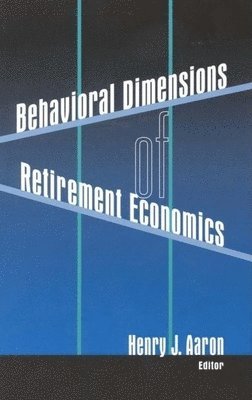
    Behavioral Dimensions of Retirement Economics

    AvHenry J. Aaron

    Häftad, Engelska, 1999

    312 kr

    Beställningsvara. Skickas inom 10-15 vardagar. Fri frakt över 249 kr.

    Beskrivning

    Deciding when and how to retire are among the most important decisions most people make. Can they be depended on to plan with foresight and make sound decisions? According to standard economic analysis the answer is a qualified ""yes."" But studies by psychologists, sociologists, and economists themselves raise doubts about this comforting appraisal. This volume by analysts trained in economics and other disciplines suggests that retirement planning and decisions fall far short of the rational ideal. Gary Burtless explains what economic research has to say about retirement behavior. Annamaria Lusardi reports that many people in their fifties and older say they have not even thought about retirement. Mathey Rabin and Ted O'Donoghue show that procrastination can cause huge economic losses. Robert Axtell and Joshua Epstein show that herd behavior explains observed patterns of retirement behavior better than does the assumption of rational decisionmaking. George Loewenstein, Drazen Prelec, and Roberto Weber report that many people incorrectly anticipate what retirement will be like and rationalize whatever decision they have made. David Fetherstonhaugh and Lee Ross report experimental evidence that the effect of Social Security provisions may depend on how these policies are ""framed"" as well as on the specific content of those policies. These and other authors also explore the broader implications of these behavioral patterns. Copublished with Russell Sage Foundation

    Produktinformation

    • Utgivningsdatum:1999-09-01
    • Mått:231 x 155 x 22 mm
    • Vikt:438 g
    • Format:Häftad
    • Språk:Engelska
    • Antal sidor:289
    • Förlag:Bloomsbury Publishing Plc
    • ISBN:9780815700630

    Utforska kategorier

    • Sociologi inom Samhälle och politik

    Mer om författaren

    Henry J. Aaron is a senior fellow in Economic Studies at the Brookings Institution, where he holds the Bruce and Virginia MacLaury Chair. Among his many books are Can We Say No? The Challenge of Rationing Health Care , with William B. Schwartz and Melissa Cox (Brookings, 2006), and Reforming Medicare: Options,Tradeoffs, and Opportunities , written with Jeanne Lambrew (Brookings, 2008).

    Recensioner i media

    "'Behavioral Dimensions of Retirement Economics'... takes a large step forward by providing a ready reference for a heterodox approach- behavioral economics- in addressing an important personal and public policy issue, retirement." —John J. Hisnanick, U.S. Naval Academy, Annapolis, Review of Social Economy, 6/1/2000|"A fascinating book for policymakers and scholars alike that applies insights from the new field of behavioral economics to the crucial decision of retirement. These psychologists, sociologists, and economists contend that people don't have the clear preferences often assumed, they lack full information, and they can't calculate the implications of all the options. As a result, they are influenced by their peers, and by how incentives are structured. In terms of Social Security reform, the implications are clear: don't expect people to respond instantaenously to changes in rules, and one lump-sum payment may be more effective than higher future benefits in encouraging people to defer retirement. A must read!" —Alicia H. Munnell, Boston College|"Fresh ideas on an old topic are always welcome, especially when that topic is once again high on the national agenda. By taking a refreshing new look at the retirement decision from the behavioral perspective, this book offers a treasure trove of them. Browse it for fun and profit." —Alan Blinder, Princeton University|"With all the talk about saving Social Security, hardly anyone grasps how individuals and families think about retirement beforehand, decide how and when to prepare for it, and experience it when it happens. That is what this fascinating book is about. It is live research still exploratory, offering new questions as well as new answers." —Robert M. Solow, Massachusetts Institute of Technology