• Fri frakt över 249 kr
  • •
  • Snabba leveranser
  • •
  • Billiga böcker
Kundservice

Du är på sajten för privatpersoner.

Företag, bibliotek eller offentlig verksamhet?

Du handlar på classic.bokus.com, där alla dina funktioner finns intakta.
Till classic.bokus.com
Bokus logotyp. Gå till startsidan.
  • Erbjudanden
  • Student
  • Topplistor
  • Barn & ungdom
  • Bokus Play
  • Bokus Play
  • E-böcker
  • Ljudböcker
  • Pocketböcker
  • Spel & pussel

10% rabatt på allt med kod NYSTART10 →

Sidfot

Mina sidor

    Hjälp

    • Kundservice
    • Vanliga frågor och svar
    • Frakt och leverans
    • Retur vid ångerrätt
    • Reklamera vara
    • Betalning
    • Köpvillkor
    • Allmänna villkor
    • Information om webbplatsens tillgänglighet

    Om Bokus

    • Om oss
    • Pressrum
    • För studenter
    • För företag
    • För bibliotek och offentlig verksamhet
    • För leverantörer
    • Hållbarhet

    Populärt

    • Aktuella erbjudanden
    • Presentkort
    • Studentlitteratur
    • Nya böcker
    • Topplistor
    • Signerade böcker
    • Engelska böcker

    Inspiration

    • Boktips
    • BookTok
    • Populära bokserier
    • Barnbokskaraktärer
    • Populära författare
    Logotyp för Bokus
    Följ oss på Facebook (extern länk)Följ oss på Instagram (extern länk)Följ oss på YouTube (extern länk)Följ oss på TikTok (extern länk)
    bokus @ CookiesAnpassa cookiesIntegritetspolicyKöpvillkor
    Till Citymail hemsida (extern länk)Till Budbee hemsida (extern länk)Till Postnord hemsida (extern länk)Till Schenker hemsida (extern länk)Till Early Bird hemsida (extern länk)Till Walleys hemsida (extern länk)
    1. Naturvetenskap och teknik
    2. Matematik och naturvetenskap
    3. Matematik

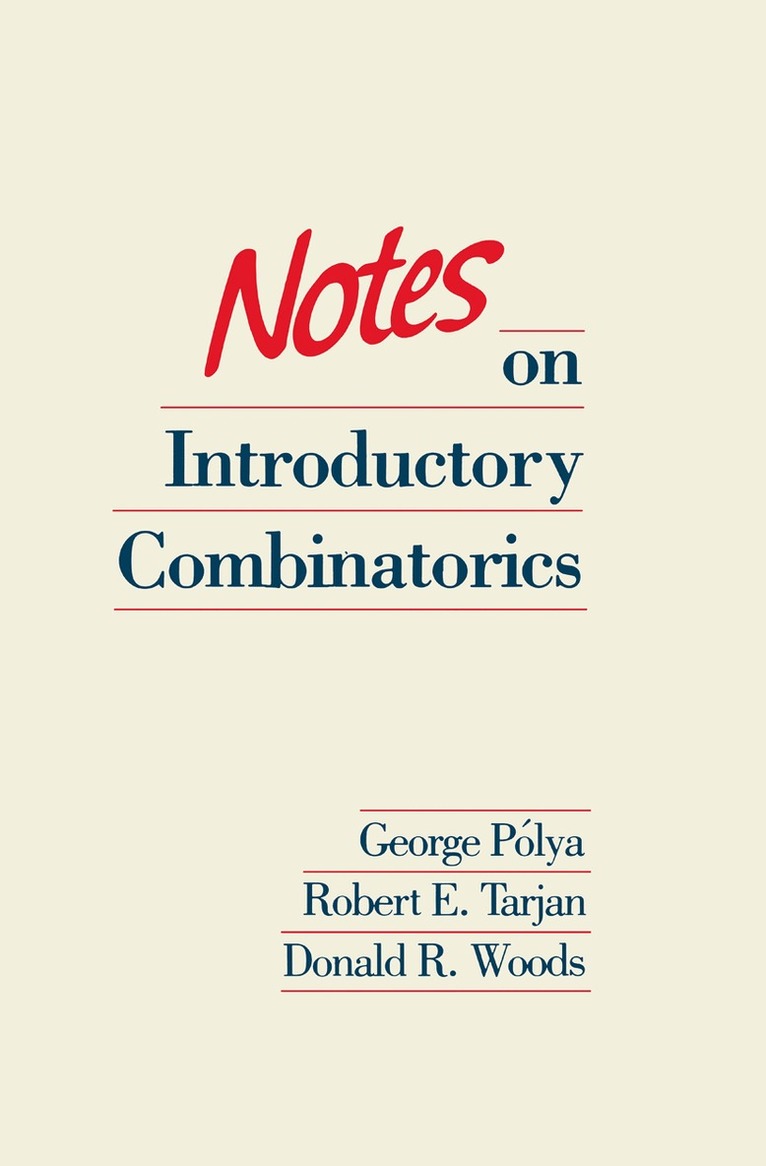
    Notes on Introductory Combinatorics

    AvGeorge Polya,Robert E. Tarjan

    Häftad, Engelska, 1990

    Del 4 i serien Progress in Computer Science and Applied Logic

    871 kr

    Beställningsvara. Skickas inom 10-15 vardagar. Fri frakt över 249 kr.

    Fler format och utgåvor

    Häftad

    709 kr

    Beskrivning

    In the winter of 1978, Professor George P61ya and I jointly taught Stanford University's introductory combinatorics course. This was a great opportunity for me, as I had known of Professor P61ya since having read his classic book, How to Solve It, as a teenager. Working with P6lya, who ·was over ninety years old at the time, was every bit as rewarding as I had hoped it would be. His creativity, intelligence, warmth and generosity of spirit, and wonderful gift for teaching continue to be an inspiration to me. Combinatorics is one of the branches of mathematics that play a crucial role in computer sCience, since digital computers manipulate discrete, finite objects. Combinatorics impinges on computing in two ways. First, the properties of graphs and other combinatorial objects lead directly to algorithms for solving graph-theoretic problems, which have widespread application in non-numerical as well as in numerical computing. Second, combinatorial methods provide many analytical tools that can be used for determining the worst-case and expected performance of computer algorithms. A knowledge of combinatorics will serve the computer scientist well. Combinatorics can be classified into three types: enumerative, eXistential, and constructive. Enumerative combinatorics deals with the counting of combinatorial objects. Existential combinatorics studies the existence or nonexistence of combinatorial configurations.

    Produktinformation

    • Utgivningsdatum:1990-01-01
    • Mått:155 x 235 x 12 mm
    • Vikt:318 g
    • Format:Häftad
    • Språk:Engelska
    • Serie:Progress in Computer Science and Applied Logic
    • Antal sidor:193
    • Upplaga:2
    • Förlag:Birkhauser Boston
    • ISBN:9780817631703

    Utforska kategorier

    • Matematik inom Naturvetenskap och teknik

    Innehållsförteckning

    • 1. Introduction.- 2. Combinations and Permutations.- 3. Generating Functions.- 4. Principle of Inclusion and Exclusion.- 5. Stirling Numbers.- 6. Pólya’s Theory of Counting.- 7. Outlook.- 8. Midterm Examination.- 9. Ramsey Theory.- 10. Matchings (Stable Marriages).- 11. Matchings (Maximum Matchings).- 12. Network Flow.- 13. Hamiltonian and Eulerian Paths.- 14. Planarity and the Four-Color Theorem.- 15. Final Examination.- 16. Bibliography.