• Fri frakt över 249 kr
  • •
  • Snabba leveranser
  • •
  • Billiga böcker
Kundservice

Du är på sajten för privatpersoner.

Företag, bibliotek eller offentlig verksamhet?

Du handlar på classic.bokus.com, där alla dina funktioner finns intakta.
Till classic.bokus.com
Bokus logotyp. Gå till startsidan.
  • Erbjudanden
  • Nyheter
  • Student
  • Topplistor
  • Barn & ungdom
  • Bokus Play
  • E-böcker
  • Pocketböcker
  • Spel & pussel

10% rabatt på allt med kod NYSTART10 →

Sidfot

Mina sidor

    Hjälp

    • Kundservice
    • Vanliga frågor och svar
    • Frakt och leverans
    • Retur vid ångerrätt
    • Reklamera vara
    • Betalning
    • Köpvillkor
    • Allmänna villkor
    • Information om webbplatsens tillgänglighet

    Om Bokus

    • Om oss
    • Pressrum
    • För studenter
    • För företag
    • För bibliotek och offentlig verksamhet
    • För leverantörer
    • Hållbarhet

    Populärt

    • Aktuella erbjudanden
    • Presentkort
    • Studentlitteratur
    • Nya böcker
    • Topplistor
    • Signerade böcker
    • Engelska böcker

    Inspiration

    • Boktips
    • BookTok
    • Populära bokserier
    • Barnbokskaraktärer
    • Populära författare
    Logotyp för Bokus
    Följ oss på Facebook (extern länk)Följ oss på Instagram (extern länk)Följ oss på YouTube (extern länk)Följ oss på TikTok (extern länk)
    bokus @ CookiesAnpassa cookiesIntegritetspolicyKöpvillkor
    Till Citymail hemsida (extern länk)Till Budbee hemsida (extern länk)Till Postnord hemsida (extern länk)Till Schenker hemsida (extern länk)Till Early Bird hemsida (extern länk)Till Walleys hemsida (extern länk)
    1. Data och IT
    2. Programmeringsböcker
    3. Programvaruutveckling

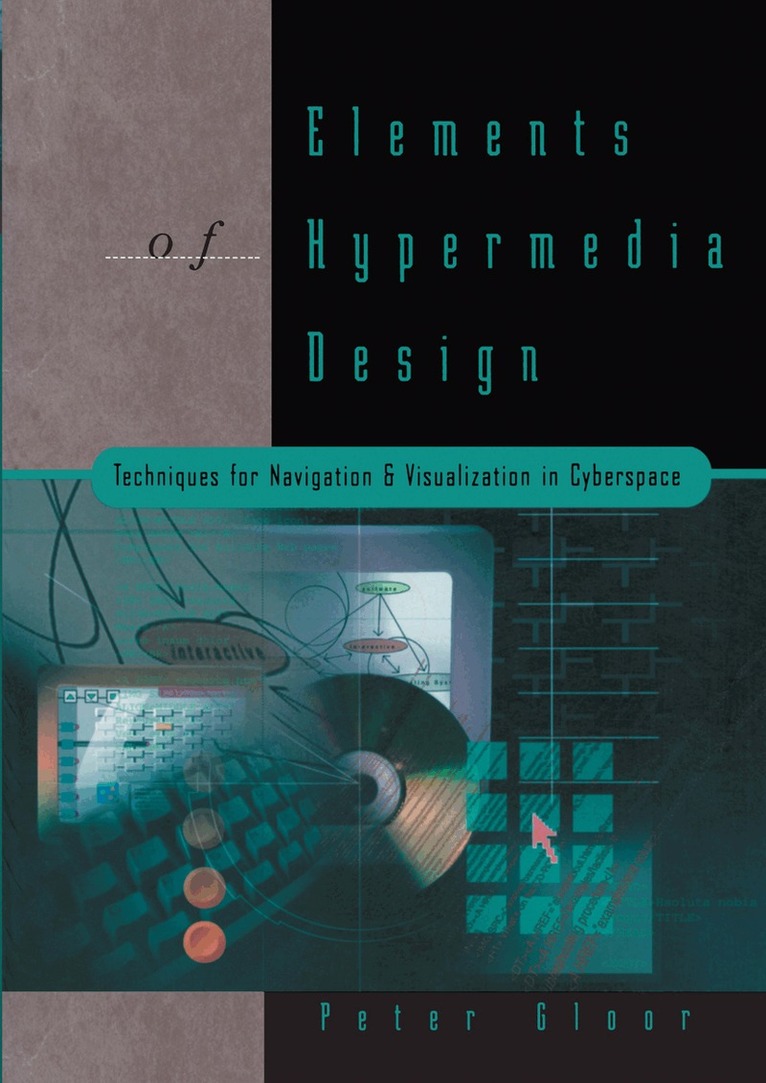
    Elements of Hypermedia Design: Techniques for Navigation & Visualization in Cyberspace

    AvPeter Gloor

    Häftad, Engelska, 1997

    563 kr

    Beställningsvara. Skickas inom 10-15 vardagar. Fri frakt över 249 kr.

    Fler format och utgåvor

    E-bok

    732 kr

    Beskrivning

    The hypermedia authoring process has been vividly described in a special issue of the Economist as a combination of writing a book, a play, a film, and a radio or television show: A hypermedia document combines all these elements and adds some of its own. The author' s first job is to structure and explain all of the infor­ mation. The author then must distill the information into brief, descriptive nodes. Each node has to contain a Iist of the ingredients, and instructions on how the ingredients are mixed together to the greatest advantage. The structure of the material provided is translated into an architectural metaphor of some kind; much of the designer' s work is the creation of this imaginary space. Then, the designers must chart the details of what to animate, what to film, who to inter­ view, and how to arrange the information in the space tobe built [Eco95a]. This book presents guidelines, tools, and techniques for prospective authors such that they can design better hypermedia documents and applications. lt surveys the different techniques used to organize, search, and structure infor­ mation in a large information system. It then describes the algorithms used to locate, reorganize, and link data to enable navigation and retrieval. It Iooks in detail at the creation and presentation of certain types of visual information, namely algorithm animations. It introduces new mechanisms for editing audio and video data streams.

    Produktinformation

    • Utgivningsdatum:1997-02-01
    • Mått:178 x 254 x 23 mm
    • Vikt:786 g
    • Format:Häftad
    • Språk:Engelska
    • Antal sidor:400
    • Upplaga:1997
    • Förlag:Birkhauser Boston Inc
    • ISBN:9780817639112

    Utforska kategorier

    • Programvaruutveckling inom Data och IT
    • Digital livsstil och datorspel inom Data och IT
    • Media och underhållning inom Ekonomi och Ledarskap

    Innehållsförteckning

    • 1 A Brief Introduction to Information Retrieval.- 2 User Modeling.- 3 World Wide Web: an Introduction.- 4 Programming the Web.- 5 The Seven Design Concepts for Navigation in Cyberspace.- 6 Linking.- 7 Searching.- 8 Sequentialization.- 9 Hierarchy.- 10 Similarity.- 11 Mapping.- 12 Guides and Agents.- 13 Conclusions.- 14 Cybertools from Text To Hypertext.- 15 Cybertools: Hierarchy with Hiermap, Viewfinder, and Navigation Diamond.- 16 Cybertools: Sequentialization with Paths.- 17 Cybertools: Similarity with Cybermap.- 18 Cybermap: System Architecture.- 19 Cybermap: Implementation Issues.- 20 Building Hierarchical Cybermaps.- 21 Cybertrees: Tree-Shaped Overview Maps.- 22 Conclusions.- 23 Introduction to Algorithm Animation.- 24 Animated Algorithms.- 25 User Interface Design for Algorithm Animation.- 26 Educational Aspects.- 27 Animating Proofs.- 28 The Art of Algorithm Animation.- 29 Algorithm Animation by Scripting.- 30 Conclusions.- 31 Introduction.- 32 Related Work.- 33 VideoScheme System Overview.- 34 VideoScheme Language Overview.- 35 VideoScheme Applications.- 36 Conclusions.- 37 Introduction.- 38 DAGS ’92: CD-ROM.- 39 DAGS ’95: On the Web.- 40 The Development Process.- 41 Extensions and Improvements.- 42 Conclusions.- References.- Permissions Acknowledgments.