Häftad, Engelska, 2009
Baudelaire's Prose Poems
532 kr
Beställningsvara. Skickas inom 5-8 vardagar. Fri frakt över 249 kr.
Beskrivning
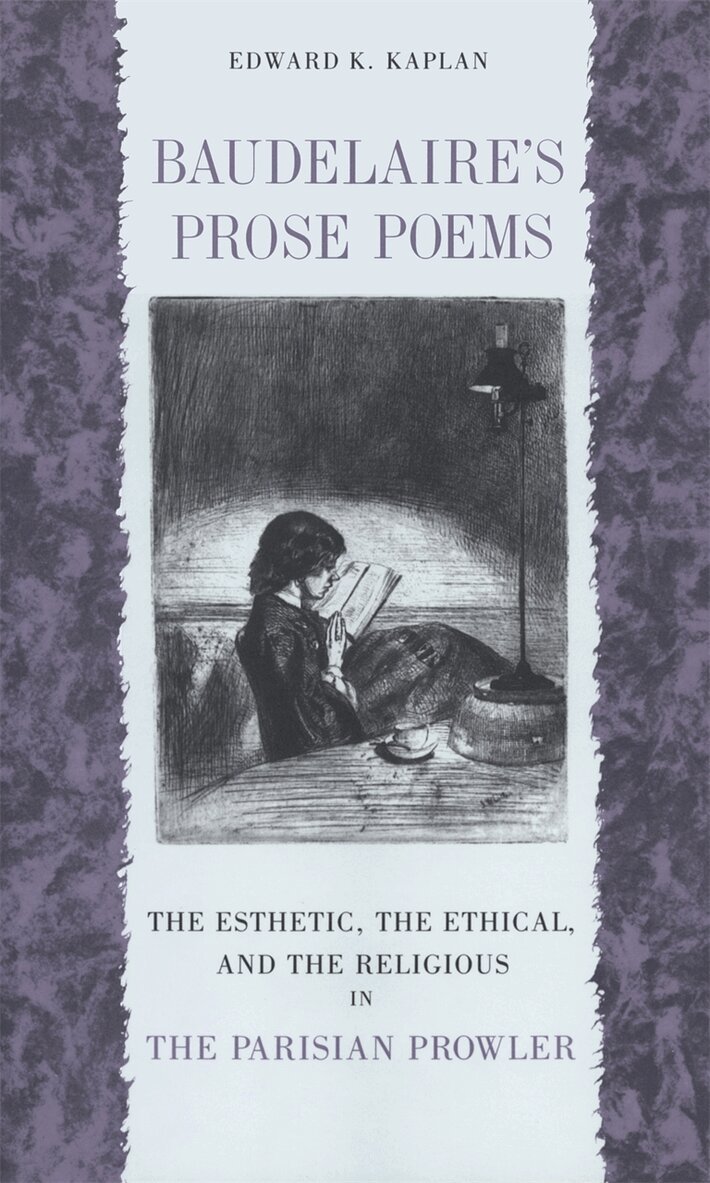
Baudelaire's Prose Poems is the first full-length, integral study of the fifty prose poems Baudelaire wrote between 1857 and his death in 1867, collected posthumously under the title Le Spleen de Paris. Edward Kaplan resurrects this neglected masterpiece by defining the structure and meaning of the entire collection, which Kaplan himself has translated as The Parisian Prowler. Engaging in a dialogue with deconstructionists whose critical methods often obscure the meaning of the whole, Kaplan rejects the view of prose poems as a random assemblage of melodic rhapsodies. Instead, he sees a coherent ensemble of "fables of modern life" that join lyricism and critical self-awareness.Kaplan defines three dimensions of experience that inform The Parisian Prowler from beginning to end: the esthetic includes art, ideal beauty, and especially the intense immediacy of sensations, fantasy, and dream; the ethical includes principles of right and wrong, relations between intimates or between individuals and the community; and the religious—not to be confused with church or dogma—points to the province of ultimate reality, whether it be God or an absolute standard of truth, justice, and meaning. These dimensions are explored by a narrator, a complex, highly self-conscious writer whose passion for pure Beauty continually frustrates his yearning for affection. He begins his tour through 1850s Paris alienated from reality, becomes aggravated by conflicts between his "ethical" and "esthetic" drives—to the point of despair—and ends by expressing loyal friendship. Analyzing the fables in relation to one another in pairs or groups, Kaplan demonstrates how later pieces intermingle or even confuse the narrator's esthetic and ethical drives, and how the most advanced "theoretical fables"—through ironic puns on their form—further undermine this simplistic dualism.Baudelaire's fables of modern life radically challenge us to examine our presuppositions, Kaplan argues. Though rarely didactic, the narrator's Socratic irony engages readers in a volatile dialogue, provoking them to form their own judgments. He often betrays self-destructive anger, rebelling against injustice or stupidity—or against women who might love him. At times he insults our complacency and self-deception with vicious glee; at other times, he recognizes his own frailty, nurturing a sense of fellowship with the oppressed. Seeking both to analyze experience objectively and to sympathize with isolated individuals like himself, Baudelaire's narrator joins criticism and poetry in a voyage of self-discovery, finally accepting experience as impure and mixed.Kaplan contends that the "prose poems" constitute a genre parallel to the poems Baudelaire added to the 1861 edition of Les Fleurs du Mal, both of which illustrate fundamental principles of the theory of modernity he developed in his essays on art. The self-reflective fables in The Parisian ProwlerM/i>—depicting a way of thinking beyond ideologies—clarify Baudelaire's development as poet, critic, and thinker.
Produktinformation
- Utgivningsdatum: 2009-01-01
- Mått: 140 x 216 x 14 mm
- Vikt: 567 g
- Format: Häftad
- Språk: Engelska
- Antal sidor: 252
- Förlag: University of Georgia Press
- ISBN: 9780820333731
Utforska kategorier
Betyg & recensioner
0 recensioner
Inga recensioner tillgängliga.