• Fri frakt över 249 kr
  • •
  • Snabba leveranser
  • •
  • Billiga böcker
Kundservice

Du är på sajten för privatpersoner.

Företag, bibliotek eller offentlig verksamhet?

Du handlar på classic.bokus.com, där alla dina funktioner finns intakta.
Till classic.bokus.com
Bokus logotyp. Gå till startsidan.
  • Erbjudanden
  • Nyheter
  • Student
  • Topplistor
  • Barn & ungdom
  • Bokus Play
  • E-böcker
  • Pocketböcker
  • Spel & pussel

10% rabatt på allt med kod NYSTART10 →

Sidfot

Mina sidor

    Hjälp

    • Kundservice
    • Vanliga frågor och svar
    • Frakt och leverans
    • Retur vid ångerrätt
    • Reklamera vara
    • Betalning
    • Köpvillkor
    • Allmänna villkor
    • Information om webbplatsens tillgänglighet

    Om Bokus

    • Om oss
    • Pressrum
    • För studenter
    • För företag
    • För bibliotek och offentlig verksamhet
    • För leverantörer
    • Hållbarhet

    Populärt

    • Aktuella erbjudanden
    • Presentkort
    • Studentlitteratur
    • Nya böcker
    • Topplistor
    • Signerade böcker
    • Engelska böcker

    Inspiration

    • Boktips
    • BookTok
    • Populära bokserier
    • Barnbokskaraktärer
    • Populära författare
    Logotyp för Bokus
    Följ oss på Facebook (extern länk)Följ oss på Instagram (extern länk)Följ oss på YouTube (extern länk)Följ oss på TikTok (extern länk)
    bokus @ CookiesAnpassa cookiesIntegritetspolicyKöpvillkor
    Till Citymail hemsida (extern länk)Till Budbee hemsida (extern länk)Till Postnord hemsida (extern länk)Till Schenker hemsida (extern länk)Till Early Bird hemsida (extern länk)Till Walleys hemsida (extern länk)
    1. Historia och arkeologi
    2. Historia
    3. Historia: särskilda händelser och ämnen
    4. Kolonialism och imperialism

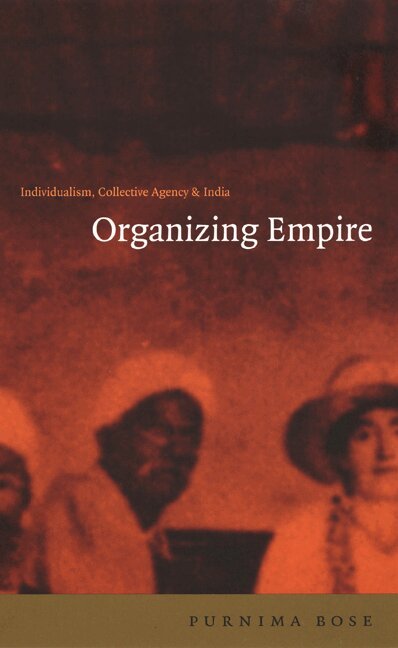
    Organizing Empire

    Individualism, Collective Agency, and India

    AvPurnima Bose

    Häftad, Engelska, 2003

    388 kr

    Beställningsvara. Skickas inom 5-8 vardagar. Fri frakt över 249 kr.

    Fler format och utgåvor

    E-bok

    568 kr

    Beskrivning

    Organizing Empire critically examines how concepts of individualism functioned to support and resist British imperialism in India. Through readings of British colonial and Indian nationalist narratives that emerged in parliamentary debates, popular colonial histories, newsletters, memoirs, biographies, and novels, Purnima Bose investigates the ramifications of reducing collective activism to individual intentions. Paying particular attention to the construction of gender, she shows that ideas of individualism rhetorically and theoretically bind colonials, feminists, nationalists, and neocolonials to one another. She demonstrates how reliance on ideas of the individual-as scapegoat or hero-enabled colonial and neocolonial powers to deny the violence that they perpetrated. At the same time, she shows how analyses of the role of the individual provide a window into the dynamics and limitations of state formations and feminist and nationalist resistance movements.From a historically grounded, feminist perspective, Bose offers four case studies, each of which illuminates a distinct individualizing rhetorical strategy. She looks at the parliamentary debates on the Amritsar Massacre of 1919, in which several hundred unarmed Indian protesters were killed; Margaret Cousins’s firsthand account of feminist organizing in Ireland and India; Kalpana Dutt’s memoir of the Bengali terrorist movement of the 1930s, which was modeled in part on Irish anticolonial activity; and the popular histories generated by ex-colonial officials and their wives. Bringing to the fore the constraints that colonial domination placed upon agency and activism, Organizing Empire highlights the complexity of the multiple narratives that constitute British colonial history.

    Produktinformation

    • Utgivningsdatum:2003-09-08
    • Mått:149 x 235 x 18 mm
    • Vikt:399 g
    • Format:Häftad
    • Språk:Engelska
    • Antal sidor:280
    • Förlag:Duke University Press
    • ISBN:9780822327684

    Utforska kategorier

    • Kolonialism och imperialism inom Historia och arkeologi
    • Asiens historia inom Historia och arkeologi

    Mer om författaren

    Purnima Bose is Associate Professor of English at Indiana University.

    Recensioner i media

    “Organizing Empire is an excellent discussion of colonial subjectivities and, in particular, how concepts of individualism and collectivity form a binary that is used by both colonial power structures and anticolonial formations.”-Inderpal Grewal, author of Home and Harem: Nation, Gender, Empire and the Cultures of Travel “Organizing Empire makes an important contribution to postcolonial theory. Through her theorization of individualism, Purnima Bose opens up in compelling ways the counterpossibilities of collective agency and helps move the discussion of anticolonial resistance from a generalized ‘subject’ to the analysis of specific conjunctures of resistant practice.”-David Lloyd, author, Ireland after History "Organizing Empire . . . serves to reveal the ideas of postcolonialism and to provide a bridge . . . over the immense divide that has developed between so much of contemporary literary studies and the discipline of history." - Terry Crowley (Canadian Journal of History) "A dense, thoughtful book about individualism and group identity in the colonial era and in the formation of Indian nationalism." (Foreign Affairs) "Bose's multi-sited research lays rich new grounds for complicating issues of documentation and representation as she questions the means by which various agents of struggle can or cannot be recognized within elite-imperial narratives. Bose's Organizing Empire undoubtedly enriches potential sites for postcolonial work, while reconfiguring the geopolitical and historical scopes of subaltern studies." - Lucienne Loh (Interventions) "One of the most noteworthy achievements . . . of the book . . . is the attention that it devotes to the traffic between the different colonies of the British empire, especially Ireland and India. . . . Bose's analysis . . . is assured and persuasive. . . . A sober and useful contribution to studies of empire." - Parama Roy (American Historical Review)

    Innehållsförteckning

    • Acknowledgments ixIntroduction 11. Rogue-Colonial Individualism: General Dyer, Colonial Masculinity, Intentionality, and the Amritsar Massacre 292. Feminist-Nationalist Individualism: Margaret Cousins, Activism, and Witnessing 743. Heroic-Nationalist Individualism: Kalpana Dutt, Gender, and the Bengali "Terrorist" Movement 1284. Heroic-Colonial Individualism: Raj Nostalgia and the Recuperation of Colonial History 169Notes 223Bibliography 251Index 265