• Fri frakt över 249 kr
  • •
  • Snabba leveranser
  • •
  • Billiga böcker
Kundservice

Du är på sajten för privatpersoner.

Företag, bibliotek eller offentlig verksamhet?

Du handlar på classic.bokus.com, där alla dina funktioner finns intakta.
Till classic.bokus.com
Bokus logotyp. Gå till startsidan.
  • Erbjudanden
  • Nyheter
  • Student
  • Topplistor
  • Barn & ungdom
  • Bokus Play
  • E-böcker
  • Pocketböcker
  • Spel & pussel

Må bättre, för mindre! Upp till 50% rabatt på hälsoböcker

Sidfot

Mina sidor

    Hjälp

    • Kundservice
    • Vanliga frågor och svar
    • Frakt och leverans
    • Retur vid ångerrätt
    • Reklamera vara
    • Betalning
    • Köpvillkor
    • Allmänna villkor
    • Information om webbplatsens tillgänglighet

    Om Bokus

    • Om oss
    • Pressrum
    • För studenter
    • För företag
    • För bibliotek och offentlig verksamhet
    • För leverantörer
    • Hållbarhet

    Populärt

    • Aktuella erbjudanden
    • Presentkort
    • Studentlitteratur
    • Nya böcker
    • Topplistor
    • Signerade böcker
    • Engelska böcker

    Inspiration

    • Boktips
    • BookTok
    • Populära bokserier
    • Barnbokskaraktärer
    • Populära författare
    Logotyp för Bokus
    Följ oss på Facebook (extern länk)Följ oss på Instagram (extern länk)Följ oss på YouTube (extern länk)Följ oss på TikTok (extern länk)
    bokus @ CookiesAnpassa cookiesIntegritetspolicyKöpvillkor
    Till Citymail hemsida (extern länk)Till Budbee hemsida (extern länk)Till Postnord hemsida (extern länk)Till Schenker hemsida (extern länk)Till Early Bird hemsida (extern länk)Till Walleys hemsida (extern länk)
    1. Historia och arkeologi
    2. Historia
    3. Amerikas historia

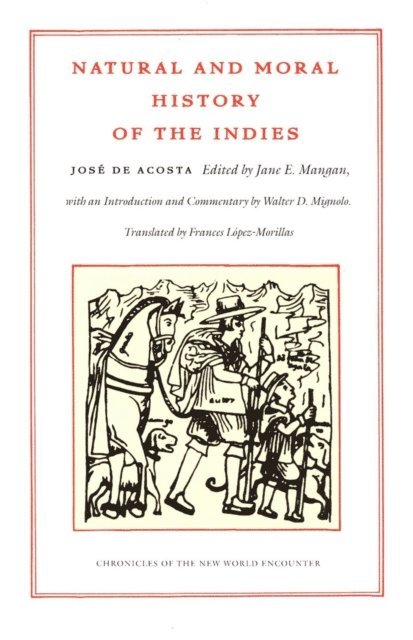
    Natural and Moral History of the Indies

    AvJosé de Acosta,Jane E. Mangan

    Häftad, Engelska, 2002

    388 kr

    Beställningsvara. Skickas inom 5-8 vardagar. Fri frakt över 249 kr.

    Fler format och utgåvor

    E-bok

    568 kr

    Häftad

    463 kr

    Beskrivning

    The Natural and Moral History of the Indies, the classic work of New World history originally published by JosÉ de Acosta in 1590, is now available in the first new English translation to appear in several hundred years. A Spanish Jesuit, Acosta produced this account by drawing on his own observations as a missionary in Peru and Mexico, as well as from the writings of other missionaries, naturalists, and soldiers who explored the region during the sixteenth century. One of the first comprehensive investigations of the New World, Acosta’s study is strikingly broad in scope. He describes the region’s natural resources, flora and fauna, and terrain. He also writes in detail about the Amerindians and their religious and political practices.A significant contribution to Renaissance Europe's thinking about the New World, Acosta's Natural and Moral History of the Indies reveals an effort to incorporate new information into a Christian, Renaissance worldview. He attempted to confirm for his European readers that a "new" continent did indeed exist and that human beings could and did live in equatorial climates. A keen observer and prescient thinker, Acosta hypothesized that Latin America's indigenous peoples migrated to the region from Asia, an idea put forth more than a century before Europeans learned of the Bering Strait. Acosta's work established a hierarchical classification of Amerindian peoples and thus contributed to what today is understood as the colonial difference in Renaissance European thinking.

    Produktinformation

    • Utgivningsdatum:2002-10-15
    • Mått:156 x 235 x 30 mm
    • Vikt:771 g
    • Format:Häftad
    • Språk:Engelska
    • Antal sidor:568
    • Förlag:Duke University Press
    • ISBN:9780822328452
    • Översättare:Frances Lopez-Morillas

    Utforska kategorier

    • Amerikas historia inom Historia och arkeologi

    Mer om författaren

    JosÉ de Acosta (1540–1600) was a Spanish Jesuit missionary trained in philosophy, theology, and history.Jane E. Mangan is Assistant Professor of History at Harvard University.Walter D. Mignolo is William H. Wannamaker Professor of Literature and Romance Studies at Duke University.Frances M. LÓpez-Morillas has translated numerous Spanish-language works into English, including Alvar NuÑez Cabeza de Vaca’s Naufragios.

    Recensioner i media

    “A superb translation of JosÉ de Acosta’s Natural History into contemporary English that has been long overdue, with a first-rate introduction by one of America’s outstanding Hispanists. The volume should prove useful to those interested in the natural history of the New World, the history of the Jesuits, and an understanding of Catholic conversion efforts in the sixteenth century.”-Patricia Seed, Rice University “JosÉ de Acosta’s Natural and Moral History of the Indies is the work of one of the sixteenth century’s keenest minds. Based on more than seventeen years of personal experience in Peru and Mexico as well as correspondence with fellow Jesuits around the world, Acosta creates a comparative understanding of the New World. This modern translation loses none of the freshness of Acosta’s prose and thankfully makes available to readers one of the most widely read and most influential books ever written on the Americas.”-Thomas Cummins, University of Chicago

    Innehållsförteckning

    • Introduction to JosÉ de Acosta’s Historia Natural y Moral de las Indias Prologue to the reader Book I 1. Of the opinion held by some authors that the heavens did not extend to the New World 2. How the heavens are round everywhere and rotate around themselves 3. How Holy Writ gives us to understand that the earth is in the midst of the universe 4. In which a response is given to what is alleged in Scripture against the heavens being round 5. Of the shape and appearance of the heavens in the New World 6. How the world has both land and sea in the direction of both poles 7. Which refutes the opinion of Lactantius, who said that there were no antipodes 8. Of Saint Augustine’s motives in denying the antipodes 9. Of Aristotle’s opinion of the New World and what it was that caused him to deny it 10. How Pliny and most of the ancients believed the same as Aristotle 11. How some mentions of this New World is found in the ancients 12. What Plato believed concerning these West Indies 13. How some have believed that in Holy Scripture Ophir is this Peru of ours 14. What Tarshish and Ophir mean in Scripture 15. Of the prophecy of Abdias, which some say concerned these Indies 16. How the first men could have come to the Indies and how they did not sail purposely to these parts 17. Of the properties and remarkable virtue of the lodestone in navigation and how the ancients did not know of it 18. Which answers those who believe that in ancient times the ocean was crossed as in our day 19. How it may be believed that the first inhabitants of the Indies came there brought by storms and against their will 20. How it is more reasonable to believe that the first dwellers in the Indies came by land 21. How wild beasts and domestic animals crossed to the lands of the Indies 22. How the race of Indians did not come by way of Atlantis, as some believe 23. How the opinion of many, who believe that the Indians come from the race of the Jews, is false 24. Why there is no sure way to establish the Indians’ origin 25. What the Indians are wont to say about their origin Book II 1. Which will deal with the nature of the equinoctial line, or equator 2. What caused the ancients to have no doubt that the Torrid Zone was uninhabitable 3. How the Torrid Zone is very wet, and how in this the ancients were much mistaken 4. How outside the Tropics there is more rain when the sun draws farther away, which is the reverse of the Torrid Zone 5. How in the Tropics the rains come in summer, or time of heat, and the calculation of winter and summer 6. How the Torrid Zone has a great abundance of water and vegetation, though Aristotle denies it 7. Which deals with the reason why the sun, outside the Tropics, causes rain when it is most distant, and in the Tropics the reverse, when it is nearest 8. How what is said of the Torrid Zone must be understood 9. How the Torrid Zone is not excessively hot but only moderately so 10. How the Torrid Zone’s heat is tempered by the abundance of rain and the brevity of the days 11. How in addition to the causes mentioned there are other reasons why the Torrid Zone is temperate, especially the proximity of the Ocean Sea 12. How the higher lands are colder and the reason for this 13. How cool winds are the chief reason why the Torrid Zone is temperate 14. How life in the equatorial region is very agreeable Book III 1. How the natural history of the Indies is pleasant and enjoyable 2. Of winds and their differences and properties and causes in general 3. Of some properties of the winds that blow in the New World 4. How easterly winds always blow in the Torrid Zone and outside it both westerlies and easterlies 5. Of the differences between easterlies and southwesterlies and other kinds of winds 6. Why there is always an east wind for sailing in the Torrid Zone 7. Why westerly winds are more usually found when leaving the Torrid Zone, at higher latitudes 8. Of exceptions to be found in the rule just expressed and the winds and calms that exist on sea and land 9. Of some wonderful effects of winds in parts of the Indies 10. Of the ocean that surrounds the Indies and of the Northern and Southern Seas 11. Of the Strait of Magellan and how it was crossed on its southern side 12. Of the strait that some say exists in Florida 13. Of the properties of the Strait of Magellan 14. Of the ebb and flow of the Ocean Sea in the Indies 15. Of the different fish and methods of fishing of the Indians 16. Of the pools and lakes that are found in the Indies 17. Of various fountains and springs 18. Of rivers 19. Of the general nature of the earth in the Indies 20. Of the properties of the land of Peru 21. Of the reasons given as to why it does not rain on the plains 22. Of the properties of New Spain and the islands and the other lands 23. Of undiscovered regions and the difference of a whole day between east and west 24. Of volcanoes or vents of fire 25. Why the fire and smoke of these volcanoes persists for so long 26. Of earthquakes 27. How earth and sea clasp one another Book IV 1. Of the three kinds of mixtures that will be dealt with in this history 2. Of the abundance of metals that exist in the Indies 3. Of the kind of land where metals are found, and how in the Indies all the metals are not worked, and how the Indians used metals 4. Of the gold that is produced in the Indies 5. Of the silver of the Indies 6. Of the mountain of PotosÍ and its discovery 7. Of the wealth that has been taken, and is still being taken daily, from the mountain of PotosÍ 8. How the mines of PotosÍ are worked 9. How silver ore is refined 10. Of the wonderful properties of quicksilver 11. Where quicksilver is found and how rich mines of it were discovered in Huancavelica 12. How quicksilver is extracted and how silver is refined with its use 13. Of the machinery for grinding ore and assaying silver 14. Of emeralds 15. Of pearls 16. Of bread in the Indies, and maize 17. Of yucca and cassava, and potatoes and chuÑo and rice 18. Of different roots that grow in the Indies 19. Of different kinds of greenstuffs and vegetables, and of those called cucumbers, and pineapples and Chilean strawberries, and plums 20. Of ajÍ, or Indies pepper 21. Of the plantain 22. Of cocoa and coca 23. Of maguey, tunal, and cochineal and of indigo and cotton 24. Of mameys and guavas and alligator pears 25. Of chicozapote and anonas and capolÍes 26. Of different kinds of fruit trees, and of coconuts and Andes almonds, a

    Betyg & recensioner

    5/5