• Fri frakt över 249 kr
  • •
  • Snabba leveranser
  • •
  • Billiga böcker
Kundservice

Du är på sajten för privatpersoner.

Företag, bibliotek eller offentlig verksamhet?

Du handlar på classic.bokus.com, där alla dina funktioner finns intakta.
Till classic.bokus.com
Bokus logotyp. Gå till startsidan.
  • Erbjudanden
  • Nyheter
  • Student
  • Topplistor
  • Barn & ungdom
  • Bokus Play
  • E-böcker
  • Pocketböcker
  • Spel & pussel

10% rabatt på allt med kod NYSTART10 →

Sidfot

Mina sidor

    Hjälp

    • Kundservice
    • Vanliga frågor och svar
    • Frakt och leverans
    • Retur vid ångerrätt
    • Reklamera vara
    • Betalning
    • Köpvillkor
    • Allmänna villkor
    • Information om webbplatsens tillgänglighet

    Om Bokus

    • Om oss
    • Pressrum
    • För studenter
    • För företag
    • För bibliotek och offentlig verksamhet
    • För leverantörer
    • Hållbarhet

    Populärt

    • Aktuella erbjudanden
    • Presentkort
    • Studentlitteratur
    • Nya böcker
    • Topplistor
    • Signerade böcker
    • Engelska böcker

    Inspiration

    • Boktips
    • BookTok
    • Populära bokserier
    • Barnbokskaraktärer
    • Populära författare
    Logotyp för Bokus
    Följ oss på Facebook (extern länk)Följ oss på Instagram (extern länk)Följ oss på YouTube (extern länk)Följ oss på TikTok (extern länk)
    bokus @ CookiesAnpassa cookiesIntegritetspolicyKöpvillkor
    Till Citymail hemsida (extern länk)Till Budbee hemsida (extern länk)Till Postnord hemsida (extern länk)Till Schenker hemsida (extern länk)Till Early Bird hemsida (extern länk)Till Walleys hemsida (extern länk)
    1. Historia och arkeologi
    2. Historia
    3. Amerikas historia

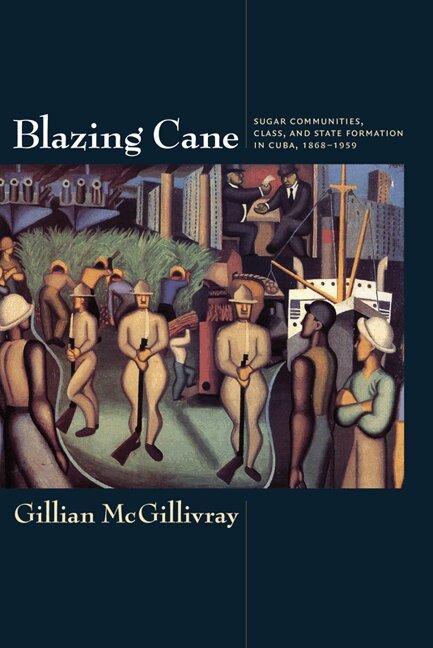
    Blazing Cane

    Sugar Communities, Class, and State Formation in Cuba, 1868–1959

    AvGillian McGillivray

    Häftad, Engelska, 2009

    Del i serien American Encounters/Global Interactions

    444 kr

    Beställningsvara. Skickas inom 5-8 vardagar. Fri frakt över 249 kr.

    Fler format och utgåvor

    E-bok

    651 kr

    Beskrivning

    Sugar was Cuba’s principal export from the late eighteenth century throughout much of the twentieth, and during that time, the majority of the island’s population depended on sugar production for its livelihood. In Blazing Cane, Gillian McGillivray examines the development of social classes linked to sugar production, and their contribution to the formation and transformation of the state, from the first Cuban Revolution for Independence in 1868 through the Cuban Revolution of 1959. She describes how cane burning became a powerful way for farmers, workers, and revolutionaries to commit sabotage, take control of the harvest season, improve working conditions, protest political repression, attack colonialism and imperialism, nationalize sugarmills, and, ultimately, acquire greater political and economic power.Focusing on sugar communities in eastern and central Cuba, McGillivray recounts how farmers and workers pushed the Cuban government to move from exclusive to inclusive politics and back again. The revolutionary caudillo networks that formed between 1895 and 1898, the farmer alliances that coalesced in the 1920s, and the working-class groups of the 1930s affected both day-to-day local politics and larger state-building efforts. Not limiting her analysis to the island, McGillivray shows that twentieth-century Cuban history reflected broader trends in the Western Hemisphere, from modernity to popular nationalism to Cold War repression.

    Produktinformation

    • Utgivningsdatum:2009-11-23
    • Mått:156 x 232 x 27 mm
    • Vikt:594 g
    • Format:Häftad
    • Språk:Engelska
    • Serie:American Encounters/Global Interactions
    • Antal sidor:416
    • Förlag:Duke University Press
    • ISBN:9780822345428

    Utforska kategorier

    • Amerikas historia inom Historia och arkeologi

    Mer om författaren

    Gillian McGillivray is Associate Professor of History at Glendon College, York University.

    Recensioner i media

    “Lucidly written, sophisticated, marvelously nuanced, and meticulously researched. . . . This is simply superb history. Summing Up: Essential. All levels/libraries.” - F. W. Knight, Choice “McGillivray’s research has been terrific. . . . She has wisely combined archival documents, a considerable number of newspaper articles, and interviews, broadening her analysis and cementing her conclusions. Overall, Blazing Cane constitutes a courageous take on this aspect of the history of twentieth-century Cuba. . .” - Manuel Barcia, A Contracorriente “McGillivray’s insistence on embedding the history of the two sugar communities within the broad sweep of Cuba’s historical development makes this book especially attractive to teachers as well as researchers. Indeed, Blazing Cane could profitably be used as the core text for courses dealing with Cuban history in the one hundred years preceding the 1959 Revolution, and as a model for how to study the interactions between local, regional, national, and transnational forces.” - Barry Carr, Hispanic American Historical Review “Blazing Cane is in the finest tradition of Cuban rural history, while at the same time clearing a new interpretative path. . . . Blazing Cane is well suited for a general audience. The section on the Chaparra sugar mill includes 14 photographs from the mill archives, which are of such high quality that one can almost taste the sugar being processed.”- Frank Argote-Freyre, European Review of Latin American and Caribbean Studies “With Blazing Cane, McGillivray has given Cubanists - and Latin Americanists in general - a treat: a book both accessible to undergraduates and meaty enough for a graduate class, one that offers convincing answers to many questions and at the same time suggests new avenues of research. In so doing, Blazing Cane provides a fresh vision of Cuba in the twentieth century, tying the nation into larger regional trends rather than separatingit from them. In the end, like the cane fires that flare up throughout the book to signal moments of change, Blazing Cane may itself be a marker, lighting a new path in the study of Cuban history.” - Joshua H. Nadel, Labor “This book offers a new understanding of Cuba’s sugar politics. It will prove essential to anyone interested in pre-1959 Cuban history or in the relationship of the middle class to state formation in Latin America.” - Aline Helg, American Historical Review “Gillian McGillivray offers a new and original understanding of the history of Cuba from the mid-nineteenth century to the Cuban revolution by reading it from the perspective of two sugar communities. She stresses the agency of workers in sugar communities, who asserted demands and engaged with, as they helped shape, the rhetoric of the state and state formation. Blazing Cane is an important contribution to modern Cuban history, and a compelling case for the impossibility of separating the local from the national and transnational in any study.”-William French, author of A Peaceful and Working People: Manners, Morals, and Class Formation in Northern Mexico “We know very little about the lives of sugar workers and their interactions with the managerial personnel of the mills in which they worked. McGillivray goes deep into documentary archives to address this vital shortcoming of the historiography of Cuba, to look at Cuban society and politics through two sugar communities. Blazing Cane gives an insightful look at how ordinary people coped with the complex and uncertain circumstances that surrounded them in the Cuban republic.”-Alejandro de la Fuente, author of A Nation for All: Race, Inequality, and Politics in Twentieth-Century Cuba “Blazing Cane is in the finest tradition of Cuban rural history, while at the same time clearing a new interpretative path. . . . Blazing Cane is well suited for a general audience. The section on the Chaparra sugar mill includes 14 photographs from the mill archives, which are of such high quality that one can almost taste the sugar being processed.”- Frank Argote-Freyre (European Review of Latin American and Caribbean Studies) “Lucidly written, sophisticated, marvelously nuanced, and meticulously researched. . . . This is simply superb history. Summing Up: Essential. All levels/libraries.” - F. W. Knight (Choice) “McGillivray’s insistence on embedding the history of the two sugar communities within the broad sweep of Cuba’s historical development makes this book especially attractive to teachers as well as researchers. Indeed, Blazing Cane could profitably be used as the core text for courses dealing with Cuban history in the one hundred years preceding the 1959 Revolution, and as a model for how to study the interactions between local, regional, national, and transnational forces.” - Barry Carr (Hispanic American Historical Review) “McGillivray’s research has been terrific. . . . She has wisely combined archival documents, a considerable number of newspaper articles, and interviews, broadening her analysis and cementing her conclusions. Overall, Blazing Cane constitutes a courageous take on this aspect of the history of twentieth-century Cuba. . .” - Manuel Barcia (A Contracorriente) “This book offers a new understanding of Cuba’s sugar politics. It will prove essential to anyone interested in pre-1959 Cuban history or in the relationship of the middle class to state formation in Latin America.” - Aline Helg (American Historical Review) “With Blazing Cane, McGillivray has given Cubanists - and Latin Americanists in general - a treat: a book both accessible to undergraduates and meaty enough for a graduate class, one that offers convincing answers to many questions and at the same time suggests new avenues of research. In so doing, Blazing Cane provides a fresh vision of Cuba in the twentieth century, tying the nation into larger regional trends rather than separating it from them. In the end, like the cane fires that flare up throughout the book to signal moments of change, Blazing Cane may itself be a marker, lighting a new path in the study of Cuban history.” - Joshua H. Nadel (Labor)

    Innehållsförteckning

    • Preface and Acknowledgments xiChronology of Major Political Events xiiiIntroduction 11. The Colonial Compact, 1500–1895 132. Revolutionary Destruction of the Colonial Compact, 1895–98 373. U.S. Power and Cuban Middlemen, 1898–1917 634. The Patrons' Compact: "Peace," "Progresss," and General Menocal, 1899–1919 865. Patrons, Matrons, and Resistance, 1899–1959 1186. From Patronage to Populism and Back Again, 1919–26 1457. Revolutionary Rejection of the Patrons' Compact, 1926–33 1888. The Populist Compact, 1934–59 226Conclusion 272Appendix. Selections from the 1946 Chaparra and Delicias Collective Contract 279Notes 287Glossary 345Bibliography 349Index 367