• Fri frakt över 249 kr
  • •
  • Snabba leveranser
  • •
  • Billiga böcker
Kundservice

Du är på sajten för privatpersoner.

Företag, bibliotek eller offentlig verksamhet?

Du handlar på classic.bokus.com, där alla dina funktioner finns intakta.
Till classic.bokus.com
Bokus logotyp. Gå till startsidan.
  • Erbjudanden
  • Nyheter
  • Student
  • Topplistor
  • Barn & ungdom
  • Bokus Play
  • E-böcker
  • Pocketböcker
  • Spel & pussel

10% rabatt på allt med kod NYSTART10 →

Sidfot

Mina sidor

    Hjälp

    • Kundservice
    • Vanliga frågor och svar
    • Frakt och leverans
    • Retur vid ångerrätt
    • Reklamera vara
    • Betalning
    • Köpvillkor
    • Allmänna villkor
    • Information om webbplatsens tillgänglighet

    Om Bokus

    • Om oss
    • Pressrum
    • För studenter
    • För företag
    • För bibliotek och offentlig verksamhet
    • För leverantörer
    • Hållbarhet

    Populärt

    • Aktuella erbjudanden
    • Presentkort
    • Studentlitteratur
    • Nya böcker
    • Topplistor
    • Signerade böcker
    • Engelska böcker

    Inspiration

    • Boktips
    • BookTok
    • Populära bokserier
    • Barnbokskaraktärer
    • Populära författare
    Logotyp för Bokus
    Följ oss på Facebook (extern länk)Följ oss på Instagram (extern länk)Följ oss på YouTube (extern länk)Följ oss på TikTok (extern länk)
    bokus @ CookiesAnpassa cookiesIntegritetspolicyKöpvillkor
    Till Citymail hemsida (extern länk)Till Budbee hemsida (extern länk)Till Postnord hemsida (extern länk)Till Schenker hemsida (extern länk)Till Early Bird hemsida (extern länk)Till Walleys hemsida (extern länk)
    1. Kultur
    2. Konstböcker
    3. Konsthistoria

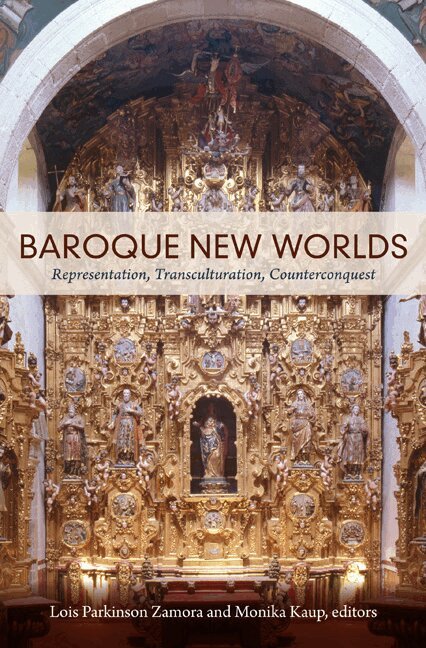
    Baroque New Worlds

    Representation, Transculturation, Counterconquest

    AvLois Parkinson Zamora,Monika Kaup

    Häftad, Engelska, 2010

    473 kr

    Beställningsvara. Skickas inom 5-8 vardagar. Fri frakt över 249 kr.

    Beskrivning

    Baroque New Worlds traces the changing nature of Baroque representation in Europe and the Americas across four centuries, from its seventeenth-century origins as a Catholic and monarchical aesthetic and ideology to its contemporary function as a postcolonial ideology aimed at disrupting entrenched power structures and perceptual categories. Baroque forms are exuberant, ample, dynamic, and porous, and in the regions colonized by Catholic Europe, the Baroque was itself eventually colonized. In the New World, its transplants immediately began to reflect the cultural perspectives and iconographies of the indigenous and African artisans who built and decorated Catholic structures, and Europe’s own cultural products were radically altered in turn. Today, under the rubric of the Neobaroque, this transculturated Baroque continues to impel artistic expression in literature, the visual arts, architecture, and popular entertainment worldwide.Since Neobaroque reconstitutions necessarily reference the European Baroque, this volume begins with the reevaluation of the Baroque that evolved in Europe during the late nineteenth century and the early twentieth. Foundational essays by Friedrich Nietzsche, Heinrich WÖlfflin, Walter Benjamin, Eugenio d’Ors, RenÉ Wellek, and Mario Praz recuperate and redefine the historical Baroque. Their essays lay the groundwork for the revisionist Latin American essays, many of which have not been translated into English until now. Authors including Alejo Carpentier, JosÉ Lezama Lima, Severo Sarduy, Édouard Glissant, Haroldo de Campos, and Carlos Fuentes understand the New World Baroque and Neobaroque as decolonizing strategies in Latin America and other postcolonial contexts. This collection moves between art history and literary criticism to provide a rich interdisciplinary discussion of the transcultural forms and functions of the Baroque.Contributors. Dorothy Z. Baker, Walter Benjamin, Christine Buci-Glucksmann, JosÉ Pascual BuxÓ, Leo Cabranes-Grant, Haroldo de Campos, Alejo Carpentier, Irlemar Chiampi, William Childers, Gonzalo Celorio, Eugenio d’Ors, Jorge Ruedas de la Serna, Carlos Fuentes, Édouard Glissant, Roberto GonzÁlez EchevarrÍa, Ángel Guido, Monika Kaup, JosÉ Lezama Lima, Friedrich Nietzsche, Mario Praz, Timothy J. Reiss, Alfonso Reyes, Severo Sarduy, Pedro HenrÍquez UreÑa, Maarten van Delden, RenÉ Wellek, Christopher Winks, Heinrich WÖlfflin, Lois Parkinson Zamora

    Produktinformation

    • Utgivningsdatum:2010-07-13
    • Mått:156 x 235 x 37 mm
    • Vikt:975 g
    • Format:Häftad
    • Språk:Engelska
    • Antal sidor:688
    • Förlag:Duke University Press
    • ISBN:9780822346425

    Utforska kategorier

    • Konsthistoria inom Kultur
    • Amerikas historia inom Historia och arkeologi

    Mer om författaren

    Lois Parkinson Zamora is John and Rebecca Moores Distinguished Professor in the Departments of English, History, and Art at the University of Houston.Monika Kaup is Associate Professor of English and Adjunct Associate Professor of Comparative Literature at the University of Washington, Seattle.

    Recensioner i media

    “Because it provides a masterful synthesis of the field (and because itoffers the first published translations of essential works written in Spanish, French, and Portuguese), the anthology (29 essays in total) is sure to become a mandatory first stop for all scholars of the Baroque. . . . Baroque New Worlds is a groundbreaking contribution for the study of transatlantic cultures,and unusual attention to detail and presentation makes Zamora and Kaup’s volume user-friendly. . . . Baroque New Worlds reminds us that, in addition to compiling and reprinting texts, an anthology can be an intellectual tour de force in its own right.” - Antonio Barrenechea, Comparative American Studies “Representing a step forward in understanding a tradition still productive in its multiplicity, this inclusive, sophisticated book highlights the trajectory of the baroque, which is sometimes submerged or ignored, but always developing into richer, more complex artifacts. Recommended.” - O. B. Gonzilez, Choice “Zamora and Kaup's book represents a new refashioning of the term Baroque, as well as usefully engaging the term ‘Neo-Baroque’ that reinvigorates and resituates discussions in the field of aesthetics and cultural criticism.” - Pamela H. Long, The Comparatist “Baroque New Worlds: Representation, Transculturation, Counterconquest is an important and often captivating anthology that brings together key thinkers and formative writings on the aesthetic, political, and cultural dimensions of the Baroque. Embracing a transhistorical approach, Lois Parkinson Zamora and Monika Kaup develop a rich understanding of the labyrinthine and slippery nature of the Baroque-from its European origins, to its adaptation within a New World context, to its Neobaroque metamorphosis in the twentieth and twenty-first centuries. This is a meticulously edited work that promises to become a key text on the Baroque and Latin American culture.”- Angela Ndalianis, author of Neo-Baroque Aesthetics and Contemporary Entertainment “Baroque New Worlds demonstrates the great and continuing usefulness of ‘Baroque’ as a way of making connections that might otherwise be hard to see, and of giving visibility to a large, important, and still-unfolding event in cultural history.”-Gordon Braden, author of Petrarchan Love and the Continental Renaissance “Because it provides a masterful synthesis of the field (and because it offers the first published translations of essential works written in Spanish, French, and Portuguese), the anthology (29 essays in total) is sure to become a mandatory first stop for all scholars of the Baroque. . . . Baroque New Worlds is a groundbreaking contribution for the study of transatlantic cultures, and unusual attention to detail and presentation makes Zamora and Kaup’s volume user-friendly. . . . Baroque New Worlds reminds us that, in addition to compiling and reprinting texts, an anthology can be an intellectual tour de force in its own right.” - Antonio Barrenechea (Comparative American Studies) “Representing a step forward in understanding a tradition still productive in its multiplicity, this inclusive, sophisticated book highlights the trajectory of the baroque, which is sometimes submerged or ignored, but always developing into richer, more complex artifacts. Recommended.” - O. B. Gonzilez (Choice) “Zamora and Kaup's book represents a new refashioning of the term Baroque, as well as usefully engaging the term ‘Neo-Baroque’ that reinvigorates and resituates discussions in the field of aesthetics and cultural criticism.” - Pamela H. Long (Comparatist)

    Innehållsförteckning

    • Illustrations xiAcknowledgments xiii"Baroque, New World Baroque, Neobaroque: Categories and Concepts" / Lois Parkinson Zamora and Monika Kaup 1Part One: Representation: Foundational Essays on Baroque Aesthetics and Ideology The European Baroque 1. "On the Baroque" (1878) / Friedrich Nietzsche 442. Excerpt from the Introduction to Principles of Art History: The Problem of the Development of Style in Later Art (1915) / Heinrich Wolfflin 493. Excerpts from The Origin of German Tragic Drama (1928) / Walter Benjamin 594. Excerpt from Lo barroco, "The Debate on the Baroque in Pontigny" (1935) / Eugenio d'Ors 785. Excerpts from "The Concept of Baroque in Literary Scholarship" (1945, rev. 1962) / Rene Wellek 956. "Baroque in England" (1960) / Mario Praz 1197. Chapter 2 from La folie du voir, "The Work of the Gaze" (1986) / Christine Buci-Glucksmann 140The New World and the Neobaroque 8. Excerpt from "Savoring Gonjora" (1928) / Alfonso Reyes 1659. Chapter 1 from Redescrubrimiento de AmÉrica en el arte, "America's Relation to Europe in the Arts" (1936) / Angel Guido 18310. "The Baroque in America" (1940) / Pedro Henriquez Urena 20011. Chapter 2 from La expresion americana, "Baroque Curiosity" / Jose Lezama Lima 21212. "The City of Columns" (1964) / Alejo Carpentier 24413. Excerpt from "Questions Concerning the Contemporary Latin American Novel" (1964) / Alejo Carpentier 25914. "The Baroque and the Neobaroque" (1972) / Severo Sarduy 27015. Chapter 3 from Barroco, "Baroque Cosmology: Kepler" (1974) / Severo Sarduy 29216. "The Rule of Anthropophagy: Europe under the Sign of Devoration" (1981) / Harolde de Campos 319Part Two. Transculturation Colonial Practice 17. "Gongora in Spanish American Poetry, Gongora in Luso-Brazilian Poetry: Critical Parallels" / Jorge Ruedas de la Serna 34318. "Sor Juana and Luis de Gongora: The Poetics of Imitatio" (2006) / Jose Pascual Buxo 35219. "American Baroque Histories and Geographies from Siguenza y Gongora and Balbuena to Balboa, Carpentier, and Lezama" / Timothy J. Reiss 39420. "Baroque Quixote: New World Writing and the Collapse of the Heroic Ideal" / William Childers 41521. "Baroque Self-Fashioning in Seventeenth-Century New France" / Dorothy Z. Baker 45022. "The Fold of Difference: Performing Baroque and Neobaroque Mexican Identities" / Leo Cabranes-Grant 467Part Three. Counterconquest Postcolonial Positions 23. Chapter 2 from Ensayo de contraconquista, "From the Baroque to the Neobaroque" (2001) / Gonzalo Celorio 48724. Chapter 1 from Barroco y modernidad, "The Baroque at the Twilight of Modernity" (2000) / Irlemar Chiampi 50825. "The Novel as Tragedy: William Faulkner" (1970) / Carlos Fuentes 53126. "Gongora's and Lezama's Appetites" (1978) / Roberto Gonzalez Echevarria 55427. "Europe and Latin America in Jose Lezama Lima" / Maarten van Delden 57128. "Seeking a Cuba of the Self: Baroque Dialogues between Jose Lezama Lima and Wallace Stevens" / Christopher Winks 59729. Chapter from Poetics of Relation, "Concerning a Baroque Abroad in the New World" (1990) / Edouard Glissant 624Bibliography 627Contributors 645Index 651