• Fri frakt över 249 kr
  • •
  • Snabba leveranser
  • •
  • Billiga böcker
Kundservice

Du är på sajten för privatpersoner.

Företag, bibliotek eller offentlig verksamhet?

Du handlar på classic.bokus.com, där alla dina funktioner finns intakta.
Till classic.bokus.com
Bokus logotyp. Gå till startsidan.
  • Erbjudanden
  • Student
  • Topplistor
  • Barn & ungdom
  • Bokus Play
  • E-böcker
  • Ljudböcker
  • Pocketböcker
  • Spel & pussel

10% rabatt på allt med kod NYSTART10 →

Sidfot

Mina sidor

    Hjälp

    • Kundservice
    • Vanliga frågor och svar
    • Frakt och leverans
    • Retur vid ångerrätt
    • Reklamera vara
    • Betalning
    • Köpvillkor
    • Allmänna villkor
    • Information om webbplatsens tillgänglighet

    Om Bokus

    • Om oss
    • Pressrum
    • För studenter
    • För företag
    • För bibliotek och offentlig verksamhet
    • För leverantörer
    • Hållbarhet

    Populärt

    • Aktuella erbjudanden
    • Presentkort
    • Studentlitteratur
    • Nya böcker
    • Topplistor
    • Signerade böcker
    • Engelska böcker

    Inspiration

    • Boktips
    • BookTok
    • Populära bokserier
    • Barnbokskaraktärer
    • Populära författare
    Logotyp för Bokus
    Följ oss på Facebook (extern länk)Följ oss på Instagram (extern länk)Följ oss på YouTube (extern länk)Följ oss på TikTok (extern länk)
    bokus @ CookiesAnpassa cookiesIntegritetspolicyKöpvillkor
    Till Citymail hemsida (extern länk)Till Budbee hemsida (extern länk)Till Postnord hemsida (extern länk)Till Schenker hemsida (extern länk)Till Early Bird hemsida (extern länk)Till Walleys hemsida (extern länk)
    1. Historia och arkeologi
    2. Historia
    3. Asiens historia

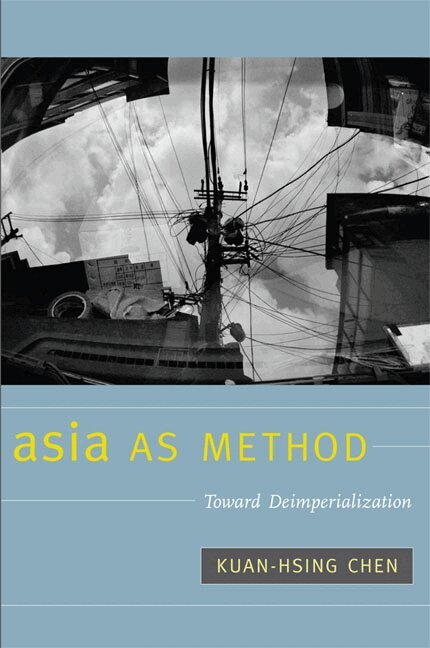
    Asia As Method

    Toward Deimperialization

    AvKuan-Hsing Chen

    Häftad, Engelska, 2010

    324 kr

    Skickas . Fri frakt över 249 kr.

    Fler format och utgåvor

    Inbunden

    1 330 kr

    E-bok

    487 kr

    Beskrivning

    Centering his analysis in the dynamic forces of modern East Asian history, Kuan-Hsing Chen recasts cultural studies as a politically urgent global endeavor. He argues that the intellectual and subjective work of decolonization begun across East Asia after the Second World War was stalled by the cold war. At the same time, the work of deimperialization became impossible to imagine in imperial centers such as Japan and the United States. Chen contends that it is now necessary to resume those tasks, and that decolonization, deimperialization, and an intellectual undoing of the cold war must proceed simultaneously. Combining postcolonial studies, globalization studies, and the emerging field of “Asian studies in Asia,” he insists that those on both sides of the imperial divide must assess the conduct, motives, and consequences of imperial histories. Chen is one of the most important intellectuals working in East Asia today; his writing has been influential in Taiwan, South Korea, Hong Kong, Japan, Singapore, and mainland China for the past fifteen years. As a founding member of the Inter-Asia Cultural Studies Society and its journal, he has helped to initiate change in the dynamics and intellectual orientation of the region, building a network that has facilitated inter-Asian connections. Asia as Method encapsulates Chen’s vision and activities within the increasingly “inter-referencing” East Asian intellectual community and charts necessary new directions for cultural studies.

    Produktinformation

    • Utgivningsdatum:2010-04-16
    • Mått:156 x 235 x 21 mm
    • Vikt:499 g
    • Format:Häftad
    • Språk:Engelska
    • Antal sidor:344
    • Förlag:Duke University Press
    • ISBN:9780822346760

    Utforska kategorier

    • Asiens historia inom Historia och arkeologi
    • Nationell befrielse och självständighet inom Historia och arkeologi

    Mer om författaren

    Kuan-Hsing Chen is a professor in the Institute for Social Research and Cultural Studies at Chiao Tung University in Taiwan. He has written and edited many books in Chinese. He is co-executive editor of the journal Inter-Asia Cultural Studies.

    Recensioner i media

    “This book is not difficult to read and if you want to tap into some very contemporaneous thoughts on Asian political and economic issues in relation to the colonized subject, and the colonizing subject, then I venture to say this book will exceed your expectations. I found it rich and emotional, and extremely useful for thoughts on Inter-Asian concerns. It is especially relevant for us all as we live within the forces of globalisation, and in the Asian region, and for Australians as colonized and imperialised subjects. . . . I can highly recommend this book to all who are involved in Asian Studies.“ - Be Ryan, M/C Reviews “Asia as Method offers a historically urgent constellation of theoretical questions, research trajectories, and political imperatives for scholars, students, activists, writers, filmmakers, and other media workers living in or affiliated with East Asia. The method in Asia as Method is not a something that should be confined to the classroom or research institute, but needs to be put into practice in our everyday dreams and struggles.” - John R. Eperjesi, TransReview “[An] ambitious and fascinating book. . . . Chen’s book is as much achallenge to Asian scholars in Asia as it is to those based in Europe and the USA.” - Thomas Radice, Journal of Intercultural Studies “Chen Kuanhsing has produced a work that should galvanize a generation of Asian scholars to debate and ponder the meaning and direction of Asia at a time when regionalization produces many challenges and moral complexities for society.” - Prasenjit Duara, International Journal of Asian Studies “Asia as Method is a book of genuinely international importance. It is a significant intellectual achievement and a major breakthrough for the definition and legitimation of the disciplinary practice of cultural studies worldwide.”-Meaghan Morris, Lingnan University (Hong Kong) and University of Sydney (Australia) “Kuan-Hsing Chen has attempted something both familiar and unusual. His book takes the old slogan of decolonization seriously and evaluates its achievements in different Asian contexts. But it also calls for continuing efforts against imperialism and the cold war, acknowledging the force of nationalism as an ally but not reposing faith in it. Asia as Method signals a new direction in cultural studies.”-Partha Chatterjee, Columbia University “Kuan-Hsing Chen is one of a handful of scholars leading the whole project of ‘internationalizing’ cultural studies-an endeavor which has positively and irrevocably transformed the cultural studies project itself.”-Stuart Hall, Professor Emeritus, The Open University “An ambitious and fascinating book. . . . Chen’s book is as much a challenge to Asian scholars in Asia as it is to those based in Europe and the USA.” - Thomas Radice (Journal of Intercultural Studies) “Chen Kuanhsing has produced a work that should galvanize a generation of Asian scholars to debate and ponder the meaning and direction of Asia at a time when regionalization produces many challenges and moral complexities for society.” - Prasenjit Duara (International Journal of Asian Studies) “This book is not difficult to read and if you want to tap into some very contemporaneous thoughts on Asian political and economic issues in relation to the colonized subject, and the colonizing subject, then I venture to say this book will exceed your expectations. I found it rich and emotional, and extremely useful for thoughts on Inter-Asian concerns. It is especially relevant for us all as we live within the forces of globalisation, and in the Asian region, and for Australians as colonized and imperialised subjects. . . . I can highly recommend this book to all who are involved in Asian Studies.“ - Be Ryan (M/C Reviews) “Asia as Method offers a historically urgent constellation of theoretical questions, research trajectories, and political imperatives for scholars, students, activists, writers, filmmakers, and other media workers living in or affiliated with East Asia. The method in Asia as Method is not a something that should be confined to the classroom or research institute, but needs to be put into practice in our everyday dreams and struggles.” - John R. Eperjesi (TransReview)

    Innehållsförteckning

    • Preface viIntroduction: Globalization and Deimperialization 11. The Imperialist Eye: The Discourse of the Southward Advance and the Subimperial Imaginary 172. Decolonization: A Geocolonial Historical Materialism 653. De-Cold War: The Im/possibility of "Great Reconciliation" 1154. Deimperialization: Club 51 and the Imperialist Assumption of Democracy 1615. Asia as Method: Overcoming the Present Conditions of Knowledge Production 211Epilogue: The Imperial Order of Things, or Notes on Han Chinese Racism 257Notes 269Special Terms 287Bibligraphy 291Index 305