• Fri frakt över 249 kr
  • •
  • Snabba leveranser
  • •
  • Billiga böcker
Kundservice

Du är på sajten för privatpersoner.

Företag, bibliotek eller offentlig verksamhet?

Du handlar på classic.bokus.com, där alla dina funktioner finns intakta.
Till classic.bokus.com
Bokus logotyp. Gå till startsidan.
  • Erbjudanden
  • Nyheter
  • Student
  • Topplistor
  • Barn & ungdom
  • Bokus Play
  • E-böcker
  • Pocketböcker
  • Spel & pussel

10% rabatt på allt med kod: NYSTART10 →

Sidfot

Mina sidor

    Hjälp

    • Kundservice
    • Vanliga frågor och svar
    • Frakt och leverans
    • Retur vid ångerrätt
    • Reklamera vara
    • Betalning
    • Köpvillkor
    • Allmänna villkor
    • Information om webbplatsens tillgänglighet

    Om Bokus

    • Om oss
    • Pressrum
    • För studenter
    • För företag
    • För bibliotek och offentlig verksamhet
    • För leverantörer
    • Hållbarhet

    Populärt

    • Aktuella erbjudanden
    • Presentkort
    • Studentlitteratur
    • Nya böcker
    • Topplistor
    • Signerade böcker
    • Engelska böcker

    Inspiration

    • Boktips
    • BookTok
    • Populära bokserier
    • Barnbokskaraktärer
    • Populära författare
    Logotyp för Bokus
    Följ oss på Facebook (extern länk)Följ oss på Instagram (extern länk)Följ oss på YouTube (extern länk)Följ oss på TikTok (extern länk)
    bokus @ CookiesAnpassa cookiesIntegritetspolicyKöpvillkor
    Till Citymail hemsida (extern länk)Till Budbee hemsida (extern länk)Till Postnord hemsida (extern länk)Till Schenker hemsida (extern länk)Till Early Bird hemsida (extern länk)Till Walleys hemsida (extern länk)
    1. Samhälle och politik
    2. Samhälle och kultur
    3. Sociala grupper och identitet

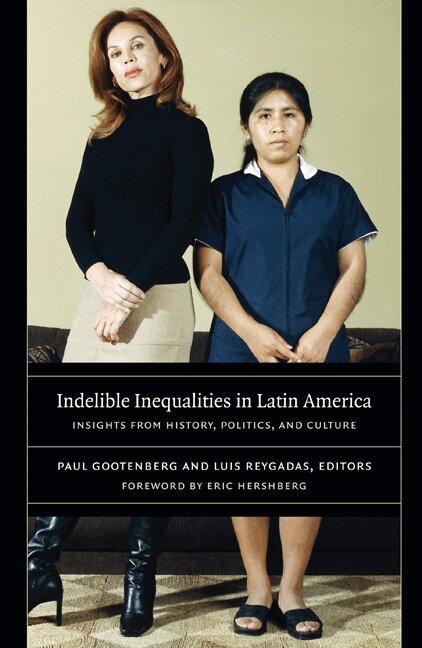
    Indelible Inequalities in Latin America

    Insights from History, Politics, and Culture

    AvLuis Reygadas,Paul Gootenberg

    Häftad, Engelska, 2010

    503 kr

    Beställningsvara. Skickas inom 3-6 vardagar. Fri frakt över 249 kr.

    Beskrivning

    Since the earliest years of European colonialism, Latin America has been a region of seemingly intractable inequalities, marked by a stark divide between the haves and the have-nots. This collection illuminates the diverse processes that have combined to produce and reproduce inequalities in Latin America, as well as some of the implications of those processes for North Americans. Anthropologists, cultural critics, historians, and political scientists from North and South America offer new and varied perspectives, building on the sociologist Charles Tilly’s relational framework for understanding enduring inequalities. While one essay is a broad yet nuanced analysis of Latin American inequality and its persistence, another is a fine-grained ethnographic view of everyday life and aspirations among shantytown residents living on the outskirts of Lima. Other essays address topics such as the initial bifurcation of Peru’s healthcare system into one for urban workers and another for the rural poor, the asymmetrical distribution of political information in Brazil, and an evolving Cuban “aesthetics of inequality,” which incorporates hip-hop and other transnational cultural currents. Exploring the dilemmas of Latin American inequalities as they are playing out in the United States, a contributor looks at new immigrant Mexican farmworkers in upstate New York to show how undocumented workers become a vulnerable rural underclass. Taken together, the essays extend social inequality critiques in important new directions.ContributorsJeanine AndersonJavier AuyeroOdette CasamayorChristina EwigPaul GootenbergMargaret GrayEric HershbergLucio RennoLuis Reygadas

    Produktinformation

    • Utgivningsdatum:2010-10-21
    • Mått:156 x 235 x 14 mm
    • Vikt:363 g
    • Format:Häftad
    • Språk:Engelska
    • Antal sidor:248
    • Förlag:Duke University Press
    • ISBN:9780822347347

    Utforska kategorier

    • Sociala grupper och identitet inom Samhälle och politik

    Mer om författaren

    Paul Gootenberg is Professor of History and Sociology at Stony Brook University and the author of Andean Cocaine: The Making of a Global Drug.Luis Reygadas is Professor of Anthropology at the Universidad AutÓnoma Metropolitana Iztapalapa, MÉxico. He is the author of La apropiaciÓn: Destejiendo las redes de la desigualdad.

    Recensioner i media

    “[A] highly worthwhile read. . . . The ideas of Charles Tilly are both usefully employed and considerably developed, and the result is a detailed, ethnographically rich text that not only lays bare the roots of Latin American inequality, but provides us with valuable suggestions for bringing about change. Readers from a variety of disciplinary backgrounds who have an interest in Latin America, inequality, or both will find ample sources of information and inspiration in this book.” - Emma O’Driscoll, History & Anthropology “Based on extensive, methodologically different research conducted in countries like Peru, Mexico, Brazil, Cuba and the US, these essays help us understand a relational logic we cannot find elsewhere in the world.” - AntonÁdia Borges, Social Anthropology “[T]his is an important contribution to research on inequalities in the regionand should be read profitably by a broad range of scholars, including historians, political scientists, sociologists, anthropologists, social and cultural geographers, and cultural studies specialists.”- Paulo Drinot, Bulletin of Latin American Research “Indelible Inequalities is an illuminating volume for scholars interested in innovative approaches to inequality, or for readers familiar with Latin American history interested in how inequality is perpetrated through less conspicuous means. Readers will gain from both individual chapters andthe volume as a whole.” - Ignacio Arana Araya, The Latin Americanist “Indelible Inequalities in Latin America raises many important questions. . . . for those who are serious in studying why extreme inequality still exists in Latin America, this book is a useful addition to one’s reading list.” - Richard Grossman, History: Reviews of New Books Paul Gootenberg and Luis Reygadas have brewed such a potent mix of perspectives and disciplinary approaches to the theme of inequality that one would expect, like an experiment in a chemistry lab, some kind of small explosion or effusion of purple smoke to signal the beginning of a chain reaction that transforms the field…. [The authors] bring together a broad range of approaches to inequality in Latin America that together provide a nuanced picture of it. - Gavin O’Toole, The Latin American Review of Books In sum, the demonstration of complex, relational, and multicausal similarities underlying the inequalities in these case studies is a fundamental contribution of the book. Beyond economic exploitation and gaps in income, the authors address fuller dimensions of inequalities. - Mariano Perelman, Anthropology of Work Review “Inequality in virtually all its multifaceted dimensions and in extremely varied surroundings does indeed appear to be an ‘indelible’ characteristic of contemporary Latin American society. Conventional literature tends to treat the issue either in strictly economic or political-economic terms, or in ways that suggest invariant deficiencies. This collection explores it in a more complex and intellectually satisfying way, by treating inequality as ‘relational,’ following the thought of the late Charles Tilly. This approach opens up the phenomenon of inequality to a much broader range of descriptive and analytical strategies, aptly illustrated by the diversity of approaches represented in this volume.”-John Coatsworth, Columbia University “Indelible Inequalities in Latin America raises many important questions. . . . for those who are serious in studying why extreme inequality still exists in Latin America, this book is a useful addition to one’s reading list.” - Richard Grossman (History: Reviews of New Books) “Indelible Inequalities is an illuminating volume for scholars interested in innovative approaches to inequality, or for readers familiar with Latin American history interested in how inequality is perpetrated through less conspicuous means. Readers will gain from both individual chapters andthe volume as a whole.” - Ignacio Arana Araya (The Latin Americanist) “[A] highly worthwhile read. . . . The ideas of Charles Tilly are both usefully employed and considerably developed, and the result is a detailed, ethnographically rich text that not only lays bare the roots of Latin American inequality, but provides us with valuable suggestions for bringing about change. Readers from a variety of disciplinary backgrounds who have an interest in Latin America, inequality, or both will find ample sources of information and inspiration in this book.” - Emma O'Driscoll (History and Anthropology) “[T]his is an important contribution to research on inequalities in the region and should be read profitably by a broad range of scholars, including historians, political scientists, sociologists, anthropologists, social and cultural geographers, and cultural studies specialists.” - Paulo Drinot (Bulletin of Latin American Research)

    Innehållsförteckning

    • Acknowledgments viiForeword: The Paradox of Inequality in Latin America / Eric Hershberg xiPart I. New Approaches, Old Disciplines 1. Latin American Inequalities: New Perspectives from History, Politics, and Culture / Paul Gootenberg 32. The Construction of Latin American Inequality / Luis Reygadas 23Part II. History, Subjectivity, and Politics 3. Health Policy and the Historical Reproduction of Class, Race, and Gender Inequality in Peru / Christina Ewig 534. Incommensurable Worlds of Practice and Value: A View from the Shantytowns of Lima / Jeanine Anderson 815. Inequalities of Political Information and Participation: The Case of the 2002 Brazilian Elections / Lucio Renno 106Part III. Culture across Borders 6. Between Orishas and Revolution: The Expression of Radical Inequalities in Post-Soviet Cuba / Odette Casamayor 1397. How Latin American Inequality Becomes Latino Inequality: A Case Study of Hudson Valley Farmworkers / Margaret Gray 1698. Afterword: Funes and the Toolbox of Inequality / Javier Auyero 193Bibliography 199About the Contributors 221Index 223