• Fri frakt över 249 kr
  • •
  • Snabba leveranser
  • •
  • Billiga böcker
Kundservice

Du är på sajten för privatpersoner.

Företag, bibliotek eller offentlig verksamhet?

Du handlar på classic.bokus.com, där alla dina funktioner finns intakta.
Till classic.bokus.com
Bokus logotyp. Gå till startsidan.
  • Erbjudanden
  • Nyheter
  • Student
  • Topplistor
  • Barn & ungdom
  • Bokus Play
  • E-böcker
  • Pocketböcker
  • Spel & pussel

10% rabatt på allt med kod: NYSTART10 →

Sidfot

Mina sidor

    Hjälp

    • Kundservice
    • Vanliga frågor och svar
    • Frakt och leverans
    • Retur vid ångerrätt
    • Reklamera vara
    • Betalning
    • Köpvillkor
    • Allmänna villkor
    • Information om webbplatsens tillgänglighet

    Om Bokus

    • Om oss
    • Pressrum
    • För studenter
    • För företag
    • För bibliotek och offentlig verksamhet
    • För leverantörer
    • Hållbarhet

    Populärt

    • Aktuella erbjudanden
    • Presentkort
    • Studentlitteratur
    • Nya böcker
    • Topplistor
    • Signerade böcker
    • Engelska böcker

    Inspiration

    • Boktips
    • BookTok
    • Populära bokserier
    • Barnbokskaraktärer
    • Populära författare
    Logotyp för Bokus
    Följ oss på Facebook (extern länk)Följ oss på Instagram (extern länk)Följ oss på YouTube (extern länk)Följ oss på TikTok (extern länk)
    bokus @ CookiesAnpassa cookiesIntegritetspolicyKöpvillkor
    Till Citymail hemsida (extern länk)Till Budbee hemsida (extern länk)Till Postnord hemsida (extern länk)Till Schenker hemsida (extern länk)Till Early Bird hemsida (extern länk)Till Walleys hemsida (extern länk)
    1. Ekonomi och Ledarskap
    2. Nationalekonomi
    3. Ekonomisk historia

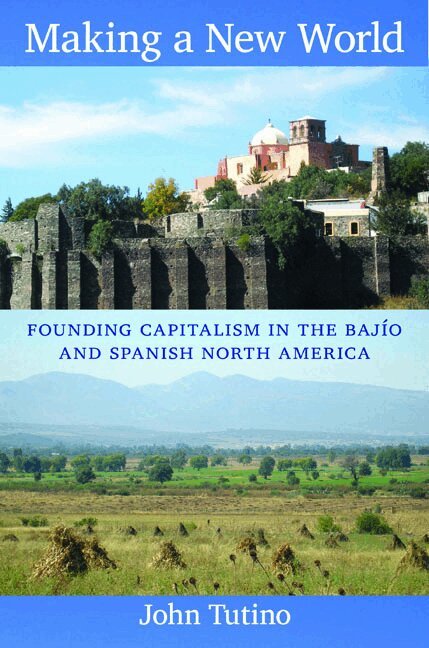
    Making a New World

    Founding Capitalism in the Bajío and Spanish North America

    AvJohn Tutino

    Häftad, Engelska, 2011

    681 kr

    Beställningsvara. Skickas inom 3-6 vardagar. Fri frakt över 249 kr.

    Fler format och utgåvor

    E-bok

    715 kr

    Beskrivning

    Making a New World is a major rethinking of the role of the Americas in early world trade, the rise of capitalism, and the conflicts that reconfigured global power around 1800. At its center is the BajÍo, a fertile basin extending across the modern-day Mexican states of Guanajuato and QuerÉtaro, northwest of Mexico City. The BajÍo became part of a new world in the 1530s, when Mesoamerican OtomÍs and Franciscan friars built QuerÉtaro, a town that quickly thrived on agriculture and trade. Settlement accelerated as regional silver mines began to flourish in the 1550s. Silver tied the BajÍo to Europe and China; it stimulated the development of an unprecedented commercial, patriarchal, Catholic society. A frontier extended north across vast expanses settled by people of European, Amerindian, and African ancestry. As mining, cloth making, and irrigated cultivation increased, inequities deepened and religious debates escalated. Analyzing the political economy, social relations, and cultural conflicts that animated the BajÍo and Spanish North America from 1500 to 1800, John Tutino depicts an engine of global capitalism and the tensions that would lead to its collapse into revolution in 1810.

    Produktinformation

    • Utgivningsdatum:2011-08-01
    • Mått:156 x 235 x 46 mm
    • Vikt:984 g
    • Format:Häftad
    • Språk:Engelska
    • Antal sidor:712
    • Förlag:Duke University Press
    • ISBN:9780822349891

    Utforska kategorier

    • Ekonomisk historia inom Ekonomi och Ledarskap
    • Internationell ekonomi inom Ekonomi och Ledarskap
    • Amerikas historia inom Historia och arkeologi

    Mer om författaren

    John Tutino teaches the history of Mexico and the Americas in the History Department and the School of Foreign Service at Georgetown University. He is the author of From Insurrection to Revolution in Mexico: Social Bases of Agrarian Violence, 1750–1940, and a co-editor of Cycles of Conflict, Centuries of Change: Crisis, Reform, and Revolution in Mexico, also published by Duke University Press.

    Recensioner i media

    “Making a New World creates a compelling new history of world capitalism in the early modern era, with Mexico at its center. It also provides a comprehensive history of the BajÍo, the dynamic mining and agricultural region crucial to understanding the sociocultural, economic, and political history of Mexico. This exciting, well-researched book makes us reconsider what we thought we knew about the Atlantic world.”-Steve J. Stern, Alberto Flores Galindo Professor of History, University of Wisconsin, Madison “Making a New World is a fascinating, bold, and challenging study. It is destined to be an indispensable source, the book of first resort on Mexico’s most dynamic region in the years leading up to Independence. Braudelian in ambition and range, it gives serious attention to power, patriarchy, capitalist production, labor, social relations, and culture; the powerful and the poor; and the rural and the urban. Provocative ideas and hypotheses abound.”-William B. Taylor, author of Magistrates of the Sacred: Priests and Parishioners in Eighteenth-Century Mexico “John Tutino’s book is a culminating achievement to more than thirty years of early New World social history. Yet it significantly improves on even the best of that work by framing New Spain in relation to North America and the wider world, showing how gender was crucial to the basic patterns of people’s lives, and illuminating social formations that have remained largely unknown until now.”-Peter Guardino, author of The Time of Liberty: Popular Political Culture in Oaxaca, 1750–1850 “[A] sprawling and fascinating new book…. [A] critical intervention in the historiographies of Mexico and the larger Atlantic World…. [R]eaders of this journal will be handsomely rewarded for engaging with the initial installment of Tutino’s study, particularly those with interests in the histories of colonial North America, the region that became the U.S.-Mexico borderlands, and the advent of capitalism.”- Andrew R. Graybill (Western Historical Quarterly) “The author should be commended for engaging these conceptual issues…. [T]his is work of great imagination and exquisite detail that should shape the fields of Latin American history, world history, and Atlantic studies.” - Robert Alegre (Itinerario) “Tutino’s book is indeed big history at its best. Compelling and provocative, thoughtful and well written, Making a New World is required reading for Mexicanists and world historians alike. Authors of world history textbooks will find themselves revising subsequent editions of their texts after reading Tutino’s persuasive arguments... Tutino’s big history should give us pause to appreciate both the forest and the trees....[his] book is that good.” - Michael M. Brescia (Catholic Historical Review) “Tutino’s broad rethinking of capitalist development from a Spanish North American perspective forces us to decenter not only the Atlantic world of European colonialism, but also the origins of U.S. hegemony. Very much like the work of Fernand Braudel whom he admires so much, Tutino deploys massive amounts of data and of conceptual reflection to help us rethink the nature of the world economy.” - Florencia E. Mallon (A Contracorriente)

    Innehållsförteckning

    • List of Maps ixPrologue: Making Global History in the Spanish Empire 1A Note on Terminology 27Introduction: A New World: The Bajío, Spanish North America, and Global Capitalism 29Part I. Making A New WorldThe Bajío and Spanish North America, 1500–1770 1. Founding the Bajío: Otomí Expansion, Chichimeca War, and Commercial Querétaro, 1500–1660 652. Forging Spanish North America: Northward Expansion, Mining Amalgamations, and Patriarchal Communities, 1590–1700 1213. New World Revivals: Silver Boom, City Lives, Awakenings, and Northward Drives, 1680–1760 1594. Reforms, Riots, and Repressions: The Bajío in the Crisis of the 1760s 228Part II. Forging Atlantic CapitalismThe Bajío, 1770–1810 5. Capitalist, Priest, and Patriarch: Don José Sánchez Espinosa and the Great Family Enterprises of Mexico City, 1780–1810 2636. Production, Patriarchy, and Polarization in the Cities: Guanajuato, San Miguel, and Querétaro, 1770–1810 3007. The Challenge of Capitalism in Rural Communities: Production, Ethnicity, and Patriarchy from La Griega to Puerto de Nieto, 1780–1810 3528. Enlightened Reformers and Popular Religion: Polarizations and Mediations, 1770–1810 403Conclusion: The Bajío and North America in the Atlantic Crucible 451Epilogue: Toward Unimagined Revolutions 487Acknowledgments 493Appendix A: Employers and Workers at Querétaro, 1588–1699 499Appendix B: Production, Patriarchy, and Ethnicity in the Bajío Bottomlands, 1670–1685 509Appendix C: Bajío Population, 1600–1800 529Appendix D: Eighteenth-Century Economic Indicators: Mining and Taxed Commerce 549Appendix E: The Sierra Gorda and New Santander, 1740–1760 559Appendix F: Population, Ethnicity, Family, and Work in Rural Communities, 1791–1792 573Appendix G: Tribute and Tributaries in the Querétaro District, 1807 609Notes 617Bibliography 665Index 685