• Fri frakt över 249 kr
  • •
  • Snabba leveranser
  • •
  • Billiga böcker
Kundservice

Du är på sajten för privatpersoner.

Företag, bibliotek eller offentlig verksamhet?

Du handlar på classic.bokus.com, där alla dina funktioner finns intakta.
Till classic.bokus.com
Bokus logotyp. Gå till startsidan.
  • Erbjudanden
  • Nyheter
  • Student
  • Topplistor
  • Barn & ungdom
  • Bokus Play
  • E-böcker
  • Pocketböcker
  • Spel & pussel

10% rabatt på allt med kod: NYSTART10 →

Sidfot

Mina sidor

    Hjälp

    • Kundservice
    • Vanliga frågor och svar
    • Frakt och leverans
    • Retur vid ångerrätt
    • Reklamera vara
    • Betalning
    • Köpvillkor
    • Allmänna villkor
    • Information om webbplatsens tillgänglighet

    Om Bokus

    • Om oss
    • Pressrum
    • För studenter
    • För företag
    • För bibliotek och offentlig verksamhet
    • För leverantörer
    • Hållbarhet

    Populärt

    • Aktuella erbjudanden
    • Presentkort
    • Studentlitteratur
    • Nya böcker
    • Topplistor
    • Signerade böcker
    • Engelska böcker

    Inspiration

    • Boktips
    • BookTok
    • Populära bokserier
    • Barnbokskaraktärer
    • Populära författare
    Logotyp för Bokus
    Följ oss på Facebook (extern länk)Följ oss på Instagram (extern länk)Följ oss på YouTube (extern länk)Följ oss på TikTok (extern länk)
    bokus @ CookiesAnpassa cookiesIntegritetspolicyKöpvillkor
    Till Citymail hemsida (extern länk)Till Budbee hemsida (extern länk)Till Postnord hemsida (extern länk)Till Schenker hemsida (extern länk)Till Early Bird hemsida (extern länk)Till Walleys hemsida (extern länk)
    1. Samhälle och politik
    2. Krig och försvar
    3. Vapen och utrustning

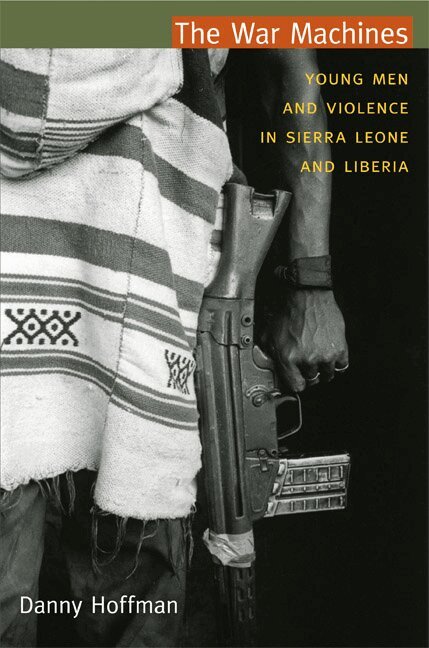
    War Machines

    Young Men and Violence in Sierra Leone and Liberia

    AvDanny Hoffman

    Häftad, Engelska, 2011

    Del i serien Cultures and Practice of Violence

    376 kr

    Beställningsvara. Skickas inom 5-8 vardagar. Fri frakt över 249 kr.

    Fler format och utgåvor

    Inbunden

    1 293 kr

    E-bok

    552 kr

    Beskrivning

    In The War Machines, Danny Hoffman considers how young men are made available for violent labor both on the battlefields and in the diamond mines, rubber plantations, and other unregulated industries of West Africa. Based on his ethnographic research with militia groups in Sierra Leone and Liberia during those countries’ recent civil wars, Hoffman traces the path of young fighters who moved from grassroots community-defense organizations in Sierra Leone during the mid-1990s into a large pool of mercenary labor. Hoffman argues that in contemporary West Africa, space, sociality, and life itself are organized around making young men available for all manner of dangerous work. Drawing on his ethnographic research over the past nine years, as well as the anthropology of violence, interdisciplinary security studies, and contemporary critical theory, he maintains that the mobilization of West African men exemplifies a global trend in the outsourcing of warfare and security operations. A similar dynamic underlies the political economy of violence in Iraq, Afghanistan, and a growing number of postcolonial spaces. An experienced photojournalist, Hoffman integrates more than fifty of his photographs of young West Africans into The War Machines.

    Produktinformation

    • Utgivningsdatum:2011-09-16
    • Mått:151 x 226 x 22 mm
    • Vikt:572 g
    • Format:Häftad
    • Språk:Engelska
    • Serie:Cultures and Practice of Violence
    • Antal sidor:328
    • Förlag:Duke University Press
    • ISBN:9780822350774

    Utforska kategorier

    • Vapen och utrustning inom Samhälle och politik

    Mer om författaren

    Danny Hoffman is Assistant Professor of Anthropology at the University of Washington, Seattle. As a photojournalist, he documented conflicts in southern Africa and the Balkans from 1994 to 1998.

    Recensioner i media

    “Hoffman’s book is at once a tightly-wound first person account of life amongst Sierra Leone’s ‘lumpen proletariat’ and an impressive work of economic and cultural theory. It is this unusual lens that makes The War Machines so thought-provoking, even for those intimately familiar with the Mano River War, and Hoffman provides enough background and context that it is still a powerful read for the uninitiated. “ - D. Tsomondo, cool’eh “This is an exceptional read for an audience well-beyond war and conflict interested anthropologists. Hoffman has an apt eye, is analytically sass and writes in straightforward prose. The book is richly illustrated with Hoffman’s excellent photos.” - Mats Utas, Anthropological Quarterly “Hoffman avoids the common language of chaos and failed states, noting that though it is hard to idealize militia life, in this context it may be seen as asocial movement prepared to defend itself against external predations. Highly recommended.” - O. Pi-Sunyer, Choice “This is a novel departure from most previous studies of youth and violence in Africa, and as such it is a necessary and provocative addition to the literature.… [A] wealth of material he brings to bear on our understanding of youth violence.” - Catherine Bolten, Anthropos “It is to Hoffman’s great credit as a scholar and author that his writing… is equally compelling, deftly articulating political philosophical concepts (no small feat with the repertoire he has selected) and evocatively rendering dynamic social environments…. Hoffman succeeds in making the political, economic and social connections he sets out to make. The War Machines provides a welcome addition to the modest Mano River canon, and a valuable entry point for academic visitors in and voyageurs out.” - Zoe Marks, The Journal of Modern African Studies “[A] path-breaking ethnography that offers a completely novel analytical framework for the anthropology of war in general, and for the interconnected wars in the West African Mano River Basin region in particular.” - Sverker FinnstrÖm, African Studies Quarterly “The ethnographic narrative, as well as the crafted images throughout the text, conveys a rich and nuanced portrayal of the lives of Hoffman’s subjects and their context, which avoids at all times violence aestheticizing or full denial of individual’s agency…. This book is a must read for any serious scholar interested in the study of globalisation, post-colonialism, or visual research methodology.” - Yolanda C. Martin, Visual Studies “It’s clear from the onset that the questions pursued are quite original and nontraditional for an anthropological reading of young West African combatants….widely accessable to those without a specific interest in an anthropological study of Africa.” - Sammy Badran, Theory & Event “[A] path-breaking ethnography that offers a completely novel analytical framework for the anthropology of war in general, and for the interconnected wars in the West African Mano River Basin region in particular.” - Sverker Finnström (African Studies Quarterly) “Hoffman avoids the common language of chaos and failed states, noting that though it is hard to idealize militia life, in this context it may be seen as asocial movement prepared to defend itself against external predations. Highly recommended.” - O. Pi-Sunyer (Choice) “It is to Hoffman’s great credit as a scholar and author that his writing… is equally compelling, deftly articulating political philosophical concepts (no small feat with the repertoire he has selected) and evocatively rendering dynamic social environments…. Hoffman succeeds in making the political, economic and social connections he sets out to make. The War Machines provides a welcome addition to the modest Mano River canon, and a valuable entry point for academic visitors in and voyageurs out.” - Zoe Marks (Journal of Modern African Studies) “It’s clear from the onset that the questions pursued are quite original and nontraditional for an anthropological reading of young West African combatants….widely accessable to those without a specific interest in an anthropological study of Africa.” - Sammy Badran (Theory & Event) “The ethnographic narrative, as well as the crafted images throughout the text, conveys a rich and nuanced portrayal of the lives of Hoffman’s subjects and their context, which avoids at all times violence aestheticizing or full denial of individual’s agency…. This book is a must read for any serious scholar interested in the study of globalisation, post-colonialism, or visual research methodology.” - Yolanda C. Martin (Visual Studies) “This is a novel departure from most previous studies of youth and violence in Africa, and as such it is a necessary and provocative addition to the literature.… [A] wealth of material he brings to bear on our understanding of youth violence.” - Catherine Bolten (Anthropos) “This is an exceptional read for an audience well-beyond war and conflict interested anthropologists. Hoffman has an apt eye, is analytically sass and writes in straightforward prose. The book is richly illustrated with Hoffman’s excellent photos.” - Mats Utas (Anthropological Quarterly)

    Innehållsförteckning

    • Illustrations ixPreface xiAcknowledgments xxiiiIntroduction: War Machines 1I. Histories1. The Mano River War: A Chronology 272. Hunters, Lumpens, and War Boys: A Social History of the Kamajors 553. States of Conflict: A Social History of the Kamajors Continued 88II. Building The Barracks4. Big Men, Small Boys 1275. The Barracks 1626. The Hotel Kamajor 1947. The Magic of War 224Conclusion: A Laboratory of the Future 252Notes 261Bibliography 273Index 289