• Fri frakt över 249 kr
  • •
  • Snabba leveranser
  • •
  • Billiga böcker
Kundservice

Du är på sajten för privatpersoner.

Företag, bibliotek eller offentlig verksamhet?

Du handlar på classic.bokus.com, där alla dina funktioner finns intakta.
Till classic.bokus.com
Bokus logotyp. Gå till startsidan.
  • Erbjudanden
  • Student
  • Topplistor
  • Barn & ungdom
  • Bokus Play
  • E-böcker
  • Ljudböcker
  • Pocketböcker
  • Spel & pussel

10% rabatt på allt med kod NYSTART10 →

Sidfot

Mina sidor

    Hjälp

    • Kundservice
    • Vanliga frågor och svar
    • Frakt och leverans
    • Retur vid ångerrätt
    • Reklamera vara
    • Betalning
    • Köpvillkor
    • Allmänna villkor
    • Information om webbplatsens tillgänglighet

    Om Bokus

    • Om oss
    • Pressrum
    • För studenter
    • För företag
    • För bibliotek och offentlig verksamhet
    • För leverantörer
    • Hållbarhet

    Populärt

    • Aktuella erbjudanden
    • Presentkort
    • Studentlitteratur
    • Nya böcker
    • Topplistor
    • Signerade böcker
    • Engelska böcker

    Inspiration

    • Boktips
    • BookTok
    • Populära bokserier
    • Barnbokskaraktärer
    • Populära författare
    Logotyp för Bokus
    Följ oss på Facebook (extern länk)Följ oss på Instagram (extern länk)Följ oss på YouTube (extern länk)Följ oss på TikTok (extern länk)
    bokus @ CookiesAnpassa cookiesIntegritetspolicyKöpvillkor
    Till Citymail hemsida (extern länk)Till Budbee hemsida (extern länk)Till Postnord hemsida (extern länk)Till Schenker hemsida (extern länk)Till Early Bird hemsida (extern länk)Till Walleys hemsida (extern länk)
    1. Kultur
    2. Musikböcker
    3. Musik: stilar och genrer
    4. Folkmusik

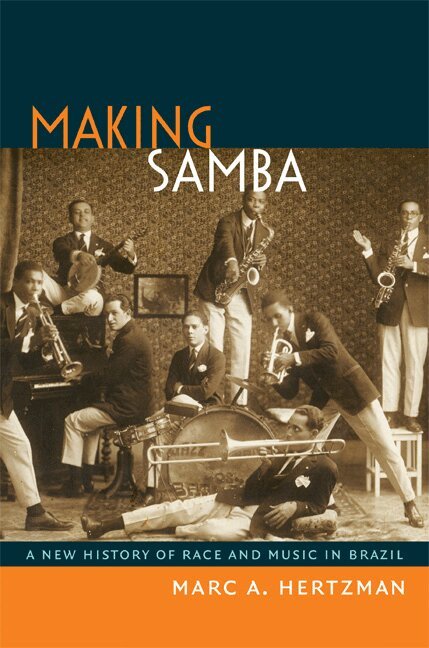
    Making Samba

    A New History of Race and Music in Brazil

    AvMarc A Hertzman

    Inbunden, Engelska, 2013

    1 419 kr

    Beställningsvara. Skickas inom 5-8 vardagar. Fri frakt över 249 kr.

    Fler format och utgåvor

    Häftad

    346 kr

    E-bok

    503 kr

    Beskrivning

    In November 1916, a young Afro-Brazilian musician named Donga registered sheet music for the song "Pelo telefone" ("On the Telephone") at the National Library in Rio de Janeiro. This apparently simple act-claiming ownership of a musical composition-set in motion a series of events that would shake Brazil's cultural landscape. Before the debut of "Pelo telephone," samba was a somewhat obscure term, but by the late 1920s, the wildly popular song had helped to make it synonymous with Brazilian national music.The success of "Pelo telephone" embroiled Donga in controversy. A group of musicians claimed that he had stolen their work, and a prominent journalist accused him of selling out his people in pursuit of profit and fame. Within this single episode are many of the concerns that animate Making Samba, including intellectual property claims, the Brazilian state, popular music, race, gender, national identity, and the history of Afro-Brazilians in Rio de Janeiro. By tracing the careers of Rio's pioneering black musicians from the late nineteenth century until the 1970s, Marc A. Hertzman revises the histories of samba and of Brazilian national culture.

    Produktinformation

    • Utgivningsdatum:2013-04-16
    • Mått:156 x 235 x 30 mm
    • Vikt:685 g
    • Format:Inbunden
    • Språk:Engelska
    • Antal sidor:392
    • Förlag:Duke University Press
    • ISBN:9780822354154

    Utforska kategorier

    • Folkmusik inom Kultur

    Mer om författaren

    Marc A. Hertzman is Assistant Professor of Latin American and Iberian Cultures and Director of the Center for Brazilian Studies at Columbia University.

    Recensioner i media

    “Hertzman skillfully navigates this history, tracing it through the 20th century and taking previous accounts to task for overgeneralization and reliance on outmoded paradigms. . . . This is a fresh, and refreshing, perspective on these topics. For music historians, researchers in Afro-Brazilian music, and serious samba aficionados.” - Genevieve Williams (Library Journal) “Marc A. Hertzman's diverse, revealing, and extensive archival research for Making Samba: A New History of Race and Music in Brazil brilliantly illustrates the advantages of a wide-ranging cultural studies approach to Rio's popular music and race relations in the first half of the twentieth century…. Making Samba provides a very rich picture of popular music and the experience of black musicians in Rio between the Empire and the 1950s.” - Jack A. Draper III (Hispanic American Historical Review) "[T]his book is highly recommended for anyone interested in Brazilian culture with a focus on the following keywords: samba, race, gender, national identity, music industry, music journalism, authorship and royalty societies, as well as biographies of many outstanding musicians.”  - André Rottgeri (Popular Music) “A sublime example of social history at its best. . . . Of special interest for samba enthusiasts is the magnificent, if lamentably brief, photo gallery of musicians. The book is ideal for the scholars of the music industry, Brazilian music, and the creation of popular music. With commendable English-language translations of idiosyncratic phrases, Making Samba is entirely accessible to those who are new to the Brazilian context.” - Michael Iyanaga (Ethnomusicology Review) “Hertzman’s judiciously research study is not so much a history of the music of samba-or the dance, for that matter-as it is a consideration of the role of samba in shaping Brazilian national identity in the 20th century. . . . Recommended."- R. M. Delson (Choice) “The book’s main success is in giving breadth and new, sophisticated contexts to both overlooked and familiar voices. Hertzman is an excellent guide to the financial inequities in that business, making this the definitive history of artist organizations.” - Jonathon Grasse (History: Reviews of New Books) “Marc Hertzman’s book offers an important new perspective on the old adage that history often moves in a circular fashion…. The book stands on its own merits of thick description and neatly positions itself vis-À-vis relevant paradigms.” - Dominik Bartmanski (Ethnic and Racial Studies) “The volume is highly informative about economic matters…. Hertzman’s erudition is clear, and his mastery of the details as well.” - Tom Moore (Music Reference Services Quarterly)

    Innehållsförteckning

    • A Note about Brazilian Terminology, Currency, and Orthography ixAbbreviations xiAcknowledgments xiiiIntroduction 11. Between Fascination and Fear: Musicians' Worlds in Nineteenth-Century Rio de Janeiro 172. Beyond the Punishment Paradigm: Popular Entertainment and Social Control after Abolition 313. Musicians Outside the Circle: Race, Wealth, and Property in Fred Figner's Music Market 664. "Our Music": "Pelo telefone," the Oito Batutas, and the Rise of "Samba" 945. Mediators and Competitors: Musicians, Journalists, and the Roda do Samba 1166. Bodies and Minds: Mapping Africa and Brazil during the Golden Age 1467. Alliances and Limits: The SBAT and the Rise of the Entertainment Class 1698. Everywhere and Nowhere: The UBC and the Consolidation of Racial and Gendered Difference 1949. After the Golden Age: Reinvention and Political Change 227Conclusion 244Notes 253Bibliography 299Index 335A photo gallery