• Fri frakt över 249 kr
  • •
  • Snabba leveranser
  • •
  • Billiga böcker
Kundservice

Du är på sajten för privatpersoner.

Företag, bibliotek eller offentlig verksamhet?

Du handlar på classic.bokus.com, där alla dina funktioner finns intakta.
Till classic.bokus.com
Bokus logotyp. Gå till startsidan.
  • Erbjudanden
  • Nyheter
  • Student
  • Topplistor
  • Barn & ungdom
  • Bokus Play
  • E-böcker
  • Pocketböcker
  • Spel & pussel

10% rabatt på allt med kod NYSTART10 →

Sidfot

Mina sidor

    Hjälp

    • Kundservice
    • Vanliga frågor och svar
    • Frakt och leverans
    • Retur vid ångerrätt
    • Reklamera vara
    • Betalning
    • Köpvillkor
    • Allmänna villkor
    • Information om webbplatsens tillgänglighet

    Om Bokus

    • Om oss
    • Pressrum
    • För studenter
    • För företag
    • För bibliotek och offentlig verksamhet
    • För leverantörer
    • Hållbarhet

    Populärt

    • Aktuella erbjudanden
    • Presentkort
    • Studentlitteratur
    • Nya böcker
    • Topplistor
    • Signerade böcker
    • Engelska böcker

    Inspiration

    • Boktips
    • BookTok
    • Populära bokserier
    • Barnbokskaraktärer
    • Populära författare
    Logotyp för Bokus
    Följ oss på Facebook (extern länk)Följ oss på Instagram (extern länk)Följ oss på YouTube (extern länk)Följ oss på TikTok (extern länk)
    bokus @ CookiesAnpassa cookiesIntegritetspolicyKöpvillkor
    Till Citymail hemsida (extern länk)Till Budbee hemsida (extern länk)Till Postnord hemsida (extern länk)Till Schenker hemsida (extern länk)Till Early Bird hemsida (extern länk)Till Walleys hemsida (extern länk)
    1. Samhälle och politik
    2. Sociologi och antropologi
    3. Antropologi

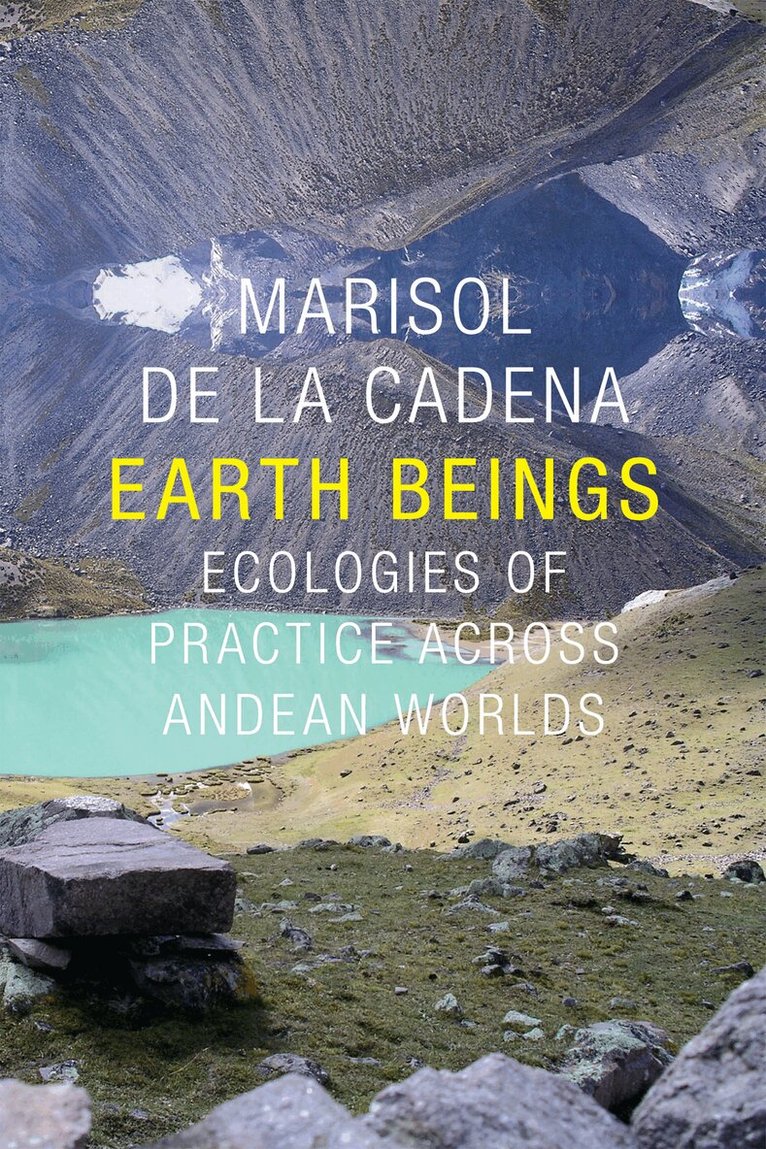
    Earth Beings

    Ecologies of Practice Across Andean Worlds

    AvMarisol de la Cadena

    Häftad, Engelska, 2015

    Del i serien Lewis Henry Morgan Lectures

    314 kr

    Beställningsvara. Skickas inom 5-8 vardagar. Fri frakt över 249 kr.

    Fler format och utgåvor

    Inbunden

    1 230 kr

    Beskrivning

    Earth Beings is the fruit of Marisol de la Cadena's decade-long conversations with Mariano and Nazario Turpo, father and son, runakuna or Quechua people. Concerned with the mutual entanglements of indigenous and nonindigenous worlds, and the partial connections between them, de la Cadena presents how the Turpos' indigenous ways of knowing and being include and exceed modern and nonmodern practices. Her discussion of indigenous political strategies-a realm that need not abide by binary logics-reconfigures how to think about and question modern politics, while pushing her readers to think beyond "hybridity" and toward translation, communication that accepts incommensurability, and mutual difference as conditions for ethnography to work.

    Produktinformation

    • Utgivningsdatum:2015-10-16
    • Mått:150 x 226 x 18 mm
    • Vikt:499 g
    • Format:Häftad
    • Språk:Engelska
    • Serie:Lewis Henry Morgan Lectures
    • Antal sidor:368
    • Förlag:Duke University Press
    • ISBN:9780822359630

    Utforska kategorier

    • Antropologi inom Samhälle och politik
    • Amerikas historia inom Historia och arkeologi

    Mer om författaren

    Marisol de la Cadena is Professor of Anthropology at the University of California, Davis, and the author of Indigenous Mestizos: The Politics of Race and Culture in Cuzco, Peru, 1919–1991, also published by Duke University Press.

    Recensioner i media

    "While theoretically sophisticated, the book’s concrete language and brief introductory asides make it suitable for advanced undergraduates unfamiliar with its core concepts."  - Carwil Bjork-James (Anthropological Quarterly) "Earth Beings is essential reading for those following current research on relational ontologies and the importance of other-than-human contributions to society (ayllu) by encouraging us to think about how beings, places, knowledges, and power interact, particularly in the Peruvian Andes, but in a way that is relevant to much of South America and beyond.... [T]he exceptional ethnographic narratives and the clarity of writing make this a monograph that could be incorporated into a senior undergraduate or, more likely, a graduate level anthropology, geography, environmental studies, political sciences, or Indigenous studies class." - Katherine MacDonald (Canadian Journal of Latin American and Caribbean Studies) "De la Cadena's Earth Beings reads, from start to finish, as a labor of love. . . . Each page is dense with insights about the intricacies and challenges of collaborative politics." - Emily Yates-Doerr (Medicine Anthropology Theory) "De la Cadena’s book is an important read and a profound application of contemporary theory to Quechua struggles in South America. It is a moving yet challenging read where the discussions, specifically on cultural politics and representation, can be applied in numerous Indigenous contexts to better transform the relational mode of interactions and divisions between nature, humans and other- than- human entities within a political realm." - Agnieszka Pawlowska-Mainville (AlterNative) "Earth Beings is a powerful ethnography, the result of more than a decade of fieldwork in the Peruvian Andes.... [T]he reader can visualize the changes in the political opportunities for indigenous peoples in Peru’s political trajectory from liberalism to socialism to, most recently, the neoliberal multiculturalism of the new millennium." - Anita Carrasco (American Ethnologist) "[T]his book is important and vividly written and deserves to be widely read for how it revalorizes and brings fresh insight to the Andean living earth as a subject of social relations." - Peter Gose (Journal of Latin American and Caribbean Anthropology) "A remarkable feat of ethnographic writing with a keen linguistic sensitivity and a stunning accomplishment of cultural translation." - Enrique Mayer (Journal of Anthropological Research) "A remarkable achievement, not only merely in the compelling case it makes for ecologies of nature-humanity practices, but above all, at the level of method and authorship, where it models a concept of anthropology as of colaboring and writing 'from' rather than 'about' a specific place and land." - Valentina Napolitano (Hau: Journal of Ethnographic Theory)

    Innehållsförteckning

    • Foreword  xiPreface. Ending This Book without Nazario Turpo  xvStory 1. Agreeing to Remember, Translating, and Carefully Co-laboring  1Interlude 1. Mariano Turpo: A Leader In-Ayllu 35Story 2. Mariano Engages "the Land Struggle": An Unthinkable Indian Leader  59Story 3. Mariano's Cosmopolitics: Between Lawyers and Ausangate  91Story 4. Mariano's Archive: The Eventfulness of the Ahistorical  117Interlude 2. Nazario Turpo: "The Altomisayuq Who Went to Heaven"  153Story 5. Chamanismo Andino in the Third Millennium: Multiculturalism Meets Earth-Beings  179Story 6. A Comedy of Equivocations: Nazario Turpo's Collaboration with the National Musuem of the American Indian  209Story 7. Munayniyuq: The Owner of the Will (and How to Control That Will)  243Epilogue. Ethnographic Cosmopolitics  273Acknowledgments  287Notes  291References  303Index  317