• Fri frakt över 249 kr
  • •
  • Snabba leveranser
  • •
  • Billiga böcker
Kundservice

Du är på sajten för privatpersoner.

Företag, bibliotek eller offentlig verksamhet?

Du handlar på classic.bokus.com, där alla dina funktioner finns intakta.
Till classic.bokus.com
Bokus logotyp. Gå till startsidan.
  • Erbjudanden
  • Nyheter
  • Student
  • Topplistor
  • Barn & ungdom
  • Bokus Play
  • E-böcker
  • Pocketböcker
  • Spel & pussel

10% rabatt på allt med kod: NYSTART10 →

Sidfot

Mina sidor

    Hjälp

    • Kundservice
    • Vanliga frågor och svar
    • Frakt och leverans
    • Retur vid ångerrätt
    • Reklamera vara
    • Betalning
    • Köpvillkor
    • Allmänna villkor
    • Information om webbplatsens tillgänglighet

    Om Bokus

    • Om oss
    • Pressrum
    • För studenter
    • För företag
    • För bibliotek och offentlig verksamhet
    • För leverantörer
    • Hållbarhet

    Populärt

    • Aktuella erbjudanden
    • Presentkort
    • Studentlitteratur
    • Nya böcker
    • Topplistor
    • Signerade böcker
    • Engelska böcker

    Inspiration

    • Boktips
    • BookTok
    • Populära bokserier
    • Barnbokskaraktärer
    • Populära författare
    Logotyp för Bokus
    Följ oss på Facebook (extern länk)Följ oss på Instagram (extern länk)Följ oss på YouTube (extern länk)Följ oss på TikTok (extern länk)
    bokus @ CookiesAnpassa cookiesIntegritetspolicyKöpvillkor
    Till Citymail hemsida (extern länk)Till Budbee hemsida (extern länk)Till Postnord hemsida (extern länk)Till Schenker hemsida (extern länk)Till Early Bird hemsida (extern länk)Till Walleys hemsida (extern länk)
    1. Samhälle och politik
    2. Politik och statsskick
    3. Centralt styre och förvaltning

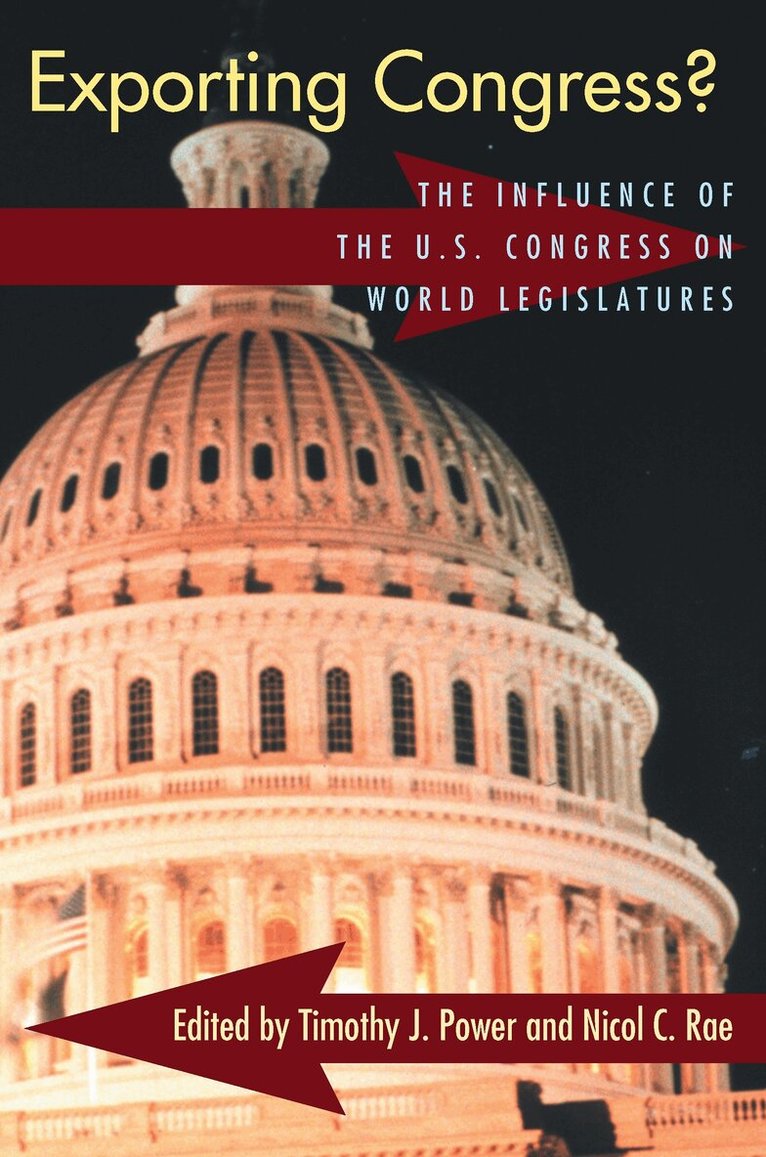
    Exporting Congress?

    The Influence of U.S. Congress on World Legislatures

    AvTimothy J. Power,Nicol Rae

    Häftad, Engelska, 2006

    669 kr

    Beställningsvara. Skickas inom 5-8 vardagar. Fri frakt över 249 kr.

    Beskrivning

    The United States Congress is often viewed as the world's most powerful national legislature. To what extent does it serve as a model for other legislative assemblies around the globe? In Exporting Congress? distinguished scholars of comparative legislatures analyze how Congress has influenced elected assemblies in both advanced and transitional democracies. They reveal the barriers to legislative diffusion, the conditions that favor Congress as a model, and the rival institutional influences on legislative development around the world. Exporting Congress? examines the conditions for the diffusion, selective imitation, and contingent utility of congressional institutions and practices in Canada, the United Kingdom, Germany, the European Parliament, and the new democracies in Latin America and Eastern Europe. These scholars find that diffusion is highly sensitive to history, geography, and other contextual factors, especially the structure of political institutions and the balance of power between the executive and legislative branches. Editors Timothy Power and Nicol Rae place the volume's empirical findings in theoretical, comparative, and historical perspective, and establish a dialogue between the separate subfields of congressional studies and comparative legislatures through the concept of legislative diffusion.

    Produktinformation

    • Utgivningsdatum:2006-06-26
    • Mått:156 x 235 x 18 mm
    • Vikt:364 g
    • Format:Häftad
    • Språk:Engelska
    • Antal sidor:248
    • Förlag:University of Pittsburgh Press
    • ISBN:9780822959212

    Utforska kategorier

    • Centralt styre och förvaltning inom Samhälle och politik
    • Statsvetenskap och politisk teori inom Samhälle och politik

    Mer om författaren

    Timothy J. Power is university lecturer in Brazilian Studies and fellow of St. Antony's College, University of Oxford. A past president of the Brazilian Studies Association, he is the author of The Political Right in Postauthoritarian Brazil.

    Recensioner i media

    Because the U.S. looms so large among the nations of the world and the highly transformative U.S. Congress is so powerful within its now venerably stable constitutional order, the expectation naturally arises that other, newer nations will seek to model their legislative institutions on at least some aspects of U.S. practice. The authors of this book have provided a fair test of this expectation in numerous settings, and report largely negative findings. Along the way, however, a reader can gain much focused information about forces shaping the formation of contemporary legislatures all over the globe.