• Fri frakt över 249 kr
  • •
  • Snabba leveranser
  • •
  • Billiga böcker
Kundservice

Du är på sajten för privatpersoner.

Företag, bibliotek eller offentlig verksamhet?

Du handlar på classic.bokus.com, där alla dina funktioner finns intakta.
Till classic.bokus.com
Bokus logotyp. Gå till startsidan.
  • Erbjudanden
  • Nyheter
  • Student
  • Topplistor
  • Barn & ungdom
  • Bokus Play
  • E-böcker
  • Pocketböcker
  • Spel & pussel

10% rabatt på allt med kod: NYSTART10 →

Sidfot

Mina sidor

    Hjälp

    • Kundservice
    • Vanliga frågor och svar
    • Frakt och leverans
    • Retur vid ångerrätt
    • Reklamera vara
    • Betalning
    • Köpvillkor
    • Allmänna villkor
    • Information om webbplatsens tillgänglighet

    Om Bokus

    • Om oss
    • Pressrum
    • För studenter
    • För företag
    • För bibliotek och offentlig verksamhet
    • För leverantörer
    • Hållbarhet

    Populärt

    • Aktuella erbjudanden
    • Presentkort
    • Studentlitteratur
    • Nya böcker
    • Topplistor
    • Signerade böcker
    • Engelska böcker

    Inspiration

    • Boktips
    • BookTok
    • Populära bokserier
    • Barnbokskaraktärer
    • Populära författare
    Logotyp för Bokus
    Följ oss på Facebook (extern länk)Följ oss på Instagram (extern länk)Följ oss på YouTube (extern länk)Följ oss på TikTok (extern länk)
    bokus @ CookiesAnpassa cookiesIntegritetspolicyKöpvillkor
    Till Citymail hemsida (extern länk)Till Budbee hemsida (extern länk)Till Postnord hemsida (extern länk)Till Schenker hemsida (extern länk)Till Early Bird hemsida (extern länk)Till Walleys hemsida (extern länk)
    1. Filosofi och religion
    2. Filosofi
    3. Filosofiska discipliner

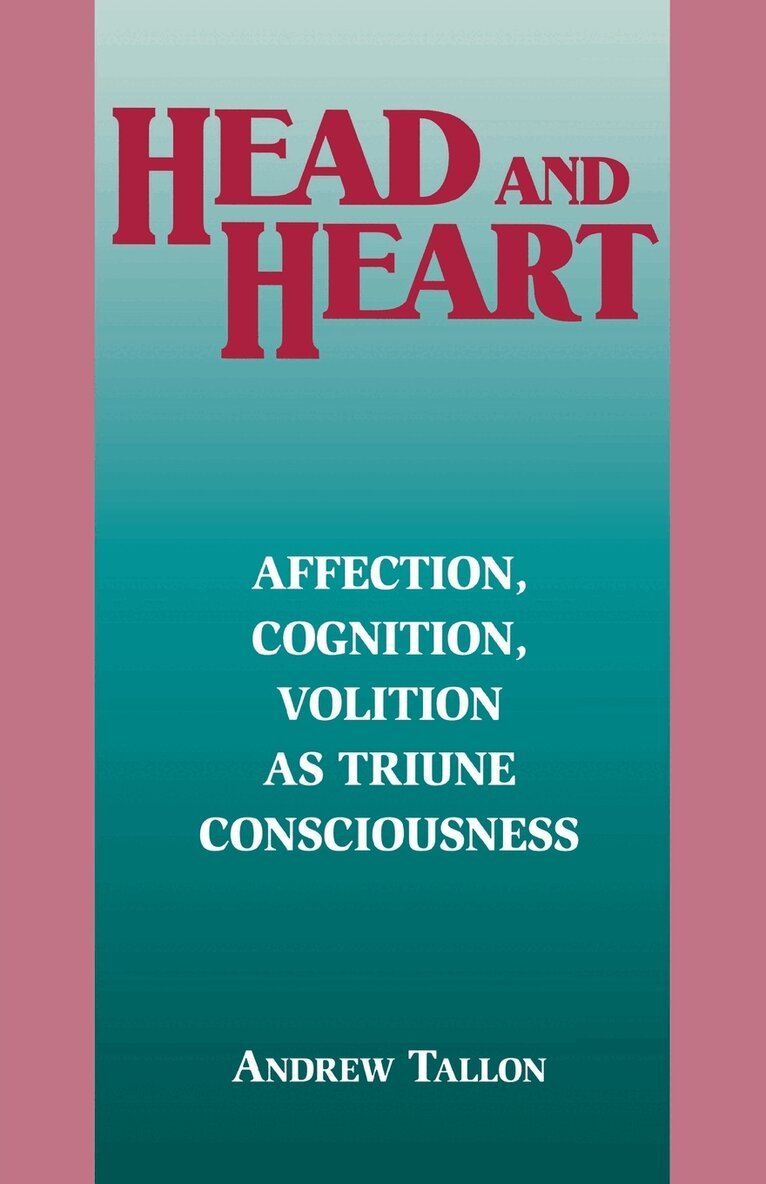
    Head and Heart

    Affection, Cognition, Volition, As Truine Consciousness

    AvAndrew Tallon

    Inbunden, Engelska, 1997

    1 103 kr

    Beställningsvara. Skickas inom 10-15 vardagar. Fri frakt över 249 kr.

    Fler format och utgåvor

    Häftad

    459 kr

    Beskrivning

    Head and Heart proposes a theory of a triune consciousness formed by the heart and mind, composed of an equal partnership of reason, will, and affection. Professor Tallon sets out asking whether and how affective consciousness fits into this triad. By first defining affection in terms of intentionality (as the theory of a triune consciousness is possible only when affectivity has been shown to participate in intentionality), he argues that affection, in its full scope of passion, emotion, and mood, earns a place equal to cognition and volition as a constituent of the human consciousness. Tallon accomplishes his task by proving the existence of affectivity as a distinct kind of consciousness inseparable from the other two, by showing precisely how affection works, how it operates in synthesis with reason and will, and, finally, by offering a new concept of a triune consciousness as paradigm for the human mind.


    Produktinformation

    • Utgivningsdatum:1997-01-01
    • Mått:140 x 216 x 22 mm
    • Vikt:565 g
    • Format:Inbunden
    • Språk:Engelska
    • Antal sidor:334
    • Förlag:Fordham University Press
    • ISBN:9780823217717

    Utforska kategorier

    • Filosofiska discipliner inom Filosofi och religion

    Mer om författaren

    Andrew Tallon is Professor of Philosophy at Marquette University and director of Marquette University Press.

    Recensioner i media

    "This book joins a growing number that argue that emotions have been incorrectly accorded second-class status. These include Robert C. Solomon's The Passions (CH, Jan'77), Ronald DeSousa's The Rationality of Emotion (CH, Jun'88), Damasio's Descartes' Error (1994), W. George Turski's Toward a Rationality of Emotions (CH, Dec'94), and the popular Emotional Intelligence (1995), by Daniel Goleman. Yet Tallon's book differs in both its method and content, moving to integrate consciousness under a single principle. In the first, and phenomenological, half of the book, Tallon (Marquette Univ.) argues that intentionality provides the single principle with which to integrate head and heart. Feeling is best understood as "affective intentionality." In the second, the hermeneutical half, Tallon interprets the phenomenon and proposes a theory to account for it. The principle of affective intentionality makes possible his thesis that cognition (the head), affectivity (the heart), and volition (the will) together form a "triune consciousness." Not only does affectivity cooperate with cognition, together they offer optimal human performance. He uses for support a variety of sources, mostly from the Continental tradition of phenomenology and existentialism, such as Sartre, Ricoeur, Heidegger, and Merleau-Ponty. Upper-division undergraduate; graduate; faculty." -Choice