• Fri frakt över 249 kr
  • •
  • Snabba leveranser
  • •
  • Billiga böcker
Kundservice

Du är på sajten för privatpersoner.

Företag, bibliotek eller offentlig verksamhet?

Du handlar på classic.bokus.com, där alla dina funktioner finns intakta.
Till classic.bokus.com
Bokus logotyp. Gå till startsidan.
  • Erbjudanden
  • Nyheter
  • Student
  • Topplistor
  • Barn & ungdom
  • Bokus Play
  • E-böcker
  • Pocketböcker
  • Spel & pussel

10% rabatt på allt med kod: NYSTART10 →

Sidfot

Mina sidor

    Hjälp

    • Kundservice
    • Vanliga frågor och svar
    • Frakt och leverans
    • Retur vid ångerrätt
    • Reklamera vara
    • Betalning
    • Köpvillkor
    • Allmänna villkor
    • Information om webbplatsens tillgänglighet

    Om Bokus

    • Om oss
    • Pressrum
    • För studenter
    • För företag
    • För bibliotek och offentlig verksamhet
    • För leverantörer
    • Hållbarhet

    Populärt

    • Aktuella erbjudanden
    • Presentkort
    • Studentlitteratur
    • Nya böcker
    • Topplistor
    • Signerade böcker
    • Engelska böcker

    Inspiration

    • Boktips
    • BookTok
    • Populära bokserier
    • Barnbokskaraktärer
    • Populära författare
    Logotyp för Bokus
    Följ oss på Facebook (extern länk)Följ oss på Instagram (extern länk)Följ oss på YouTube (extern länk)Följ oss på TikTok (extern länk)
    bokus @ CookiesAnpassa cookiesIntegritetspolicyKöpvillkor
    Till Citymail hemsida (extern länk)Till Budbee hemsida (extern länk)Till Postnord hemsida (extern länk)Till Schenker hemsida (extern länk)Till Early Bird hemsida (extern länk)Till Walleys hemsida (extern länk)
    1. Samhälle och politik
    2. Politik och statsskick
    3. Centralt styre och förvaltning

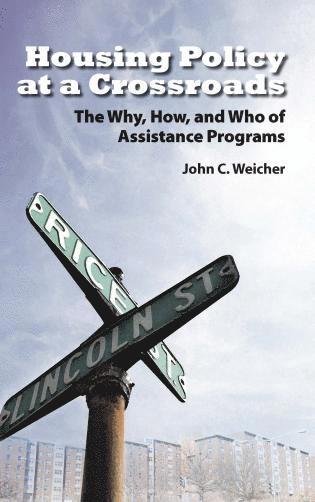
    Housing Policy at a Crossroads

    The Why, How, and Who of Assistance Programs

    AvJohn C. Weicher

    Inbunden, Engelska, 2012

    1 197 kr

    Beställningsvara. Skickas inom 3-6 vardagar. Fri frakt över 249 kr.

    Beskrivning

    Since Franklin D. Roosevelt's New Deal, American housing policy has focused on building homes for the poor. But seventy-five years of federal housing projects have not significantly ameliorated crime, decreased unemployment, or improved health; recent reforms have failed to revitalize low-income neighborhoods or stimulate the economy. To be successful in the twenty-first century, American housing policy must stop reinventing failed programs. Housing Policy at a Crossroads: The Why, How, and Who of Assistance Programs provides a comprehensive survey of past low-income housing programs, including public and subsidized housing, tax credits for developers, and block grants for state and local governments. John C. Weicher's comparative analysis of these programs yields several key conclusions: Affordability, not quality, is the most pressing challenge for housing policy today; of all the housing programs, vouchers have provided the most choice for the poor at the lowest cost to the taxpayer; because vouchers are much less expensive than public or subsidized housing, future subsidized projects would be an inefficient use of resources; vouchers should be offered only to the poorest members of society, ensuring that aid is available to those who need it most. At once a history of housing policy, a guide to issues confronting policymakers, and a case for vouchers as the cheapest, most effective solution, Housing Policy at a Crossroads is a timely warning that reinventing failed building programs would be a very costly wrong turn for America.

    Produktinformation

    • Utgivningsdatum:2012-12-16
    • Mått:164 x 238 x 28 mm
    • Vikt:644 g
    • Format:Inbunden
    • Språk:Engelska
    • Antal sidor:350
    • Förlag:AEI Press
    • ISBN:9780844742588

    Utforska kategorier

    • Centralt styre och förvaltning inom Samhälle och politik
    • Regional planering inom Naturvetenskap och teknik

    Mer om författaren

    John C. Weicher is director of the Hudson Institute's Center for Housing and Financial Markets.

    Recensioner i media

    Weicher provides an analysis of assistance programs for low-income households in federal housing policy since the early 20th century. The book begins with an appropriate review of the historical development of federal housing programs. Weicher then argues that since FDR's New Deal housing policies, low-income residents of urban neighborhoods have not witnessed improvements in crime, unemployment, or health. As an economist, the author writes nine chapters to build the argument that federal housing subsidies have been largely ineffective for decades. Weicher asserts that HUD's policies did not induce the production of affordable, decent housing. He argues that the best policy response is to embrace housing vouchers that provide households with greater choice and lower the costs of the housing programs. It is a nice addition to the literature because it contributes to an understanding of the political debate on housing assistance. Practitioners will benefit from the author's experiences. Summing Up: Recommended. Professional collections.

    Innehållsförteckning

    • ContentsList of Tables xiPreface xvIntroduction 11. Housing Assistance and the Problems of Poverty 4Subsidized Housing as Social Welfare Policy 4The Logic of the Rationale 6Subsequent Evidence 9Secretary Kemp’s “New War on Poverty” 13Subsidized Housing as Community Development 14Subsidized Housing as Macroeconomic Stimulus 17The Remaining Rationale 202. Housing Conditions and Problems 22The National Housing Goal 22Affordability 23Quality 26The Housing Situation of Lower-Income Renters 27Priority Problems by Household Category 31Trends in Housing Conditions 36Long-Term Trends in Housing Quality 38Why Has Housing Quality Improved? 44The Trend in Rent Burdens 47Conclusion 53Exhibit 2-1: Income Categories Used in Federal HousingPrograms 54Exhibit 2-2: Definitions of Inadequate Housing 55viiWeicher.indb 7 9/15/12 6:58 PMviii Housing Polic y at a Crossroads3. Housing Assistance Programs: Taxonomy and History 56Public Housing 57Privately Owned Projects 61Tenant-Based Assistance: Section 8 Existing Housing 79Housing Block Grants: The HOME Program 83The Low-Income Housing Tax Credit 88The Housing Trust Fund 92What’s Wrong with the Programs? 96Conclusion 994. Program Activity and Costs in the Aggregate 101Budgetary Cost Concepts and Basic Financing Practices 101How Much and How Many? Dollars and Housing Units 104Conceptual Confusions 117Appendix to Chapter 4: HUD Funding for RentalHousing Assistance 119HUD Budget Authority and Outlays 119Public Housing Modernization 122Incremental Units 122The Total Stock of Assisted Units 123The Low-Income Housing Tax Credit 1245. The Voucher/Production Debate: Program Comparisons 127Limitations of the Literature 128“A Decent Home”: Housing Quality 130HOPE VI: A Special Situation 143Affordability and Rent Burden 145Subsidy Utilization and Program Participation 151Demographics of Program Participation 155Housing Market Effects 159Conclusion 1656. The Voucher/Production Debate: Neighborhood Issues 167“A Suitable Living Environment”:Where Assisted Households Live 167Neighborhood Revitalization and Preservation 178House Prices 185Racial Integration 188Weicher.indb 8 9/15/12 6:58 PMCONTENTS ixEconomic Opportunity 194Health 199Crime 201Conclusion 2027. The Voucher/Production Debate: Program Costs 205The GAO Cost Comparisons 206Cost Comparisons between Vouchers and theOlder Project-Based Programs 212Current Cost Estimates and Comparisons 214The Ongoing Cost of Providing Housing Assistance 222Conclusion 2258. The Voucher/Production Debate: Program Efficiency 226The Concept of Program Efficiency 226Production Efficiency 228Consumption Efficiency 233Overall Program Efficiency 236Conclusion 2409. Is There Enough Housing? 241“Enough Housing” for What? 242Using the Voucher to Address Housing Needs 243The Voucher and Local Markets 246Conclusion 250The Comparability of Housing Outcomes 250The Lower Cost of Vouchers 251Reviving the Rationales for Production Programs 253Emerging Trends in Housing Policy 253Summing Up and Looking Ahead 257Notes 259References 309About the Author 327Weicher.