• Fri frakt över 249 kr
  • •
  • Snabba leveranser
  • •
  • Billiga böcker
Kundservice

Du är på sajten för privatpersoner.

Företag, bibliotek eller offentlig verksamhet?

Du handlar på classic.bokus.com, där alla dina funktioner finns intakta.
Till classic.bokus.com
Bokus logotyp. Gå till startsidan.
  • Erbjudanden
  • Nyheter
  • Student
  • Topplistor
  • Barn & ungdom
  • Bokus Play
  • E-böcker
  • Pocketböcker
  • Spel & pussel

10% rabatt på allt med kod: NYSTART10 →

Sidfot

Mina sidor

    Hjälp

    • Kundservice
    • Vanliga frågor och svar
    • Frakt och leverans
    • Retur vid ångerrätt
    • Reklamera vara
    • Betalning
    • Köpvillkor
    • Allmänna villkor
    • Information om webbplatsens tillgänglighet

    Om Bokus

    • Om oss
    • Pressrum
    • För studenter
    • För företag
    • För bibliotek och offentlig verksamhet
    • För leverantörer
    • Hållbarhet

    Populärt

    • Aktuella erbjudanden
    • Presentkort
    • Studentlitteratur
    • Nya böcker
    • Topplistor
    • Signerade böcker
    • Engelska böcker

    Inspiration

    • Boktips
    • BookTok
    • Populära bokserier
    • Barnbokskaraktärer
    • Populära författare
    Logotyp för Bokus
    Följ oss på Facebook (extern länk)Följ oss på Instagram (extern länk)Följ oss på YouTube (extern länk)Följ oss på TikTok (extern länk)
    bokus @ CookiesAnpassa cookiesIntegritetspolicyKöpvillkor
    Till Citymail hemsida (extern länk)Till Budbee hemsida (extern länk)Till Postnord hemsida (extern länk)Till Schenker hemsida (extern länk)Till Early Bird hemsida (extern länk)Till Walleys hemsida (extern länk)
    1. Filosofi och religion
    2. Filosofi
    3. Filosofiska discipliner

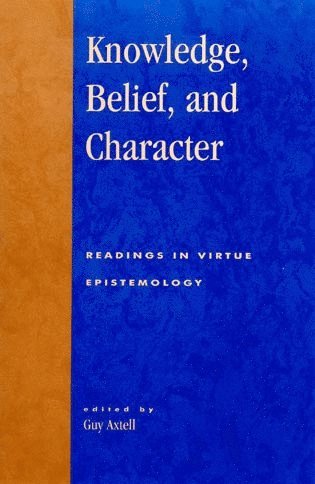
    Knowledge, Belief, and Character

    Readings in Contemporary Virtue Epistemology

    AvGuy Axtell

    Häftad, Engelska, 2000

    Del i serien Studies in Epistemology and Cognitive Theory

    507 kr

    Beställningsvara. Skickas inom 10-15 vardagar. Fri frakt över 249 kr.

    Beskrivning

    There have been many books over the past decade, including outstanding collections of essays, on the topic of the ethical virtues and virtue-theoretic approaches in ethics. But the professional journals of philosophy have only recently seen a strong and growing interest in the intellectual virtues and in the development of virtue-theoretic approaches in epistemology. There have been four single-authored book length treatments of issues of virtue epistemology over the last seven years, beginning with Ernest Sosa's Knowledge in Perspective (Cambridge, 1991), and extending to Linda Zabzebski's Virtue of the Mind (Cambridge, 1996). Weighing in with Jonathan Kvanvig's The Intellectual Virtues and the Life of the Mind (1992), and James Montmarquet's Epistemic Virtue and Doxastic Responsibility (1993), Rowman & Littlefield has had a particularly strong interest in the direction and growth of the field. To date, there has been no collection of articles directly devoted to the growing debate over the possibility and potential of a virtue epistemology. This volume exists in the belief that there is now a timely opportunity to gather together the best contributions of the influential authors working in this growing area of epistemological research, and to create a collection of essays as a useful course text and research source. Several of the articles included in the volume are previously unpublished. Several essays discuss the range and general approach of virtue theory in comparison with other general accounts. What advantages are supposed to accrue from a virtue-based account in epistemology, in handling well-known problems such as 'Gettier,' and 'Evil-Genie'-type problems? Can reliabilist virtue epistemology handle skeptical challenges more satisfactorily than non-virtue-centered forms of epistemic reliabilism? Others provide a needed discussion of relevant analogies and disanalogies between ethical and epistemic evaluation. The readings all contribute to our understanding of the relative importance, for a theory of justified belief, of the reliability of our cognitive faculties and of the individual's responsibility in gathering and weighing evidence. Highlights of the readings include direct exchanges between leading exponents of this approach and their critics. In addition, the volume includes contributions from feminist writers who offer a reassessment of the intellectual virtues from witin their own research paradigm.

    Produktinformation

    • Utgivningsdatum:2000-04-26
    • Mått:146 x 228 x 14 mm
    • Vikt:331 g
    • Format:Häftad
    • Språk:Engelska
    • Serie:Studies in Epistemology and Cognitive Theory
    • Antal sidor:256
    • Förlag:Bloomsbury Publishing Plc
    • ISBN:9780847696536

    Utforska kategorier

    • Filosofiska discipliner inom Filosofi och religion

    Mer om författaren

    Guy Axtell is professor of philosophy at University of Nevada.

    Recensioner i media

    Axtell has done an excellent job of selecting outstanding examples of the virtue theoretic approach to epistemology. For someone interested in the issue, Axtell's book is a great introduction.

    Innehållsförteckning

    • Part 1 AcknowledgementsPart 2 IntroductionPart 3 Reliability and Intellectual VirtueChapter 4 Epistemic Folkways and Scientific Epistemology. Alvin GoldmanChapter 5 Reliabilism and Intellectual Virtue. Ernest SosaChapter 6 Three Forms of Virtue Epistemology. Ernest SosaChapter 7 Ever Since Descartes. Hilary KornblithPart 8 Knowledge and SkepticismChapter 9 Virtue, Skepticism, and Context. John GrecoChapter 10 Supervenience, Virtues, and Consequences. Jonathan DancyChapter 11 Sosa on Knowledge, Justification, and "Aptness". Lawrence BonJourChapter 12 Perspectives in Virtue Epistemology: A Response to Dancy and BonJour. Ernest SosaPart 13 Responsibility, Motives, and ConsequencesChapter 14 From Reabilism to Virtue Epistemology. Linda ZagrebskyChapter 15 Moral and Epistemic Virtue. Julia DriverChapter 16 An "Internalist" Conception of Epistemic Virtue. James MontmarquetChapter 17 Regulating Inquiry: Virtue, Doubt, and Sentiment. Christopher HookwayPart 18 Special Interest Topics in Virtue TheoryChapter 19 Critical Thinking, Moral Integrity, and Citizenship: Teaching for the Intellectual Virtues. Richard PaulChapter 20 Virtue Theory and the Fact/ Value Problem. Guy AxtellChapter 21 Epistemic Vice. Casey SwankChapter 22 Phronesis and Religious Belief. Linda ZagrebskiPart 23 Index of NamesPart 24 About the Contributors