• Fri frakt över 249 kr
  • •
  • Snabba leveranser
  • •
  • Billiga böcker
Kundservice

Du är på sajten för privatpersoner.

Företag, bibliotek eller offentlig verksamhet?

Du handlar på classic.bokus.com, där alla dina funktioner finns intakta.
Till classic.bokus.com
Bokus logotyp. Gå till startsidan.
  • Erbjudanden
  • Nyheter
  • Student
  • Topplistor
  • Barn & ungdom
  • Bokus Play
  • E-böcker
  • Pocketböcker
  • Spel & pussel

10% rabatt på allt med kod: NYSTART10 →

Sidfot

Mina sidor

    Hjälp

    • Kundservice
    • Vanliga frågor och svar
    • Frakt och leverans
    • Retur vid ångerrätt
    • Reklamera vara
    • Betalning
    • Köpvillkor
    • Allmänna villkor
    • Information om webbplatsens tillgänglighet

    Om Bokus

    • Om oss
    • Pressrum
    • För studenter
    • För företag
    • För bibliotek och offentlig verksamhet
    • För leverantörer
    • Hållbarhet

    Populärt

    • Aktuella erbjudanden
    • Presentkort
    • Studentlitteratur
    • Nya böcker
    • Topplistor
    • Signerade böcker
    • Engelska böcker

    Inspiration

    • Boktips
    • BookTok
    • Populära bokserier
    • Barnbokskaraktärer
    • Populära författare
    Logotyp för Bokus
    Följ oss på Facebook (extern länk)Följ oss på Instagram (extern länk)Följ oss på YouTube (extern länk)Följ oss på TikTok (extern länk)
    bokus @ CookiesAnpassa cookiesIntegritetspolicyKöpvillkor
    Till Citymail hemsida (extern länk)Till Budbee hemsida (extern länk)Till Postnord hemsida (extern länk)Till Schenker hemsida (extern länk)Till Early Bird hemsida (extern länk)Till Walleys hemsida (extern länk)
    1. Samhälle och politik
    2. Samhälle och kultur
    3. Sociala och etiska frågor
    4. Migration

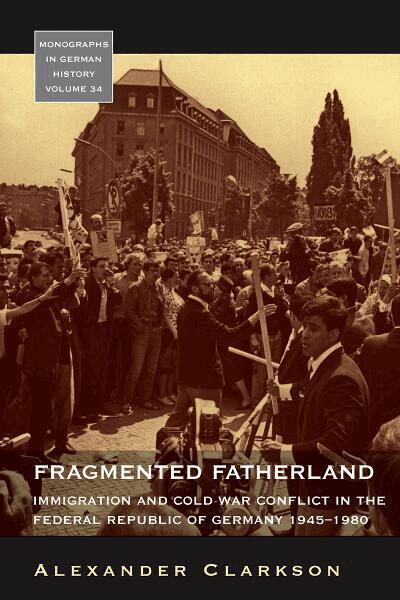
    Fragmented Fatherland

    Immigration and Cold War Conflict in the Federal Republic of Germany, 1945-1980

    AvAlexander Clarkson

    Inbunden, Engelska, 2013

    Del i serien Monographs in German History

    1 916 kr

    Beställningsvara. Skickas inom 5-8 vardagar. Fri frakt över 249 kr.

    Fler format och utgåvor

    E-bok

    325 kr

    Häftad

    526 kr

    Beskrivning

    1945 to 1980 marks an extensive period of mass migration of students, refugees, ex-soldiers, and workers from an extraordinarily wide range of countries to West Germany. Turkish, Kurdish, and Italian groups have been studied extensively, and while this book uses these groups as points of comparison, it focuses on ethnic communities of varying social structures—from Spain, Iran, Ukraine, Greece, Croatia, and Algeria—and examines the interaction between immigrant networks and West German state institutions as well as the ways in which patterns of cooperation and conflict differ. This study demonstrates how the social consequences of mass immigration became intertwined with the ideological battles of Cold War Germany and how the political life and popular movements within these immigrant communities played a crucial role in shaping West German society.

    Produktinformation

    • Utgivningsdatum:2013-09-01
    • Mått:152 x 229 x 18 mm
    • Vikt:499 g
    • Format:Inbunden
    • Språk:Engelska
    • Serie:Monographs in German History
    • Antal sidor:246
    • Förlag:Berghahn Books
    • ISBN:9780857459589

    Utforska kategorier

    • Migration inom Samhälle och politik
    • Europas historia inom Historia och arkeologi

    Mer om författaren

    Alexander Clarkson studied Modern History at Balliol College, Oxford, where he completed his doctorate. He is currently Lecturer in the German and European Studies Departments at King’s College London.

    Recensioner i media

    “Drawing on a vast number of government records, including the national and local intelligence services as well as extensive press and secondary sources, Clarkson deftly and cogently analyzes the evolution of the FRG's policies, from the conservative front line Cold War state of the 1950s that strongly supported anticommunist  immigrants from Eastern Europe and the Balkans to a detente-seeking government in the late 1960s and 1970s that balanced the anti-colonial and anti-authoritarian movements within its borders with its core political and economic interests.” · Choice“…the case studies of this compelling work illustrate the extent to which demographic structures have impacted the political activism of these immigrants in West Germany… Clarkson’s work opens up new avenues of research on the early Federal Republic, including its history as an immigration country.” · German Studies Review“…a fine and admirably concise book that can profitably be read by anyone interested in the postwar history of migration in Germany and Europe.” · International Migration Review“In this very interesting and extremely well-researched book, Alexander Clarkson examines how immigrant political movements interacted with the West German state, found shifting allies in it and were monitored by West German state police and security services… [It] is impressive for breaking the long-standing mould of looking at a single ethnic immigrant population; instead it makes its case by examining how the West German state differentiated between various groups, developing unique, context-specific relationships with each one… This interesting contribution develops the literature on immigration and on postwar political history by drawing on the lessons of their intersection in ways that narrate a fuller picture of postwar European history.” · German History“The author succeeds in analyzing comprehensively and accurately a very complex topic. In this way he offers a well-informed contribution to the exploration of the history of the Federal Republic and the early ’immigration society’.” · H-Soz-u-Kult“This is an excellent book, informative as well as thought-provoking. The argument is quite original, embedded in a rich context of political-cultural change over a span of several decades, without overwhelming the reader with party-political detail. The author does a tremendous job of presenting very complex institutional relationships.” · Joyce Marie Mushaben, University of Missouri-St. Louis

    Innehållsförteckning

    • Introduction: New Neighbours, New Challenges: Recognising DiversityChapter 1. Old Allies in a New World: The Relationship between Émigrés and the German Political EstablishmentChapter 2. Support or Suppress?: Croatian Nationalists and the West German Security ServicesChapter 3. ‘Subversive’ Immigrants and Social Democrats: Shared Memories of a ‘Romantic’ PastChapter 4. A Battle on Many Fronts: Greek Immigrants and Political ViolenceChapter 5. Both Losers and Winners?: The Iranian Community and the Student MovementConclusion: Nation and Fragmentation: Managing DiversityBibliography