• Fri frakt över 249 kr
  • •
  • Snabba leveranser
  • •
  • Billiga böcker
Kundservice

Du är på sajten för privatpersoner.

Företag, bibliotek eller offentlig verksamhet?

Du handlar på classic.bokus.com, där alla dina funktioner finns intakta.
Till classic.bokus.com
Bokus logotyp. Gå till startsidan.
  • Erbjudanden
  • Nyheter
  • Student
  • Topplistor
  • Barn & ungdom
  • Bokus Play
  • E-böcker
  • Pocketböcker
  • Spel & pussel

10% studentrabatt med kod TERM26

Sidfot

Mina sidor

    Hjälp

    • Kundservice
    • Vanliga frågor och svar
    • Frakt och leverans
    • Retur vid ångerrätt
    • Reklamera vara
    • Betalning
    • Köpvillkor
    • Allmänna villkor
    • Information om webbplatsens tillgänglighet

    Om Bokus

    • Om oss
    • Pressrum
    • För studenter
    • För företag
    • För bibliotek och offentlig verksamhet
    • För leverantörer
    • Hållbarhet

    Populärt

    • Aktuella erbjudanden
    • Presentkort
    • Studentlitteratur
    • Nya böcker
    • Topplistor
    • Signerade böcker
    • Engelska böcker

    Inspiration

    • Boktips
    • BookTok
    • Populära bokserier
    • Barnbokskaraktärer
    • Populära författare
    Logotyp för Bokus
    Följ oss på Facebook (extern länk)Följ oss på Instagram (extern länk)Följ oss på YouTube (extern länk)Följ oss på TikTok (extern länk)
    bokus @ CookiesAnpassa cookiesIntegritetspolicyKöpvillkor
    Till Citymail hemsida (extern länk)Till Budbee hemsida (extern länk)Till Postnord hemsida (extern länk)Till Schenker hemsida (extern länk)Till Early Bird hemsida (extern länk)Till Walleys hemsida (extern länk)
    1. Ekonomi och Ledarskap
    2. Nationalekonomi
    3. Internationell ekonomi

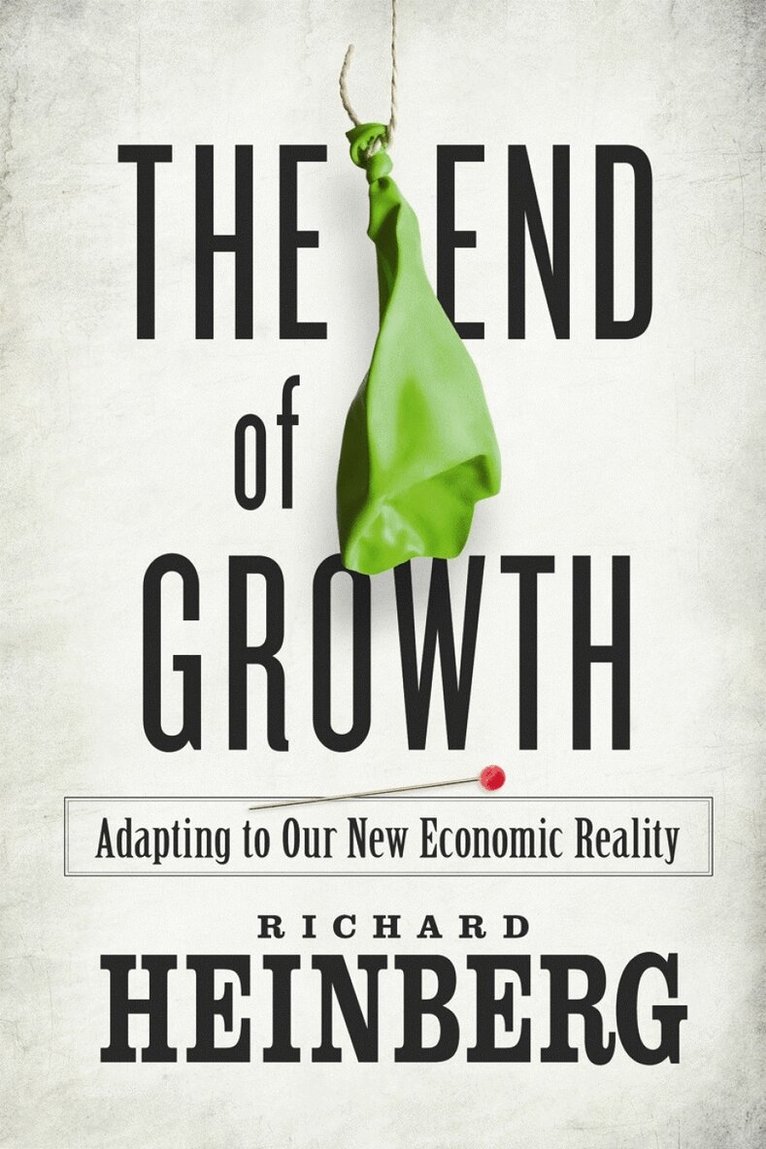
    End of Growth

    Adapting to Our New Economic Reality

    AvRichard Heinberg

    Häftad, Engelska, 2011

    156 kr

    Tillfälligt slut

    Fler format och utgåvor

    E-bok

    231 kr

    Häftad

    161 kr

    Beskrivning

    Economists insist that recovery is at hand, yet unemployment remains high, real estate values continue to sink, and governments stagger under record deficits. "The End of Growth" proposes a startling diagnosis: humanity has reached a fundamental turning point in its economic history. The expansionary trajectory of industrial civilisation is colliding with non-negotiable natural limits. Richard Heinberg's latest landmark work goes to the heart of the ongoing financial crisis, explaining how and why it occurred, and what we must do to avert the worst potential outcomes. Written in an engaging, highly readable style, it shows why growth is being blocked by three factors: resource depletion; and, environmental impacts and crushing levels of debt. These converging limits will force us to re-evaluate cherished economic theories and to reinvent money and commerce. This book describes what policy makers, communities, and families can do to build a new economy that operates within Earth's budget of energy and resources.We can thrive during the transition if we set goals that promote human and environmental well-being, rather than continuing to pursue the now-unattainable prize of ever-expanding GDP.

    Produktinformation

    • Utgivningsdatum:2011-09-01
    • Mått:152 x 229 x 15 mm
    • Vikt:315 g
    • Format:Häftad
    • Språk:Engelska
    • Antal sidor:288
    • Förlag:New Society Publishers
    • ISBN:9780865716957
    • Utmärkelser:Runner-up for Foreword Review Book of the Year Business & Economics 2011 (United States)

    Utforska kategorier

    • Internationell ekonomi inom Ekonomi och Ledarskap
    • Miljövetenskap och miljöpolitik inom Naturvetenskap och teknik
    • Miljöekonomi inom Ekonomi och Ledarskap

    Mer om författaren

    Richard Heinberg: is the author of nine previous books including The Party’s Over, Peak Everything, and Blackout. He is a Senior Fellow of Post Carbon Institute, a think tank helping chart humanity’s transition from the brief, waning reign of fossil-fueled megatechnology to the dawning era of re-adaptation to nature’s limits. Widely regarded as one of the world’s foremost Peak Oil educators, Richard lectures widely and appears on radio, television, and in films. With a wry, unflinching approach, he explains the trends that shape our world.

    Recensioner i media

    "Heinberg draws in the big three drivers of inevitable crisis—resource constraints, environmental impacts, and financial system overload—and explains why they are not individual challenges but one integrated systemic problem. By time you finish this book, you will have come to two conclusions. First, we are not facing a recession—this is the end of economic growth. Second, this is not our children's problem—it is ours. It's time to get ready, and reading this book is the place to start."— Paul Gilding, author, The Great Disruption,Former head of Greenpeace International"Richard has rung the bell on the limits to growth. This is real. The consequences for economics, finance, and our way of life in the decades ahead will be greater than the consequences of the industrial revolution were for our recent ancestors. Our coming shift from quantity of consumption to quality of life is the great challenge of our generation—frightening at times, but ultimately freeing."— John Fullerton, President and Founder, Capital Institute"Why have mainstream economists ignored environmental limits for so long? If Heinberg is right, they will have a lot of explaining to do. The end of conventional economic growth would be a shattering turn of events—but the book makes a persuasive case that this is indeed what we are seeing."— Lester Brown, Founder, Earth Policy Institute and author, World on the Edge"Heinberg shows how peak oil, peak water, peak food, etc. lead not only to the end of growth, and also to the beginning of a new era of progress without growth."— Herman E. Daly, Professor Emeritus, School of Public Policy, University of Maryland"The End of Growth offers a comprehensive, timely and persuasive analysis of the reality of ecological limits as they relate to economic growth. Filled with facts and figures and very readable, the book makes a rational case while paying attention to nuance and counterarguments. A must-read for anyone who depends upon economic growth, which means all of us."— Leslie E. Christian, CFA, President and CEO Portfolio 21 Investments"Heinberg has masterfully summarized and updated the case against economics, and its fraudulent scorecard—GDP. He explains why conventional economic growth is ending now, and why growth of human populations and material consumption will follow suit. Yet we all can still grow in wisdom and continue expanding the knowledge of our universe, while growing greener technologies capturing the sun's daily free photon flow as we transition to the Solar Age."— Hazel Henderson, author, The Politics of the Solar Age (1981) and other books, President of Ethical Markets Media (USA and Brazil) and its Green Transition Scoreboard®"Dig into this book! It is crammed full of ideas, information and perspective on where our troubled world is headed—a Baedeker for the perplexed, and that's most of us."— James Gustave Speth, author of The Bridge at the Edge of the World: Capitalism, the Environment and Crossing from Crisis to Sustainability"Read this book and have the light switched on."— Caroline Lucas, Member of Parliament (UK)"Richard Heinberg is not one to shy away from difficult topics and The End of Growth is no exception. Heinberg explains today's environmental and economic realities—which are scary to face. But believe me, not facing them is a whole lot scarier. And as Heinberg explains, the sooner we have this critically needed conversation about how to live in a healthy, fair, and meaningful way on this one planet we have, the better it will be for all of us."—Annie Leonard, author, The Story of Stuff"A vitally important book—it helps clear away many of the mistaken assumptions that clutter our heads when we think about 'obvious' and 'natural' facts of our economic life. You really need to read it if you want to understand the next few crucial years."— Bill McKibben, author of Deep Economy and Eaarth"From all my research, I'm come to appreciate how much the expectation of unending growth dominates public policy — and how ephemeral that goal is likely to prove. Until now, however, no one has had the foresight to address this critical topic. Congratulations to Richard Heinberg for providing such a lucid account of the natural limits to growth and the urgent need for a new economic model."— Michael Klare, author, Rising Powers, Shrinking Planet

    Innehållsförteckning

    • Acknowledgments Introduction: The New Normal Why Is Growth Ending? The End of Growth Should Come As No Surprise Why Is Growth So Important? But Isn't Growth Normal? The Simple Math of Compounded Growth The Peak Oil Scenario From Scary Theory to Scarier Reality Bursting Bubbles What Comes After Growth? A Guide to the Book 1. The Great Balloon Race Economic History in Ten Minutes Economics for the Hurried 20th-Century Economics Business Cycles, Interest Rates, and Central Banks Mad Money I Owe You 2. The Sound of Air Escaping Houses of Cards Setting the Stage: 1970 to 2001 Shadow Banks and the Housing Bubble What Goes UpThe Mother of All Manias Limits to Debt All Loaned Up and Nowhere to Go Stimulus Duds, Bailout Blanks Actions by Other Nations and Their Central Banks After All the Arrows have Flown Deflation or Inflation? The Bridge to Nowhere 3. Earth's Limits: Why Growth Won't Return Oil Other Energy Sources How Markets May Respond to Resource Scarcity: The Goldilocks Syndrome Water Food Metals and Other Minerals Climate Change, Pollution, Accidents, Environmental Decline, and Natural Disasters 4. Won't Innovation, Substitution, and Efficiency Keep Us Growing? Substitutes Forever Energy Efficiency to the Rescue Business Development: The Cavalry's on the Way Moore's or Murphy's Law? Specialization and Globalization: Genies at Our Command 5. Shrinking Pie: Competition and Relative Growth in a Finite World The China Bubble Currency Wars Post-Growth Geopolitics Population Stress: Old vs. Young on a Full Planet The End of "Development"? The Post-Growth Struggle Between Rich and Poor 6. Managing Contraction, Redefining Progress The Default Scenario Haircuts for All...or Free Money? Post-Growth Money Post-Growth Economics Gross National Happiness Our Problems Are Resolvable In Principle 7. Life After Growth Setting Priorities Transition Towns Common Security Clubs Putting the New Economy on the Map What Might a Sustainable Society Look Like? Perspective Notes Index About the Author