• Fri frakt över 249 kr
  • •
  • Snabba leveranser
  • •
  • Billiga böcker
Kundservice

Du är på sajten för privatpersoner.

Företag, bibliotek eller offentlig verksamhet?

Du handlar på classic.bokus.com, där alla dina funktioner finns intakta.
Till classic.bokus.com
Bokus logotyp. Gå till startsidan.
  • Erbjudanden
  • Nyheter
  • Student
  • Topplistor
  • Barn & ungdom
  • Bokus Play
  • E-böcker
  • Pocketböcker
  • Spel & pussel

Må bättre, för mindre! Upp till 50% rabatt på hälsoböcker

Sidfot

Mina sidor

    Hjälp

    • Kundservice
    • Vanliga frågor och svar
    • Frakt och leverans
    • Retur vid ångerrätt
    • Reklamera vara
    • Betalning
    • Köpvillkor
    • Allmänna villkor
    • Information om webbplatsens tillgänglighet

    Om Bokus

    • Om oss
    • Pressrum
    • För studenter
    • För företag
    • För bibliotek och offentlig verksamhet
    • För leverantörer
    • Hållbarhet

    Populärt

    • Aktuella erbjudanden
    • Presentkort
    • Studentlitteratur
    • Nya böcker
    • Topplistor
    • Signerade böcker
    • Engelska böcker

    Inspiration

    • Boktips
    • BookTok
    • Populära bokserier
    • Barnbokskaraktärer
    • Populära författare
    Logotyp för Bokus
    Följ oss på Facebook (extern länk)Följ oss på Instagram (extern länk)Följ oss på YouTube (extern länk)Följ oss på TikTok (extern länk)
    bokus @ CookiesAnpassa cookiesIntegritetspolicyKöpvillkor
    Till Citymail hemsida (extern länk)Till Budbee hemsida (extern länk)Till Postnord hemsida (extern länk)Till Schenker hemsida (extern länk)Till Early Bird hemsida (extern länk)Till Walleys hemsida (extern länk)
    1. Psykologi och pedagogik
    2. Pedagogik
    3. Pedagogisk metodik

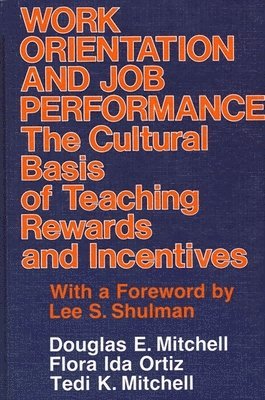
    Work Orientation and Job Performance

    The Cultural Basis of Teaching Rewards and Incentives

    AvDouglas E. Mitchell,Flora Ida Ortiz

    Häftad, Engelska, 1987

    Del i serien SUNY series, Educational Leadership

    378 kr

    Tillfälligt slut

    Beskrivning

    With critical attention focused on education, and the teaching profession itself under close scrutiny by federal, state, and local officials and governing boards, a heightened sense of the need to attract and retain good teachers has surfaced as a national priority. Based on data collected on elementary school teachers, principals, and central office administrators in a large unified school district, the authors draw upon cultural rather than economic or psychological concepts to reveal and explain how educators become oriented to their work responsibilities. The book presents a comprehensive description of the rewards and incentives provided for teachers. It also describes the roles of principals and links the principal's work to classroom performance and teaching effectiveness. Throughout this fascinating account the authors describe and reflect upon the ways in which teaching is controlled by a system of beliefs and meanings that specify the overall purposes of schooling and establish norms for social relationships with students and colleagues.

    Produktinformation

    • Utgivningsdatum:1987-11-15
    • Mått:152 x 229 x 25 mm
    • Vikt:354 g
    • Format:Häftad
    • Språk:Engelska
    • Serie:SUNY series, Educational Leadership
    • Antal sidor:245
    • Förlag:State University of New York Press
    • ISBN:9780887065682

    Utforska kategorier

    • Pedagogisk metodik inom Psykologi och pedagogik

    Mer om författaren

    The three authors are affiliated with the University of California, Riverside, where Douglas E. Mitchell is Professor and Flora Ida Ortiz is Associate Professor in the School of Education.

    Recensioner i media

    "...an extremely relevant piece of research in terms of contemporary educational reform. In light of the current controversy over the restructuring of the teaching profession, merit pay, etc. a detailed ethnographic study of this type is enormously valuable. The theoretical introduction provided at the beginning of the book is particularly informative, along with the literature review. Their descriptions are concise and informative."— Eugene F. Provenzo Jr., University of Miami

    Innehållsförteckning

    • Foreword Acknowledgments Chapter I Teacher Incentives and School Performance Effective Schools and TeachersThe Plan of this BookData Sources and Research MethodsA Preliminary Perspective on Teaching IncentivesChapter II Work Motivation, Rewards, and Incentive Systems: A Review of Prior Research Motivation, Rewards, and IncentivesDistinguishing Incentives from RewardsThe Work Motivation LiteratureThe Dangers of Overreliance on Some IncentivesSix Underlying Psychological TheoriesBehaviorist TheoriesNeed PsychologiesCognitive PsychologiesToward a Cultural Theory of Teaching IncentivesA Cultural Perspective on School OrganizationsClassrooms as Subcultural GroupsCulture at the Individual LevelChapter III  The Work Orientations and Incentive Systems of Fifteen Elementary Teachers Organizational Incentives: Achievement Production versus Child NurtureGroup-Level Incentives: Keeping School versus Teaching LessonsIndividual Incentives: Role Definitions and Career OrientationsGroup 1. The Master TeachersGroup 2. The InstructorsGroup 3. The CoachesGroup 4. The HelpersSummary and ConclusionChapter IV Teaching Lessons: The Cultural Enterprise of the Classroom Lesson Structures: Archetypes and VariationsThe Teacher-Led Verbal LessonThe Activity LessonThe Drill and Practice LessonTests as LessonsBasic Elements of the Lesson StructureBeginning DemarcationsLesson OpeningsThe Lesson ProperLesson ClosingsEnding DemarcationsWork Orientations and Lesson StructuresThe Master TeachersThe InstructorsThe CoachesThe HelpersSummary and ConclusionChapter V Managing Classrooms: A Cultural Perspective on Rules and Their Enforcement The Fragile Character of Classroom orderUsing Rewards to Enforce RulesRule-Based Order: Overt Power StrategiesRule-Based Order: Normative StrategiesKindergarten: Where the Socialization Process BeginsSuccessful Enculturation: Direction Giving Rather than Rule EnforcementThe Intrusion of the School's Rule StructureConclusionChapter VI Five School Principals: Administrative Work in Cultural Perspective The Principal as Manager: The Case of Mrs. PContradictions in Mrs. P's StyleThe Principal as Administrator: The Case of Mr. QContradictions in Mr. Q's StyleThe Principal as Leader: The Case of Mr. RContradictions in Mr. R's StyleThe Principal as Supervisor: The Case of Mrs. SContradictions in Mrs. S's StyleThe Multistyle Principal: The Case of Mrs. TFlexibility Rather than ContradictionSummary and ConclusionsChapter VII Cultural Incentives and Effective Teaching Motivation and RewardsMotivation through Reward DistributionDistinguishing Rewards from ReinforcementsTypes of RewardsDistinguishing Rewards from IncentivesSchool Incentive SystemsTeachers Receive Both Intrinsic and Extrinsic RewardsIncentives as Cultural ExpressionsLessons and Rules: The Technical Core of the ClassroomPrincipals' Influence on Teacher Incentive SystemsThe Cultural Roles Played by PrincipalsConclusionChapter VIII Policy Implications Establishing Culturally Grounded Teacher Incentive SystemsEnhancing School AchievementImproving School AdministrationConclusionBibliography Index