• Fri frakt över 249 kr
  • •
  • Snabba leveranser
  • •
  • Billiga böcker
Kundservice

Du är på sajten för privatpersoner.

Företag, bibliotek eller offentlig verksamhet?

Du handlar på classic.bokus.com, där alla dina funktioner finns intakta.
Till classic.bokus.com
Bokus logotyp. Gå till startsidan.
  • Erbjudanden
  • Nyheter
  • Student
  • Topplistor
  • Barn & ungdom
  • Bokus Play
  • E-böcker
  • Pocketböcker
  • Spel & pussel

10% studentrabatt med kod TERM26

Sidfot

Mina sidor

    Hjälp

    • Kundservice
    • Vanliga frågor och svar
    • Frakt och leverans
    • Retur vid ångerrätt
    • Reklamera vara
    • Betalning
    • Köpvillkor
    • Allmänna villkor
    • Information om webbplatsens tillgänglighet

    Om Bokus

    • Om oss
    • Pressrum
    • För studenter
    • För företag
    • För bibliotek och offentlig verksamhet
    • För leverantörer
    • Hållbarhet

    Populärt

    • Aktuella erbjudanden
    • Presentkort
    • Studentlitteratur
    • Nya böcker
    • Topplistor
    • Signerade böcker
    • Engelska böcker

    Inspiration

    • Boktips
    • BookTok
    • Populära bokserier
    • Barnbokskaraktärer
    • Populära författare
    Logotyp för Bokus
    Följ oss på Facebook (extern länk)Följ oss på Instagram (extern länk)Följ oss på YouTube (extern länk)Följ oss på TikTok (extern länk)
    bokus @ CookiesAnpassa cookiesIntegritetspolicyKöpvillkor
    Till Citymail hemsida (extern länk)Till Budbee hemsida (extern länk)Till Postnord hemsida (extern länk)Till Schenker hemsida (extern länk)Till Early Bird hemsida (extern länk)Till Walleys hemsida (extern länk)
    1. Språk och ordböcker
    2. Språkvetenskap och lingvistik

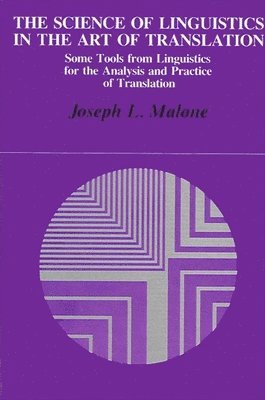
    Science of Linguistics in the Art of Translation

    Some Tools from Linguistics for the Analysis and Practice of Translation

    AvJoseph L. Malone

    Inbunden, Engelska, 1988

    Del i serien SUNY series in Linguistics

    1 108 kr

    Tillfälligt slut

    Fler format och utgåvor

    Häftad

    Tillf. slut

    Beskrivning

    Drawing from more than two hundred examples representing twenty-two languages of wide genetic and typological variety, the author guides the reader through a broad collection of situations encountered in the analysis and practice of translation. This enterprise gains structure and rigor from the methods and findings of contemporary linguistic theory, while realism and relevance are served by the choice of "naturalistic" examples from published translations. Coverage draws from a variety of genres and text-types (literary works, the Bible, newspaper articles, legal and philosophical writings, for examples), and addresses a thorough selection of structural-functional aspects. These range from discrepancies between source and target languages in sentence construction, to dfiferences between source and target poetic traditions with respect to meter and rhyme.

    Produktinformation

    • Utgivningsdatum:1988-07-08
    • Mått:152 x 229 x 23 mm
    • Vikt:499 g
    • Format:Inbunden
    • Språk:Engelska
    • Serie:SUNY series in Linguistics
    • Antal sidor:256
    • Förlag:State University of New York Press
    • ISBN:9780887066535

    Utforska kategorier

    • Språkvetenskap och lingvistik inom Språk och ordböcker

    Mer om författaren

    Joseph L. Malone is Professor of Linguistics and Departmental Chair at Barnard College, Columbia University.

    Recensioner i media

    "It provides a precise, concise, and comprehensive linguistic description and analysis of what a good translator does in the act of translation. Like good criticism, this book makes one aware of the seemingly mystifying things that go on in translating from one language to another. The concepts are basic to linguistics and the examples are well chosen." — Edward L. Greenstein, Jewish Theological Seminary of America

    Innehållsförteckning

    • Acknowledgements Introduction 0.1 Basic Goals of the Book 0.1.1 Linguistics and Translation0.1.2 The Science of Linguistics0.1.3 The Art of Translation0.1.4 The Analysis and Practice of Translation0.2 Linguistic Scaffolding0.2.1 Primary Organizational Components0.2.2 Secondary Organizational Components0.2.3 An Extended Illustration0.2.4 Compositional Levels0.2.5 Representational Strata0.3 Format of Translational Examples and Bibliographical References0.3.1 Translational Examples0.3.2 Bibliographical References0.4 Overview of the Book's Structure0.5 List of Terms and Symbols Not Defined Elsewhere0.6 A Note on TerminologyNotesPart One Chapter 1 Trajections; Matching (Equation and Substitution)1.1 Trajections in General1.1.1 Basic Characterization1.1.2 Preliminary Examples1.2 Equation1.3 Substitution1.4 Matching1.4.1 Carry-over Matching1.4.2 Calque Matching, Prefab Matching, and False FriendshipNotesChapter 2 Zigzagging (Divergence and Convergence)2.1 Divergence2.1.1 Linguistic Cues2.1.2 Situational Cues2.1.3 Stylistic Cues2.1.4 Artistic Suspense; Stylistically Induced Divergence2.2 Convergence2.3 ZigzaggingNotesChapter 3 Recrescence (Amplification and Reduction)3.1 Amplification3.1.1 Compensatory Amplification—Glossing3.1.2 Classificatory Amplification3.2 Reduction3.2.1 Compensatory Reduction3.2.2 Variational Reduction3.3 Recrescence3.3.1 Minimax Size Adjustments for Metrical Fit3.3.2 Global Preferences for Larger or Smaller Units3.3.3 Japanese kureru-yaru and Author's EmpathyNotesChapter 4 Repackaging (Diffusion and Condensation)4.1 Diffusion4.1.1 Diffusion versus Amplification4.1.2 Definitional Diffusion4.1.3 Diffusion of Grammatical Inflections4.1.4 Diffusion of Sentences4.2 Condensation4.2.1 Condensation in Response to Poetic Requirements4.2.2 Condensation to Compensate for Syntactic Deficiency4.3 Repackaging4.3.1 Size Adjustments and Preferences4.3.2 Repackaging and Recurrence Chains4.3.3 Repackaging and de novo TranslationNotesChapter 5 Reordering5.0 Preliminaries5.1 Reordering to Optimize Comprehension5.2 Reordering Relative to Narrative Flow5.3 Reordering of Target-Alien Stylistic Patterns (Greek hysteron-proteron)5.4 Feature ReorderingNotesChapter 6 Some Dimensions of Trajectional Analysis6.0 Preliminaries6.1 Levels of Composition: Recoding6.2 Relations Between Trajections6.2.1 Implications6.2.2 Hook-ups6.3 Trajections as Applied-Linguistic ConstructsNotesChapter 7 Some Trajectional Parameters7.0 Preliminaries7.1 Structural-Strategical Parameters7.2 Linguistic-Stylistic-Situational Parameters7.2.1 The Chiaroscuro Nature of Stylistic Patterns7.3 Compensatory-Classificatory Parameters7.4 Paradigmatic-Syntagmatic Parameters7.5 Positive and Negative Hook-ups7.6 Translinguistic-Unilinguistic ParametersNotesPart Two Chapter 8 Systemic and Formalistic Techniques8.0 Preliminaries8.1 The Systemic Perspective: Sets and Scatters8.2 Charts and Diagrams: Set-to-Set Substitution, Set-to-Scatter Equation8.3 Japanese Self-Referent Pronouns; French Dizaines versus English Dozens; Scatter-to-Set Translation8.4 Formal and Functional SetsNotesChapter 9 Taxonomies9.0 Preliminaries9.1 Taxonomic Conflation9.2 Matching and Diffusional Deconflation9.3 Nonce ConflationNotesChapter 10 Zeroes10.0 Preliminaries10.1 Zeroes in Recurrence and Coreference Chains; Biblical Hebrew Parallelism10.2 Zeroes in the Study of Style and Textual AmbiguityNotesChapter 11 Abstract Syntactic Representations11.0 Preliminaries: The Notion of 'Government'11.1 The Latin Accusative-with-Infinitive Construction11.2 Some Guidelines for Synthesizing Abstract Syntactic Representations (ASRs)11.3 Derivations, Rules, and Strata of RepresentationNotesChapter 12 Bridge Technique 12.0 Preliminaries12.1 Basic Properties of the Technique12.2 Spanning: French tâcher and Spanish procurar versus English try12.3 Refashioning; Antispanning, Lexicalization12.4 Situational and Stylistic Patterns12.4.1 Spanish versus English Gender12.4.2 Hebrew versus English Subject Raising12.4.3 Norwegian Word Order versus English Extraposition12.5 Disassembly and Reassembly: Representational Strata and TrajectionsNotesPart Three Chapter 13 Phonetics, Phonology, and Poetic Form13.0 Preliminaries: Phonetic Transcription13.1 Cenematics and Orthometrics13.2 Feature and Subsequence Rhyme13.3 Two Modes of Linguistic Application13.4 Cenematic Strata and Derivations; APRsNotesChapter 14 Transduction 14.1 Turkish Rhyme14.2 Alliteration in Old Irish14.3 Transduction14.3.1 'Ahi Ali Baba'14.3.2 'Slieve Cua'NotesChapter 15 Transjacence 15.0 Preliminaries15.1 Paronomasia and Other Cenematic-Plerematic Complexes15.1.1 Alliterative and Rhyming Binomials15.1.2 Mimesis15.1.3 Free Association15.1.4 Eponymy15.2 Source-Text Recurrence Chains15.2.1 Symbolism15.2.2 Situational Inducement15.2.3 Patterned or Arbitrary Distribution15.2.4 The Distance Factor15.2.5 Author's ProclivityNotesChapter 16 Parallax16.0 Preliminaries16.1 Displacement Parallax16.2 Antipodal Parallax16.3 Macroscopic Parallax16.4 Microscopic Parallax16.5 Personalizing Parallax16.6 Depersonalizing Parallax16.7 The Functions of Parallax in Literary LanguageNotesBibliography Index of Persons and Translational Resources Index of Languages Index of Subjects