• Fri frakt över 249 kr
  • •
  • Snabba leveranser
  • •
  • Billiga böcker
Kundservice

Du är på sajten för privatpersoner.

Företag, bibliotek eller offentlig verksamhet?

Du handlar på classic.bokus.com, där alla dina funktioner finns intakta.
Till classic.bokus.com
Bokus logotyp. Gå till startsidan.
  • Erbjudanden
  • Nyheter
  • Student
  • Topplistor
  • Barn & ungdom
  • Bokus Play
  • E-böcker
  • Pocketböcker
  • Spel & pussel

10% rabatt på allt med kod: NYSTART10 →

Sidfot

Mina sidor

    Hjälp

    • Kundservice
    • Vanliga frågor och svar
    • Frakt och leverans
    • Retur vid ångerrätt
    • Reklamera vara
    • Betalning
    • Köpvillkor
    • Allmänna villkor
    • Information om webbplatsens tillgänglighet

    Om Bokus

    • Om oss
    • Pressrum
    • För studenter
    • För företag
    • För bibliotek och offentlig verksamhet
    • För leverantörer
    • Hållbarhet

    Populärt

    • Aktuella erbjudanden
    • Presentkort
    • Studentlitteratur
    • Nya böcker
    • Topplistor
    • Signerade böcker
    • Engelska böcker

    Inspiration

    • Boktips
    • BookTok
    • Populära bokserier
    • Barnbokskaraktärer
    • Populära författare
    Logotyp för Bokus
    Följ oss på Facebook (extern länk)Följ oss på Instagram (extern länk)Följ oss på YouTube (extern länk)Följ oss på TikTok (extern länk)
    bokus @ CookiesAnpassa cookiesIntegritetspolicyKöpvillkor
    Till Citymail hemsida (extern länk)Till Budbee hemsida (extern länk)Till Postnord hemsida (extern länk)Till Schenker hemsida (extern länk)Till Early Bird hemsida (extern länk)Till Walleys hemsida (extern länk)
    1. Filosofi och religion
    2. Filosofi
    3. Filosofiska discipliner

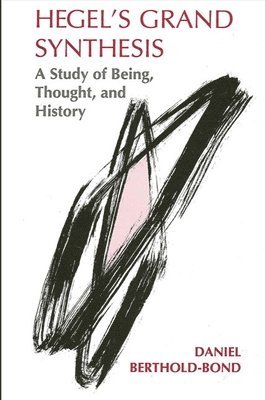
    Hegel's Grand Synthesis

    A Study of Being, Thought, and History

    AvDaniel Berthold-Bond

    Inbunden, Engelska, 1989

    Del i serien SUNY series in Hegelian Studies

    1 076 kr

    Tillfälligt slut

    Fler format och utgåvor

    Häftad

    Tillf. slut

    Beskrivning

    This book offers the first genuinely systematic treatment of Hegel's eschatology in the literature. It is an investigation into Hegel's project to demonstrate the ultimate unity of thought and being (consciousness and reality, self and world). The author traces the project through Hegel's epistemology, metaphysics, and philosophy of history.The grand synthesis creates a basic tension, an ambivalence, that reaches its most acute formulation in Hegel's eschatological language of a final completion or fulfillment of history. This conflicts with his dialectic and Heracletian metaphysics of becoming. Berthold-Bond concludes that a substantially new approach to Hegel's eschatology is needed.

    Produktinformation

    • Utgivningsdatum:1989-07-03
    • Mått:152 x 229 x 16 mm
    • Vikt:499 g
    • Format:Inbunden
    • Språk:Engelska
    • Serie:SUNY series in Hegelian Studies
    • Antal sidor:246
    • Förlag:State University of New York Press
    • ISBN:9780887069550

    Utforska kategorier

    • Filosofiska discipliner inom Filosofi och religion

    Mer om författaren

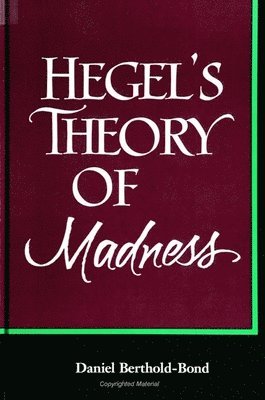
    Daniel Berthold-Bond is Professor of Philosophy at Bard College and author of Hegel's Theory of Madness, also published by SUNY Press.

    Innehållsförteckning

    • Abbreviations Chapter One: Introduction Chapter Two: Hegel's Theory of Truth 1. Truth as a Temporal, Historical Eventa. Hegel and Frege: Truth and Thoughtb. The Principle of Developmentc. The Principle of Concretiond. The Question of Relativism2. The "Agency" of Trutha. Hegel and Heidegger: The Anthropocentric Interpretation of Truthb. Hegel's Panlogistic Interpretation of Truthc. Hegel's Attempted Synthesis of Anthropomorphism and Panlogism3. The Criterion of Truth: Hegel's Twist on the Correspondence TheoryChapter Three: The "Riddle and Problem" of Knowledge 1. The Problem Itself2. Hegel's Solution to the Problema. Criticisms of Kanti. The Kantian Critical Philosophy as Scepticismii. The Basic Issue: Is Alteration a Distortion?iii. The Ding an sich as Caput Mortuumb. Hegel's Positive Solutioni. "Removing the Curtain"ii. Hegel's Epistemological Criteriology3. Hegel's Idealisma. Kant's "Critical Idealism" and Fichte's "Subjective Idealism"b. The "Overlapping" of Realism and IdealismChapter Four: Becoming and Dialectic 1. Hegel's Notion of Substancea. The Influence of Aristotleb. The Influence of Leibnizc. The Influence of Heraclitus2. The Nature of Becominga. "Mere Logical Becoming"b. The Deeper Significance of Becoming3. The Nature of Dialectica. Dialectic as Negativityb. Dialectic as a Mode of ThoughtChapter Five: Hegel's Philosophic Method: The "Self-Construction of Reason" 1. Introductory Remarks on Method2. Method and Reason3. Method as Dialectica. Dialectic and the Dynamic Character of Thoughtb. Dialectic and the Grand Synthesis: The Dovetailing of Categories of hought and Being4. Method as Teleologya. Teleology and Systemb. Teleology and CircularityChapter Six: The Question of Completion: Hegel and Christian Eschatology 1. The Ambiguity2. The Book of Revelation3. Revelation and Reason4. Hegel's Christian Eschatology and the Apocalyptic Vision of a "New World"a. Sufferingb. The Cursec. The "Tabernacle of God"d. The "New World"5. The Ambiguity DeepensChapte Seven: The Question of Completion: Hegel's Philosophic Eschatology 1. The "New World" Revisited2. Evidence for the Epochal Reading of Hegel's Eschatology: Placing the New World" in Context3. Pro and Con4. Other Viewsa. The Literal (Absolutist) Interpretationb. Epochal Interpretations, Hesitant and Otherwisec. Attempts at a Synthetic Interpretation5. ConclusionNotes Bibliography Subject Index Name Index