• Fri frakt över 249 kr
  • •
  • Snabba leveranser
  • •
  • Billiga böcker
Kundservice

Du är på sajten för privatpersoner.

Företag, bibliotek eller offentlig verksamhet?

Du handlar på classic.bokus.com, där alla dina funktioner finns intakta.
Till classic.bokus.com
Bokus logotyp. Gå till startsidan.
  • Erbjudanden
  • Nyheter
  • Student
  • Topplistor
  • Barn & ungdom
  • Bokus Play
  • E-böcker
  • Pocketböcker
  • Spel & pussel

10% rabatt på allt med kod NYSTART10 →

Sidfot

Mina sidor

    Hjälp

    • Kundservice
    • Vanliga frågor och svar
    • Frakt och leverans
    • Retur vid ångerrätt
    • Reklamera vara
    • Betalning
    • Köpvillkor
    • Allmänna villkor
    • Information om webbplatsens tillgänglighet

    Om Bokus

    • Om oss
    • Pressrum
    • För studenter
    • För företag
    • För bibliotek och offentlig verksamhet
    • För leverantörer
    • Hållbarhet

    Populärt

    • Aktuella erbjudanden
    • Presentkort
    • Studentlitteratur
    • Nya böcker
    • Topplistor
    • Signerade böcker
    • Engelska böcker

    Inspiration

    • Boktips
    • BookTok
    • Populära bokserier
    • Barnbokskaraktärer
    • Populära författare
    Logotyp för Bokus
    Följ oss på Facebook (extern länk)Följ oss på Instagram (extern länk)Följ oss på YouTube (extern länk)Följ oss på TikTok (extern länk)
    bokus @ CookiesAnpassa cookiesIntegritetspolicyKöpvillkor
    Till Citymail hemsida (extern länk)Till Budbee hemsida (extern länk)Till Postnord hemsida (extern länk)Till Schenker hemsida (extern länk)Till Early Bird hemsida (extern länk)Till Walleys hemsida (extern länk)
    1. Psykologi och pedagogik
    2. Psykologi
    3. Psykologiska teorier och skolor
    4. Freudiansk psykologi

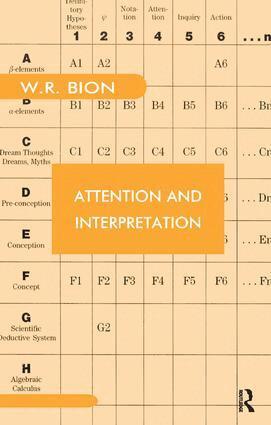
    Attention and Interpretation

    AvWilfred R. Bion

    Häftad, Engelska, 1984

    553 kr

    Beställningsvara. Skickas inom 10-15 vardagar. Fri frakt över 249 kr.

    Fler format och utgåvor

    Inbunden

    2 354 kr

    E-bok

    652 kr

    E-bok

    652 kr

    Beskrivning

    Bion's central thesis in this volume is that for the study of people, whether individually or in groups, a cardinal requisite is accurate observation, accompanied by accurate appreciation and formulation of the observations so made. The study represents a further development of a theme introduced in the author's earlier works, particularly in Elements of Psychoanalysis (1963) and Transformations (1965). Bion's concern with the subject stems directly from his psycho-analytic experience and reflects his endeavor to overcome, in a scientific frame of reference, the immense difficulty of observing, assessing, and communicating non-sensuous experience.Here, he lays emphasis on he overriding importance of attending to the realities of mental phenomena as they manifest themselves in the individual or group under study. In influences that interpose themselves between the observer and the subject of his scrutiny giving rise to opacity, are examined, together with ways of controlling them. Problems of language are considered: In order to express and communicate, the analyst is obliged to use words and formulations deriving from a background of sensuous experience and designed for a different task. Furthermore, the author says "It is too often forgotten that the gift of speech, so centrally employed, has been elaborated s much for the purpose of concealing thought by dissimulation and lying as for the purpose of elucidating or communicating thought".The practical value of this volume for those engaged in psycho-analytic work is self-evident; furthermore, its implications extend to many other areas of study. The discussion is wide-ranging: based on Kleinian theory, it encompasses theological dogma and mathematics, and the relationships between these fields. In particular, an attempt is made to show the analogy of certain psychological concepts with mathematical formulations such as set theory.Readers already familiar with Bion's work will welcome this further statement of his views. Those encountering his writing for the first time will at once perceive the originality of his approach and the precision of his theoretical exposition.

    Produktinformation

    • Utgivningsdatum:1984-12-31
    • Mått:147 x 230 x 10 mm
    • Vikt:186 g
    • Format:Häftad
    • Språk:Engelska
    • Antal sidor:144
    • Förlag:Taylor & Francis Ltd
    • ISBN:9780946439089

    Utforska kategorier

    • Freudiansk psykologi inom Psykologi och pedagogik

    Mer om författaren

    Wilfred R. Bion (1897 -1979) was born in India and first came to England at the age of eight to receive his schooling. During the First World War he served in France as a tank commander and was awarded the DSO and the Legion of Honour. After reading history at Queen's College, Oxford, he studied medicine at University College London, before a growing interest in psychoanalysis led him to undergo training analysis with John Rickman and, later, Melanie Klein. During the 1940s his attention was directed to the study of group processes. Abandoning his work in this field in favor of psychoanalytic practice, he subsequently rose to the position of Director of the London Clinic of Psychoanalysis (1956-62) and President of the British Psychoanalytical Society (1962-65). From 1968 he worked in Los Angeles, returning to England two months before his death in 1979. A pioneer in group dynamics, he was associated with the 'Tavistock group', the group of pioneering psychologists that founded the Tavistock Institute in 1946 on the basis of their shared wartime experiences. He later wrote the influential 'Experiences in Groups', an important guide for the group psychotherapy and encounter group movements beginning in the 1960s, and which quickly became a touchstone work for applications of group theory in a wide variety of fields. Bion's training included an analysis with Melanie Klein following World War II. He was a leading member in the Kleinian school while in London, but his theories, which were always based in the phenomena of the analytic encounter, eventually revealed radical departures from both Kleinian and Freudian theory. While Bion is most well known outside of the psychoanalytic community for his work on group dynamics, the psychoanalytic conversation that explores his work is concerned with his theory of thinking and his model of the development of a capacity for thought.

    Recensioner i media

    Bion's central thesis in this volume is that for the study of people, whether individually or in groups, a cardinal requisite is accurate observation, accompanied by accurate appreciation and formulation of the observations so made. The study represents a further development of a theme introduced in the author's earlier works, particularly in Elements of Psychoanalysis (1963) and Transformations (1965). Bion's concern with the subject stems directly from his psycho-analytic experience and reflects his endeavor to overcome, in a scientific frame of reference, the immense difficulty of observing, assessing, and communicating non-sensuous experience.Here, he lays emphasis on he overriding importance of attending to the realities of mental phenomena as they manifest themselves in the individual or group under study. In influences that interpose themselves between the observer and the subject of his scrutiny giving rise to opacity, are examined, together with ways of controlling them. Problems of language are considered: In order to express and communicate, the analyst is obliged to use words and formulations deriving from a background of sensuous experience and designed for a different task. Furthermore, the author says "It is too often forgotten that the gift of speech, so centrally employed, has been elaborated s much for the purpose of concealing thought by dissimulation and lying as for the purpose of elucidating or communicating thought".The practical value of this volume for those engaged in psycho-analytic work is self-evident; furthermore, its implications extend to many other areas of study. The discussion is wide-ranging: based on Kleinian theory, it encompasses theological dogma and mathematics, and the relationships between these fields. In particular, an attempt is made to show the analogy of certain psychological concepts with mathematical formulations such as set theory.Readers already familiar with Bion's work will welcome this further statement of his views. Those encountering his writing for the first time will at once perceive the originality of his approach and the precision of his theoretical exposition.

    Innehållsförteckning

    • Introduction -- Medicine as a Model -- Reality Sensuous and Psychic -- Opacity of Memory and Desire -- Theories: Particular Instance or General Configuration -- The Mystic and the Group -- Container and Contained -- Vertices: Evolution -- Ultimate Reality -- Visual Images and Invariants -- Lies and the Thinker -- Container and Contained Transformed -- Prelude to or Substitute for Achievement