• Fri frakt över 249 kr
  • •
  • Snabba leveranser
  • •
  • Billiga böcker
Kundservice

Du är på sajten för privatpersoner.

Företag, bibliotek eller offentlig verksamhet?

Du handlar på classic.bokus.com, där alla dina funktioner finns intakta.
Till classic.bokus.com
Bokus logotyp. Gå till startsidan.
  • Erbjudanden
  • Nyheter
  • Student
  • Topplistor
  • Barn & ungdom
  • Bokus Play
  • E-böcker
  • Pocketböcker
  • Spel & pussel

10% rabatt på allt med kod NYSTART10 →

Sidfot

Mina sidor

    Hjälp

    • Kundservice
    • Vanliga frågor och svar
    • Frakt och leverans
    • Retur vid ångerrätt
    • Reklamera vara
    • Betalning
    • Köpvillkor
    • Allmänna villkor
    • Information om webbplatsens tillgänglighet

    Om Bokus

    • Om oss
    • Pressrum
    • För studenter
    • För företag
    • För bibliotek och offentlig verksamhet
    • För leverantörer
    • Hållbarhet

    Populärt

    • Aktuella erbjudanden
    • Presentkort
    • Studentlitteratur
    • Nya böcker
    • Topplistor
    • Signerade böcker
    • Engelska böcker

    Inspiration

    • Boktips
    • BookTok
    • Populära bokserier
    • Barnbokskaraktärer
    • Populära författare
    Logotyp för Bokus
    Följ oss på Facebook (extern länk)Följ oss på Instagram (extern länk)Följ oss på YouTube (extern länk)Följ oss på TikTok (extern länk)
    bokus @ CookiesAnpassa cookiesIntegritetspolicyKöpvillkor
    Till Citymail hemsida (extern länk)Till Budbee hemsida (extern länk)Till Postnord hemsida (extern länk)Till Schenker hemsida (extern länk)Till Early Bird hemsida (extern länk)Till Walleys hemsida (extern länk)
    1. Psykologi och pedagogik
    2. Psykologi
    3. Psykologiska teorier och skolor
    4. Freudiansk psykologi

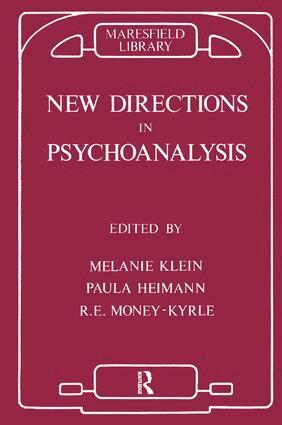
    New Directions in Psychoanalysis

    The Significance of Infant Conflict in the Pattern of Adult Behaviour

    AvPaula Heimann,Melanie Klein

    Häftad, Engelska, 1985

    948 kr

    Beställningsvara. Skickas inom 10-15 vardagar. Fri frakt över 249 kr.

    Beskrivning

    Melanie Klein's contribution to psycho-analysis is centered on her exploration into the early stages of the mental development of the child, which she began while a pupil of Karl Abraham. Taking as her starting point Freud's concept of free association, as used in the analysis of adults, she set herself the task of adapting this technique to the psycho-analytic treatment of children. From this was evolved her play technique whereby, though providing a situation in which a child could play "freely", she was able to interpret his play - that is, describe and explain to him the feelings and phantasies that seemed to be expressed within it.By means of this technique, Klein made a most significant contribution to psycho-analysis. Not only she showed that it is possible to achieve therapeutic results more fruitful than those usually achieved with adults; but she was also able to map out in greater detail than had ever before been possible the early stages of mental development.The psycho-analytic picture as illuminated by her work emphasizes two principal stages of normal development, which Klein called "positions". The first, issuing from the infant's unintegrated and violently conflicting attitude to the vital objects of this world, is marked by a persecutory anxiety which may retard or disrupt the integration of the infant's ego. In the second stage the infant begins to apprehend that the gratifying objects he needs and loves are but other aspects of the menacing and frustrating objects he hates. This discovery arouses concern for these objects, and he experiences depression. However, in so far as he can tolerate the depressive position, it gives rise to reparative impulses and a capacity for unselfish concern and protective love. The extent to which he achieves this normal outcome determines the stability of his health or his liability to illness. In Klein's view, two of Freud's great discoveries, the super-ego and the Oedipus complex, have their roots in these early periods of development.This is a milestone in Kleinian psycho-analysis, and includes contributions from among others Joan Riviere and W.R. Bion.

    Produktinformation

    • Utgivningsdatum:1985-12-31
    • Mått:147 x 230 x 35 mm
    • Vikt:812 g
    • Format:Häftad
    • Språk:Engelska
    • Antal sidor:548
    • Förlag:Taylor & Francis Ltd
    • ISBN:9780946439133

    Utforska kategorier

    • Freudiansk psykologi inom Psykologi och pedagogik

    Mer om författaren

    Melanie Klein was an Austrian-born British psychoanalyst who devised novel therapeutic techniques for children that had an impact on child psychology and contemporary psychoanalysis. She was a leading innovator in theorizing object relations theory, and remains one of the most important figures in psychoanalytical theory and practice. Roger Money-Kyrle (1898-1980) was an influential psychoanalyst particularly noted for his promotion and development of the ideas of Melanie Klein. He was analysed by Ernest Jones, by Freud and later by Klein. Initially his interest in psychoanalysis was stimulated in connection with his work in philosophy, anthropology, and the social sciences generally, but following his analysis with Klein he became a practising analyst and subsequently a training analyst. His papers reflect both his interest in the contributions that psychoanalytic thought could make to understanding social problems, in particular in matters of war and politics, and also his contributions to analytic theory and praxis.

    Recensioner i media

    Melanie Klein's contribution to psycho-analysis is centered on her exploration into the early stages of the mental development of the child, which she began while a pupil of Karl Abraham. Taking as her starting point Freud's concept of free association, as used in the analysis of adults, she set herself the task of adapting this technique to the psycho-analytic treatment of children. From this was evolved her play technique whereby, though providing a situation in which a child could play freely", she was able to interpret his play - that is, describe and explain to him the feelings and phantasies that seemed to be expressed within it.By means of this technique, Melanie Klein made a most significant contribution to psycho-analysis. Not only she showed that it is possible to achieve therapeutic results more fruitful than those usually achieved with adults; but she was also able to map out in greater detail than had ever before been possible the early stages of mental development.The psycho-analytic picture as illuminated by her work emphasizes two principal stages of normal development, which Melanie Klein called "positions". The first, issuing from the infant's unintegrated and violently conflicting attitude to the vital objects of this world, is marked by a persecutory anxiety which may retard or disrupt the integration of the infant's ego. In the second stage the infant begins to apprehend that the gratifying objects he needs and loves are but other aspects of the menacing and frustrating objects he hates. This discovery arouses concern for these objects, and he experiences depression. However, in so far as he can tolerate the depressive position, it gives rise to reparative impulses and a capacity for unselfish concern and protective love. The extent to which he achieves this normal outcome determines the stability of his health or his liability to illness. In Melanie Klein's view, two of Freud's great discoveries, the super-ego and the Oedipus complex, have their roots in these early periods of development.

    Innehållsförteckning

    • PREFACE BY ERNEST JOINES -- INTRODUCTION -- PART ONE -- PAPERS IN CLINICAL PSYCHO-ANALYSIS -- 1. MELANIEKLEN -- The Psydio-41nalytlc Play Technique: Its history and sigficawe -- 2. PAULA HEIMANN -- A Contribution w the re-eva1uation of the (Edipus Complex—early stages -- 3. W. CLIFFORD M. SCOTT -- A Psycho-Analytic concept of the orgin Depression -- 4. 11. GWEN EVANS -- Early Anxiety Situation in the aialynsefa boy rn the Lerscy Period -- 5. MARION MILNER -- The role of Illusion In Symbol Formation -- 6. LOIS MUNRO -- Steps in Ego-Integration observed In a Play-Analysis -- 7. EMIUO RODEUGUE -- The analysis of a three-year-old mute schizophrenic -- 8. HERBERT ROSENFELD -- Notes on the Psyche-Analysis of the Super-Ego Conflict in an acute schizophrenic patient -- 9. W.R.BION -- Language and the schizophrenic -- 10. PAULA HETMANN -- A combination of Defence Mechanisms in Paranoid States -- 11. BERYL SANDFORD -- An obsessional man’s need to be “kept” -- H12. ANS A. THORNER -- Three Defeswcs against Inner Persecution -- PART TWO -- PAPERS IN APPLIED PSYCHO-ANALYSIS MELANIE KLEIN -- On identification -- 14. JOAN R.IVIERE -- The Unconscious Phantasy of an Inner World reflected in -- examples front literature -- 15. JOAN RIVIERE -- The Inner World in Ibsen’s MASTER-BUILDER -- 16. HANNA SEGAL -- A Psycho-Analytical approach to Aesthetics -- 17. ADRIAN STOKES -- Form in Art -- 18. R. B. MONEY-KYRLE -- Psycho-Analysis and Ethics -- 19. W. K. BION -- Group Dynamics: a re-view -- 20. ELLIOTT JAQUES -- Social Systems as a defence against Persecutory and Deprcssiie -- Anxiety -- 21. R. E. MONEY-KYRLE -- An inconclusive contribution to the theory of the Death Instinct.