• Fri frakt över 249 kr
  • •
  • Snabba leveranser
  • •
  • Billiga böcker
Kundservice

Du är på sajten för privatpersoner.

Företag, bibliotek eller offentlig verksamhet?

Du handlar på classic.bokus.com, där alla dina funktioner finns intakta.
Till classic.bokus.com
Bokus logotyp. Gå till startsidan.
  • Erbjudanden
  • Nyheter
  • Student
  • Topplistor
  • Barn & ungdom
  • Bokus Play
  • E-böcker
  • Pocketböcker
  • Spel & pussel

10% rabatt på allt med kod NYSTART10 →

Sidfot

Mina sidor

    Hjälp

    • Kundservice
    • Vanliga frågor och svar
    • Frakt och leverans
    • Retur vid ångerrätt
    • Reklamera vara
    • Betalning
    • Köpvillkor
    • Allmänna villkor
    • Information om webbplatsens tillgänglighet

    Om Bokus

    • Om oss
    • Pressrum
    • För studenter
    • För företag
    • För bibliotek och offentlig verksamhet
    • För leverantörer
    • Hållbarhet

    Populärt

    • Aktuella erbjudanden
    • Presentkort
    • Studentlitteratur
    • Nya böcker
    • Topplistor
    • Signerade böcker
    • Engelska böcker

    Inspiration

    • Boktips
    • BookTok
    • Populära bokserier
    • Barnbokskaraktärer
    • Populära författare
    Logotyp för Bokus
    Följ oss på Facebook (extern länk)Följ oss på Instagram (extern länk)Följ oss på YouTube (extern länk)Följ oss på TikTok (extern länk)
    bokus @ CookiesAnpassa cookiesIntegritetspolicyKöpvillkor
    Till Citymail hemsida (extern länk)Till Budbee hemsida (extern länk)Till Postnord hemsida (extern länk)Till Schenker hemsida (extern länk)Till Early Bird hemsida (extern länk)Till Walleys hemsida (extern länk)
    1. Naturvetenskap och teknik
    2. Matematik och naturvetenskap
    3. Matematik

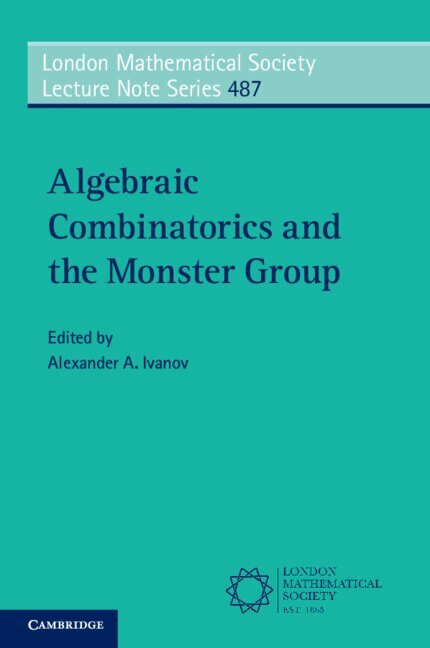
    Algebraic Combinatorics and the Monster Group

    AvAlexander A. Ivanov

    Häftad, Engelska, 2023

    Del 487 i serien London Mathematical Society Lecture Note Series

    1 281 kr

    Beställningsvara. Skickas inom 10-15 vardagar. Fri frakt över 249 kr.

    Beskrivning

    Covering, arguably, one of the most attractive and mysterious mathematical objects, the Monster group, this text strives to provide an insightful introduction and the discusses the current state of the field. The Monster group is related to many areas of mathematics, as well as physics, from number theory to string theory. This book cuts through the complex nature of the field, highlighting some of the mysteries and intricate relationships involved. Containing many meaningful examples and a manual introduction to the computer package GAP, it provides the opportunity and resources for readers to start their own calculations. Some 20 experts here share their expertise spanning this exciting field, and the resulting volume is ideal for researchers and graduate students working in Combinatorial Algebra, Group theory and related areas.

    Produktinformation

    • Utgivningsdatum:2023-08-17
    • Mått:152 x 229 x 30 mm
    • Vikt:860 g
    • Format:Häftad
    • Språk:Engelska
    • Serie:London Mathematical Society Lecture Note Series
    • Antal sidor:582
    • Förlag:Cambridge University Press
    • ISBN:9781009338042

    Utforska kategorier

    • Matematik inom Naturvetenskap och teknik
    • Grupper och gruppteori inom Naturvetenskap och teknik
    • Kombinatorik och grafteori inom Naturvetenskap och teknik

    Mer om författaren

    Alexander A. Ivanov earned his PhD degree in mathematics in 1984 from the Moscow Physical Technical Institute. He was a researcher at Institute for System Analysis and received Doctor of Science degree from Moscow State University in 2000. Since 1995, Professor Ivanov has taught at the Imperial College London. He gave an invited talk at 1990 ICM in Kyoto and authored five monographs.

    Recensioner i media

    'Describing the Monster group mathematical structures is the culmination of decades of work. Just as the largest Mathieu group framed the 24-dimensional Leech lattice, so also that lattice is the foundation for constructing the Moonshine Module and the Monster algebra, through which the Monster has become central in a theory with deep connections to modern physics. The first part of the book is a collection of five papers on the Monster and other algebraic structures, presented by international leaders in the area providing an outsider with the necessary content and concepts. It presents an account of the current status of the theory and available computational tools for studying the Monster and its algebras. The machinery for developing Majorana theory and axial algebras underpinning the Monster is based on Algebraic Combinatorics, to which the second part of this collection is devoted.' Cheryl Praeger, Emeritus Professor, University of Western Australia

    Innehållsförteckning

    • Part I. The Monster: 1. Lectures on vertex algebras Atsushi Matsuo; 2. 3-Transposition groups arising in vertex operator algebras Hiroshi Yamauchi; 3. On holomorphic vertex operator algebras of central charge 24 Ching Hung Lam; 4. Maximal 2-local subgroups of the Monster and Baby Monster Ulrich Meierfrankenfeld and Sergey Shpectorov; 5. The future of Majorana theory II Alexander A. Ivanov; Part II. Algebraic Combinatorics: 6. The geometry of Freudenthal-Tits magic square Hendrik Van Maldegham; 7. On generation of polar Grassmanisns Ilaria Cardinali, Lucca Giuzzi and Antonio Pasini; 8. Ovoidal maximal subspaces of polar spaces Antonio Pasini and Hendrik Van Maldegham; 9. On the behaviour of regular unipotent elements from subsystem subgroups of type A_n with special highest weights Tatsiana S. Busel and Irina D. Suprunenko; 10. Some remarks on the parameter c_2 for a distance-regular graph with classical parameters Jack H. Koolen, Jongyook Park and Qianqian Yang; 11. Distance-regular graphs, the subconstituent algebra, and the q-polynomial property Paul Terwilliger; 12. Terwilliger algebras and the Weisfeiler-Leman stabilization Tatsuro Ito; 13. Extended doubling of self-complementary strongly regular graphs and an analogue for digraphs Takuya Ikuta and Akihiro Munemasa; 14. Using GAP package for research in graph theory, design theory and finite geometries Leonard H. Soicher.