• Fri frakt över 249 kr
  • •
  • Snabba leveranser
  • •
  • Billiga böcker
Kundservice

Du är på sajten för privatpersoner.

Företag, bibliotek eller offentlig verksamhet?

Du handlar på classic.bokus.com, där alla dina funktioner finns intakta.
Till classic.bokus.com
Bokus logotyp. Gå till startsidan.
  • Erbjudanden
  • Nyheter
  • Student
  • Topplistor
  • Barn & ungdom
  • Bokus Play
  • E-böcker
  • Pocketböcker
  • Spel & pussel

10% rabatt på allt med kod: NYSTART10 →

Sidfot

Mina sidor

    Hjälp

    • Kundservice
    • Vanliga frågor och svar
    • Frakt och leverans
    • Retur vid ångerrätt
    • Reklamera vara
    • Betalning
    • Köpvillkor
    • Allmänna villkor
    • Information om webbplatsens tillgänglighet

    Om Bokus

    • Om oss
    • Pressrum
    • För studenter
    • För företag
    • För bibliotek och offentlig verksamhet
    • För leverantörer
    • Hållbarhet

    Populärt

    • Aktuella erbjudanden
    • Presentkort
    • Studentlitteratur
    • Nya böcker
    • Topplistor
    • Signerade böcker
    • Engelska böcker

    Inspiration

    • Boktips
    • BookTok
    • Populära bokserier
    • Barnbokskaraktärer
    • Populära författare
    Logotyp för Bokus
    Följ oss på Facebook (extern länk)Följ oss på Instagram (extern länk)Följ oss på YouTube (extern länk)Följ oss på TikTok (extern länk)
    bokus @ CookiesAnpassa cookiesIntegritetspolicyKöpvillkor
    Till Citymail hemsida (extern länk)Till Budbee hemsida (extern länk)Till Postnord hemsida (extern länk)Till Schenker hemsida (extern länk)Till Early Bird hemsida (extern länk)Till Walleys hemsida (extern länk)
    1. Juridik
    2. Internationell rätt
    3. Folkrätt

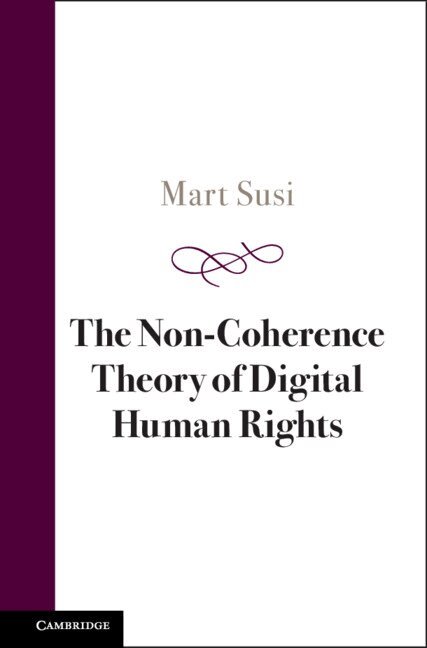
    The Non-Coherence Theory of Digital Human Rights

    AvMart Susi

    Inbunden, Engelska, 2024

    1 240 kr

    Beställningsvara. Skickas inom 10-15 vardagar. Fri frakt över 249 kr.

    Fler format och utgåvor

    Häftad

    377 kr

    Beskrivning

    Susi offers a novel non-coherence theory of digital human rights to explain the change in meaning and scope of human rights rules, principles, ideas and concepts, and the interrelationships and related actors, when moving from the physical domain into the online domain. The transposition into the digital reality can alter the meaning of well-established offline human rights to a wider or narrower extent, impacting core concepts such as transparency, legal certainty and foreseeability. Susi analyses the 'loss in transposition' of some core features of the rights to privacy and freedom of expression. The non-coherence theory is used to explore key human rights theoretical concepts, such as the network society approach, the capabilities approach, transversality, and self-normativity, and it is also applied to e-state and artificial intelligence, challenging the idea of the sameness of rights. This title is part of the Flip it Open programme and may also be available Open Access. Check our website Cambridge Core for details.

    Produktinformation

    • Utgivningsdatum:2024-02-29
    • Mått:152 x 229 x 21 mm
    • Vikt:622 g
    • Format:Inbunden
    • Språk:Engelska
    • Antal sidor:340
    • Förlag:Cambridge University Press
    • ISBN:9781009407700

    Utforska kategorier

    • Folkrätt inom Juridik
    • Juridisk teknik inom Juridik
    • IT-rätt och kommunikationsrätt inom Juridik

    Mer om författaren

    Mart Susi is Professor of Human Rights Law at the School of Governance, Law and Society, Tallinn University. He has initiated several academic networks and projects involving above 100 academics from around the world and is Chair of Global Digital Human Rights Network.

    Innehållsförteckning

    • Introduction: the distorted image; Part I. The Contextual Challenges and Purpose of The Non-Coherence Theory of Digital Human Rights: 1. Horizontal and vertical governance models and normativity; 2. The ontological dimension-reflections on distorted images and normative fragmentation; 3. The epistemic dimension-rhetoric by and recognition of multiple actors; 4. On the controversy about the relative weight of rights; 5. Constitutional entitlements to human rights in the digital domain; Part II. Reflections On Some Theories and Doctrines: 6. The doctrine of the sameness of rights online and offline; 7. Claims of new internet-specific human rights; 8. The capabilities approach; 9. The frankfurt school and normative order of the internet; 10. The articulation and critical review of self-normativity; 11. The transversality principle (Teubner); 12. Network society approach (Castells); Part III. The Core Elements of The Non-Coherence Theory: 13. Doctrinal changes in scope and the meaning of human; 14. The variance principle and digital transparency; 15. Legal certainty and uncertainty; 16. On foreseeability and non-foreseeability; 17. Reflections from the academic debate; Part IV. The Impact of The Non-Coherence Theory: 18. The e-state and fundamental rights; 19. Proportionality deficit paradox; 20. Automated systems and artificial intelligence; Part V. Internet Balancing Formula: 21. The Internet Balancing Formula; 22. Robert Alexy's views on the internet balancing formula; 23. Reply to Alexy critique; In lieu of the concluding remarks – the trailer for the monograph.