• Fri frakt över 249 kr
  • •
  • Snabba leveranser
  • •
  • Billiga böcker
Kundservice

Du är på sajten för privatpersoner.

Företag, bibliotek eller offentlig verksamhet?

Du handlar på classic.bokus.com, där alla dina funktioner finns intakta.
Till classic.bokus.com
Bokus logotyp. Gå till startsidan.
  • Erbjudanden
  • Student
  • Topplistor
  • Barn & ungdom
  • Bokus Play
  • E-böcker
  • Ljudböcker
  • Pocketböcker
  • Spel och pussel

Pocketfynda! Hundratals böcker för 49 kr/st →

Sidfot

Mina sidor

    Hjälp

    • Kundservice
    • Vanliga frågor och svar
    • Frakt och leverans
    • Retur vid ångerrätt
    • Reklamera vara
    • Betalning
    • Köpvillkor
    • Allmänna villkor
    • Information om webbplatsens tillgänglighet

    Om Bokus

    • Om oss
    • Pressrum
    • För studenter
    • För företag
    • För bibliotek och offentlig verksamhet
    • För leverantörer
    • Hållbarhet

    Populärt

    • Aktuella erbjudanden
    • Presentkort
    • Studentlitteratur
    • Nya böcker
    • Topplistor
    • Signerade böcker
    • Engelska böcker

    Inspiration

    • Boktips
    • BookTok
    • Barnbokskaraktärer
    • Populära författare
    Logotyp för Bokus
    Följ oss på Facebook (extern länk)Följ oss på Instagram (extern länk)Följ oss på YouTube (extern länk)Följ oss på TikTok (extern länk)
    bokus @ CookiesAnpassa cookiesIntegritetspolicyKöpvillkor
    Till Citymail hemsida (extern länk)Till Budbee hemsida (extern länk)Till Postnord hemsida (extern länk)Till Schenker hemsida (extern länk)Till Early Bird hemsida (extern länk)Till Walleys hemsida (extern länk)
    1. Samhälle och politik
    2. Samhälle och kultur
    3. Sociala och etiska frågor
    4. Våld och övergrepp

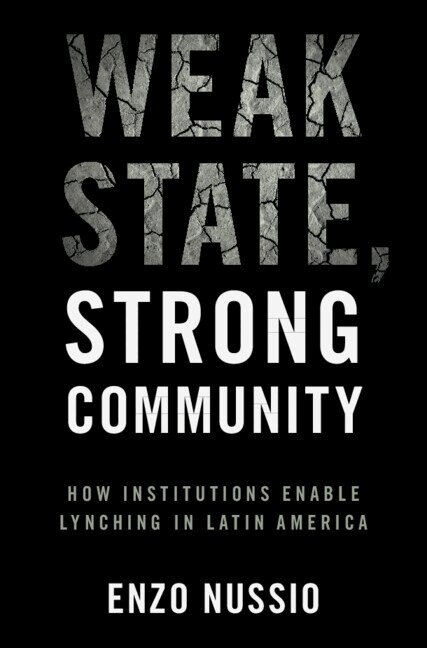
    Weak State, Strong Community

    How Institutions Enable Lynching in Latin America

    AvEnzo Nussio

    Häftad, Engelska, 2026

    366 kr

    Kommande

    Fler format och utgåvor

    Inbunden

    Kommande

    Beskrivning

    How do institutions enable violence? Weak State, Strong Community advances a new theory of violence that moves beyond state-centric approaches, arguing that the forms of violence we observe depend on who rules locally. Variation in state capacity and legitimacy, as well as in community ties and values, produces distinct patterns of violence across contexts. The book examines these dynamics through lynching, a globally prevalent form of punishment violence that provides a window into community rule - contexts where states are weak and communities are strong. Drawing on cross-national data, case studies, and surveys in Latin America, the book shows how these institutional contexts enable lynching events and motivate individuals to participate in such violence. In doing so, it highlights a moral paradox: In their quest for justice, the perpetrators of lynchings themselves commit an injustice. This title is also available as open access on Cambridge Core.

    Produktinformation

    • Utgivningsdatum:2026-09-30
    • Format:Häftad
    • Språk:Engelska
    • Antal sidor:300
    • Förlag:Cambridge University Press
    • ISBN:9781009856645

    Utforska kategorier

    • Våld och övergrepp inom Samhälle och politik
    • Politik och statsskick inom Samhälle och politik

    Mer om författaren

    Enzo Nussio is a research professor at the University of Zurich. He has published widely on conflict, terrorism, and lynching, often focusing on Latin America where he worked for many years.

    Recensioner i media

    'Since at least the writings of Thomas Hobbes scholars have been trying to understand the circumstances in which social order arises. This profound book uses lynchings as a lens to advance a new explanation based on the relative strength of community and state. A tour de force on one of the most central topics in social theory.' James A. Robinson, author of Why Nations Fail and recipient of the Nobel Memorial Prize in Economic Sciences

    Innehållsförteckning

    • 1. Introduction; Part I. Theory: 2. The state-community theory of violence; 3. The concept of lynching; 4. The mechanisms linking community rule to lynching; Part II. Empirics; 5. Cases of lynching under community rule; 6. Number of lynchings and community rule; 7. Participation in lynching and community rule; 8. Conclusions.