• Fri frakt över 249 kr
  • •
  • Snabba leveranser
  • •
  • Billiga böcker
Kundservice

Du är på sajten för privatpersoner.

Företag, bibliotek eller offentlig verksamhet?

Du handlar på classic.bokus.com, där alla dina funktioner finns intakta.
Till classic.bokus.com
Bokus logotyp. Gå till startsidan.
  • Erbjudanden
  • Nyheter
  • Student
  • Topplistor
  • Barn & ungdom
  • Bokus Play
  • E-böcker
  • Pocketböcker
  • Spel & pussel

10% rabatt på allt med kod: NYSTART10 →

Sidfot

Mina sidor

    Hjälp

    • Kundservice
    • Vanliga frågor och svar
    • Frakt och leverans
    • Retur vid ångerrätt
    • Reklamera vara
    • Betalning
    • Köpvillkor
    • Allmänna villkor
    • Information om webbplatsens tillgänglighet

    Om Bokus

    • Om oss
    • Pressrum
    • För studenter
    • För företag
    • För bibliotek och offentlig verksamhet
    • För leverantörer
    • Hållbarhet

    Populärt

    • Aktuella erbjudanden
    • Presentkort
    • Studentlitteratur
    • Nya böcker
    • Topplistor
    • Signerade böcker
    • Engelska böcker

    Inspiration

    • Boktips
    • BookTok
    • Populära bokserier
    • Barnbokskaraktärer
    • Populära författare
    Logotyp för Bokus
    Följ oss på Facebook (extern länk)Följ oss på Instagram (extern länk)Följ oss på YouTube (extern länk)Följ oss på TikTok (extern länk)
    bokus @ CookiesAnpassa cookiesIntegritetspolicyKöpvillkor
    Till Citymail hemsida (extern länk)Till Budbee hemsida (extern länk)Till Postnord hemsida (extern länk)Till Schenker hemsida (extern länk)Till Early Bird hemsida (extern länk)Till Walleys hemsida (extern länk)
    1. Naturvetenskap och teknik
    2. Geovetenskap
    3. Miljövetenskap och miljöpolitik

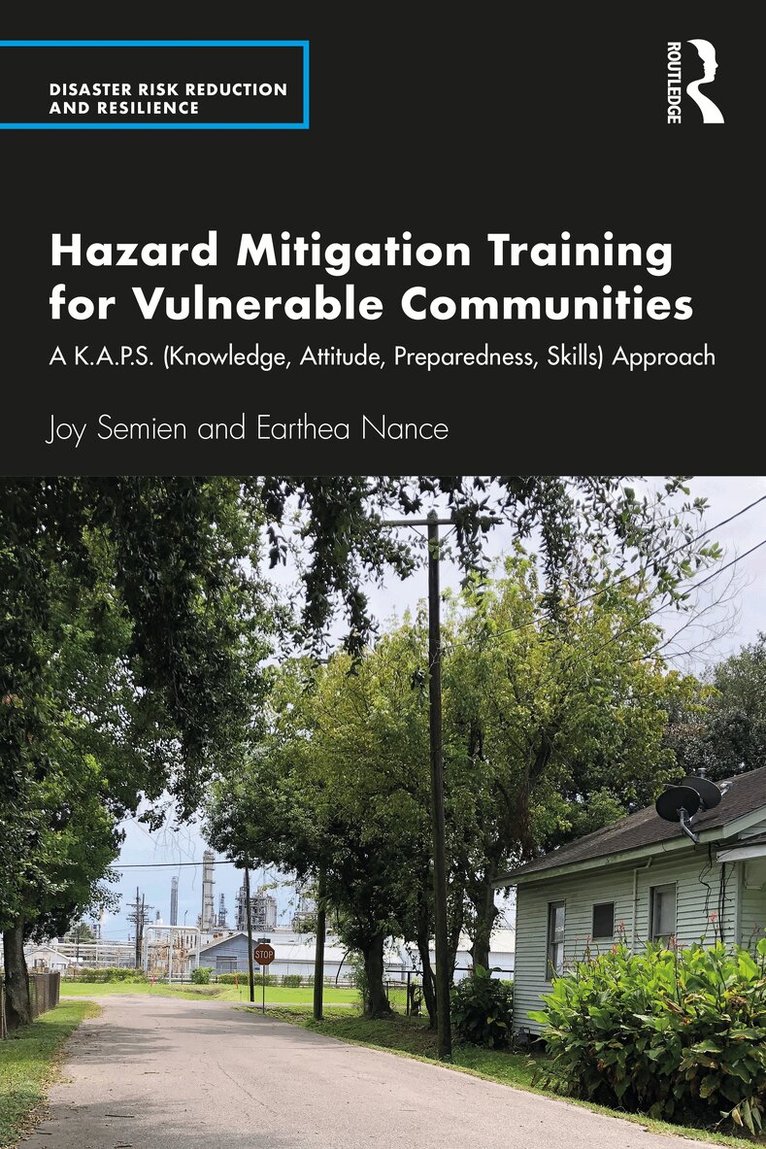
    Hazard Mitigation Training for Vulnerable Communities

    A K.A.P.S. (Knowledge, Attitude, Preparedness, Skills) Approach

    AvJoy Semien,Earthea Nance

    Inbunden, Engelska, 2022

    Del i serien Disaster Risk Reduction and Resilience

    2 421 kr

    Beställningsvara. Skickas inom 10-15 vardagar. Fri frakt över 249 kr.

    Fler format och utgåvor

    Häftad

    540 kr

    Beskrivning

    This book is designed to educate vulnerable communities, emergency practitioners, and disaster researchers to increase the social and physical capacity of communities to mitigate and adapt to disaster impacts. With climate change escalating the intensity and range of disasters, we have entered an unprecedented time. The tools in this book allow researchers, practitioners, and community leaders to adopt new training techniques that are more engaging and effective, using a bottom-up framework to integrate knowledge, attitude, preparedness, and skills (K.A.P.S).This book is uniquely designed to support instructors, researchers, practitioners, and community leaders in their effort to promote preparedness across marginalized communities. The book contains a full range of templates, worksheets, survey questions, background information, and guidance for carrying out training; the material has been field-validated to meet research standards.The K.A.P.S. Framework outlined throughout the book is designed to serve as an adaptable model that national and international audiences can utilize to better prepare their communities for disasters due to hurricanes, floods, and tornadoes. As climate change continues to ravage communities, the K.A.P.S. training program will prove to be an important tool for community trainers and academics across a range of hazards and disasters.

    Produktinformation

    • Utgivningsdatum:2022-05-24
    • Mått:174 x 246 x 15 mm
    • Vikt:517 g
    • Format:Inbunden
    • Språk:Engelska
    • Serie:Disaster Risk Reduction and Resilience
    • Antal sidor:176
    • Förlag:Taylor & Francis Ltd
    • ISBN:9781032010717

    Utforska kategorier

    • Miljövetenskap och miljöpolitik inom Naturvetenskap och teknik
    • Socialt arbete och välfärd inom Samhälle och politik

    Mer om författaren

    Joy Semien is an interdisciplinary multi-hazard research scientist and community capacity builder. She holds a BSc in Biology from Dillard University and an MSc in Urban Planning and Environmental Policy from Texas Southern University, where she created the K.A.P.S. Framework to train high-risk communities. Joy works as a research assistant for the Hazard Reduction and Recovery Center at Texas A&M University where she is completing her doctoral degree in Urban and Regional Sciences. She has centered her doctoral research on examining the immediate impact and short-term recovery of small businesses and nonprofits that have experienced compounded events.Joy's research interest focuses on developing methods to uniquely bridge systemic gaps across disciplines while exploring the intersectionality of hazards, race, and social justice. Ultimately, she seeks to turn research into action to increase marginalized, multi-hazard communities’ ability to prepare, respond, and recover from disasters.Earthea Nance is committed to working with vulnerable communities at disproportionate risk of disasters, pollution, and inadequate infrastructure. In December 2021, she was appointed by President Biden to serve as the Regional Administrator for the Environmental Protection Agency, Region 6. Dr. Nance previously served as a public official for the City of New Orleans after Hurricane Katrina, where she managed $60 million in flood mitigation funds and established the city’s first approved plans for hazard mitigation, sustainability, and green energy. As a scholar, Earthea developed and implemented disaster training programs and conducted community-based research on the impacts of major disasters in Gulf Coast communities and in communities without access to water and sanitation in Brazil and Mozambique. As an advocate, she brought community and equity perspectives into regional disaster policy in the Houston metro area. Earthea earned a PhD in Civil and Environmental Engineering from Stanford University, and MSc and BSc degrees from the University of California-Davis. She previously taught at Texas Southern University, the University of New Orleans, Massachusetts Institute of Technology, and Virginia Tech.

    Innehållsförteckning

    • Part I: Disasters and Communities1. Disaster Education as a Form of Community Capacity Building 2. Climate Resilience and Justice3. Social Construct of VulnerabilityPart II: The K.A.P.S. Model4. Applying the Knowledge and Attitudes in K.A.P.S.Applying the K (Knowledge) in K.A.P.S.Applying the A (Attitude) in K.A.P.S.How do we teach it?What do we teach?5. Applying the Preparedness and Skills in K.A.P.S.Applying the P (Preparedness) in K.A.P.S.Applying the S (Skills) in K.A.P.S.How do we teach it?What do we teach?Part III: Implementing K.A.P.S.6. Building A K.A.P.S. Community TrainingStep 1: Community ProfileStep 2: Stakeholder Recruitment Step 3: Requesting Fiscal SupportStep 4: Designing the K.A.P.S. Curriculum Step 5: Participant Recruitment 7. Implementing and Evaluating a K.A.P.S. Community Training Scheduling the WorkshopThe Size of the Workshop Obtaining Consent Risks and BenefitsWorkshop Flow Approaches to Evaluating K.A.P.S.Getting to Know the Data Preparing the DataAnalyzing the Data K.A.P.S. Disaster Preparedness Index for Researchers K.A.P.S. Disaster Preparedness Index for Practitioners and Community LeadersPresenting the Data for The K.A.P.S. Disaster Preparedness IndexEnsuring Reliability and Validity 8. Epilogue Appendix A: Lesson PlansAppendix B: Materials to Build a K.A.P.S. Community Training Appendix C: Material for Implementing and Evaluating a K.A.P.S. Community TrainingAppendix D: International/national Community Preparedness Resources