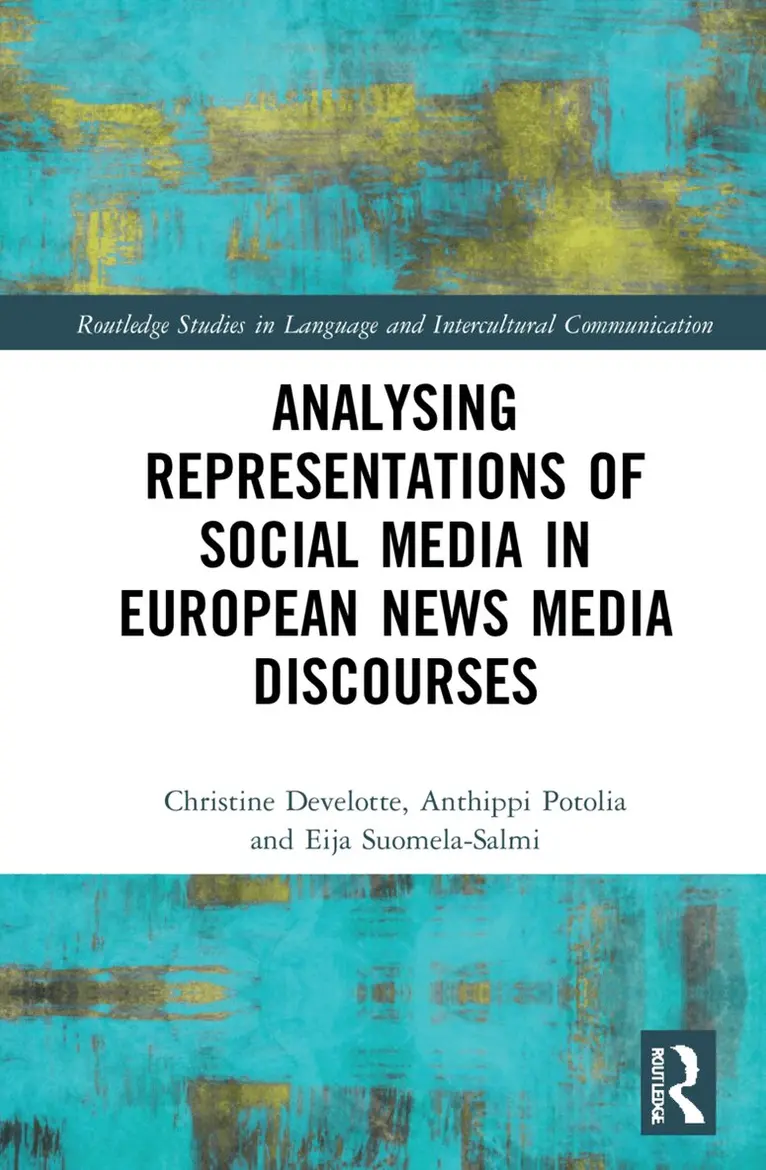
Analysing Representations of Social Media in European News Media Discourse
AvChristine Develotte,Anthippi Potolia
2 540 kr
Beställningsvara. Skickas inom 10-15 vardagar. Fri frakt över 249 kr.
Fler format och utgåvor
Beskrivning
Produktinformation
- Utgivningsdatum:2021-11-02
- Mått:152 x 229 x 21 mm
- Vikt:453 g
- Format:Inbunden
- Språk:Engelska
- Serie:Routledge Studies in Language and Intercultural Communication
- Antal sidor:296
- Förlag:Taylor & Francis Ltd
- ISBN:9781032023519
Utforska kategorier
Mer om författaren
Christine Develotte is Emerita Professor of Applied Linguistics (Lyon, France) and member of the ICAR Laboratory. Anthippi Potolia is Associate Professor of Applied Linguistics at the University of Paris 8 Vincennes – Saint-Denis. Eija Suomela-Salmi is Emerita Professor of French at the University of Turku, Finland.
Recensioner i media
Select Guide Rating
Innehållsförteckning
- General introduction1. Origins of the project2. The issue and the research question3. Related studies4. Study approach5. Presentation of the International Team and Outline of the Work6. Outline of the workPart 1: Theoretical framework and methodologyChapter 1: Discourse analyses and key research concepts 1. Insights in two analytical perspectives of discourses1.1. The French School of Discourse Analysis1.2. Critical Discourse Analysis vs. French Discourse Analysis2. Discursive construction of social reality2.1. Discursive exposure and construction of reality2.2. The communication scheme and transmission of information2.3. The notion of social representations: definition and characteristics2.4. The concept of Glocalisation3. The media discourse and its particularities3.1. Media discourse and interdiscursivity3.2. Discursive strategies: The "effects of facts" and the "effects of the real"3.3. The notion of didacticityChapter 2: Corpus and methodology1. The choice of the free daily newspaper Metro2. From the existent corpus to the reference corpus3. The particularities of the reference corpus4. The study corpus5. From macro-views… for an ecological approach to the methodological device6. To the micro-views… for the analysis of the data6.1. The semiotic markers6.2. Linguistic markersPart 2: Contextualisation of and macro level analysis of the object of studyChapter 3: The three editions of Metro and the editors’ perspective1. Metro newspapers in a nutshell1.1. Metro Helsinki1.2. Metro Athens1.3. Metro Paris2. The perspective of Metro editors2.1. Overall characteristics2.2. Readership in the three countries2.3. Metro in the local newspaper scene 2.4. News-making processes2.5. Editors’ views on social mediaConclusionsChapter 4: The emergence and evolution of a new discourse object (2007-2011)1. Facebook and Twitter in Metro Helsinki1.1. Corpus in figures: The big picture 1.2. Taking a closer look: Approaching the corpus through the headlines1.2.1. From Facebook to fb1.2.2. From tweets about news to tweets about celebrities1.3. Emergence and evolution: Facebook and Twitter in the articles of Metro Helsinki 1.3.1. Year 2007: Introducing Facebook – from an Internet curiosity to an extensive online community1.3.2. Year 2008: Facebook’s growing business and new ways of using social media1.3.3. Year 20091.3.3.1. Ever growing popularity tinged with criticism towards Facebook, Inc.1.3.3.2. Twitter’s popularity abroad and unpopularity in Finland1.3.4. Year 20101.3.4.1. Facebook: Columns, stars and threats1.3.4.2. Athletes join the celebrities on Twitter1.3.5. Year 20111.3.5.1. Facebook misuse: From teenagers to politicians 1.3.5.2. Twitter and the "evolution of social media"1.4. Specificities of the Finnish corpus1.4.1. Reader participation in the Finnish edition1.4.2. Editor’s views on changing media habits and the future of the pressConclusion2. Facebook and Twitter in Metro Paris2.1. Overview of quantitative data2.2. From quantitative to qualitative, starting with the titles2.2.1. From Failbook to Facebook’s success stroy2.2.2. Politics in the Age of Twitter – Lauren Bacall Would Tweet Too2.3. Facebook and Twitter in the body of the articles, year after year2.3.1. Year 2007: a timid start marked by paradox2.3.2. Year 2008: Facebook continues its quiet entry and Twitter appears2.3.3. Year 20092.3.3.1. Facebook, a media for mass mobilisation2.3.3.2. Twitter enters politics beginning in June2.3.4. Year 20102.3.4.1. Facebook: a medium for mass mobilisations that must be mastered 2.3.4.2. Twitter, a medium for celebrities2.3.5. Year 20112.3.5.1. Facebook, a medium for celebrities and politics 2.3.5.2. Twitter: birth of a feature, ‘Twittoscope’ a new political barometer2.4. Specificities of the French corpus2.4.1. Didactic discourse2.4.2. ‘Twittoscope’: a section unique to Metro ParisConclusion 3. Facebook and Twitter in Metro Athens3.1. Focus on the quantitative data3.2. From quantitative to qualitative: entry by titles3.2.1. Facebook: A multifunctional anthropomorphic space3.2.2. Twitter: Gossip, humor and addiction3.3. The subjects of "Facebook" and "Twitter" discourse in the body of the articles3.3.1. Year 2008: Facebook evidence 3.3.2. Year 2009 3.3.2.1. Facebook: capable of good and evil 3.3.2.2. Twitter: a dynamic entry into the lives of the stars3.3.3. Year 20103.3.3.1. Facebook: interact, share, take part3.3.3.2. Twitter: on the brink of the omnipresence of [famous] people, political news3.3.4. Year 20113.3.4.1. Facebook: towards admission to adulthood3.3.4.2. Twitter: gossiping, brawling, shouting, etc.3.4. Specificities of the Greek corpus3.4.1. Facebook TV3.4.2. The absence of mediation ConclusionPart 3: Social media representations in three different discursive spacesChapter 5: Networking: Social media and representations of professional life1. "Social media and working life" in the three editions of Metro: an overview1.1. Three national corpora in figures1.2. Different sub-themes2. Job search advice for readers2.1. Promoting advantages while acknowledging risks2.2. Instructions, warnings and encouragements: A didactic approach2.3. Who is advised? Who are the users?3. Model users and usages3.1. Police as user of social media – a legitimating discourse3.2. Creating opportunities and enabling individuals3.3. Dynamic male entrepreneurs as model users4. Wanted: Social media etiquette4.1. Confusion and confrontations4.2. E-reputation and the inevitable digital identityConclusionChapter 6: Social media and mass mobilisations1. Presentation of global corpus1.1. Different types of movements1.1.1. Social media and international mobilisations1.1.2. Social media and national political movements 1.1.3. Social media and celebratory movements1.2. Articles reflecting on the connection between social media and movements2. Social medias’ openness to the world2.1. Mass mobilisation via social networking sites: Ideas from abroad2.1.1. In France: a broad geographical spectrum, from Colombia to Russia2.1.2. For Greece, mobilisations come from Southern Europe2.1.3. In Finland: Echoes of Spain and northern countries (Canada, Norway, Russia) 2.2. Mass mobilisation via social media: ideas that spread to other countries3. Creating new forms of meeting in France and Finland3.1. France, the aperitif phenomenon3.2. In Finland: Many ideas, for the public good or for partying…3.3. … Combined with more classic demonstrations against political figures4. Excesses, regulation and recycling4.1. France: Progressively increasing intervention by law enforcement4.2. Finland: Encouraging citizen responsibility and regulation4.3. Co-opting movements in France: From the aperitif phenomenon to the sausage/red wine aperitif of the extreme right ConclusionChapter 7: Social media and the Arab Spring1. Presentation of the corpus from three countries 1.1. Number and publication dates of articles1.2. Newspaper sections, size and types2. Delving into the corpus through…2.1. … the titles2.1.1. Digital and social media in the titles2.1.2. Overview of the titles2.1.2.1. Finland: beyond revolution2.1.2.2. France: making a saga of the Arab Spring2.1.2.3. Greece: moving readers2.2. … the illustrations2.2.1. Finland: champions of the day after2.2.2. France: from didactic to pathos2.2.3. Greece: condemning intolerance3. Towards a granular analysis: the text body3.1. The Arab Spring as seen by… 3.1.1. … Finland3.1.2. … France3.1.3. … Greece3.2. Social media and the Arab Spring: roles, images, impact3.2.1. Finland: moderate mention made of social media3.2.2. France: combat repression, fight for freedom (of expression)3.2.3. Greece: post revolution takes pride of place3.3. Opinion articles: a special case3.3.1. Finland: emerging from its cocoon3.3.2. France: demand and inform3.3.3. Greece: anti-imperialism and singing the praises of youthConclusionGeneral conclusion1. Research questions and the main findings of the study2. Limitations of this study3. Free newspapers and social media as the year 2020 approaches4. Directions for future researchBibliographyAppendix A Metro Editors – Interview QuestionsAppendix B Titles with Keywords “Facebook” and “Twitter” in the Three National Corpora
Mer från samma författare
Analysing Representations of Social Media in European News Media Discourse
Eija Suomela-Salmi, Anthippi Potolia, Christine Develotte
746 kr
Analysing Representations of Social Media in European News Media Discourse
Eija Suomela-Salmi, Anthippi Potolia, Christine Develotte
768 kr
Interactions and Screens in Research and Education
Christine Develotte, Amélie Bouquain, Tatiana Codreanu
Häftad, 2023
132 kr
Mer från samma serie
Critical Turn in Language and Intercultural Communication Pedagogy
Maria Dasli, Adriana Raquel Díaz
Häftad, 2018
773 kr
Impact of Global English on Cultural Identities in the United Arab Emirates
Sarah Hopkyns
Inbunden, 2020
2 541 kr
Intercultural Challenges for the Reintegration of Displaced Professionals
Tony Johnstone Young, Sara Ganassin, Stefanie Schneider, Alina Schartner, Steve Walsh
Inbunden, 2022
2 467 kr
Language and Intercultural Communication in Tourism
Bal Krishna Sharma, Shuang Gao
Inbunden, 2021
2 467 kr
Teaching and Learning Second Language Pragmatics for Intercultural Understanding
Troy McConachy, Anthony J. Liddicoat
Inbunden, 2021
2 541 kr
Beyond Native-Speakerism
Stephanie Ann Houghton, Damian J. Rivers, Kayoko Hashimoto
Häftad, 2020
714 kr
Du kanske också är intresserad av
- 10% rabatt på allt
Analysing Representations of Social Media in European News Media Discourse
Christine Develotte, Anthippi Potolia, Eija Suomela-Salmi
Häftad, 2023
655 kr
Analysing Representations of Social Media in European News Media Discourse
Eija Suomela-Salmi, Anthippi Potolia, Christine Develotte
746 kr
Analysing Representations of Social Media in European News Media Discourse
Eija Suomela-Salmi, Anthippi Potolia, Christine Develotte
768 kr
New Approaches to Assessing Language and (Inter-)Cultural Competences in Higher Education / Nouvelles approches de l’évaluation des compétences langagières et (inter-)culturelles dans l’enseignement supérieur
Fred Dervin, Eija Suomela-Salmi
Inbunden, 2010
1 279 kr
Virtual Exchange for Intercultural Language Learning and Teaching
Martine Derivry-Plard, Anthippi Potolia
725 kr
Virtual Exchange for Intercultural Language Learning and Teaching
Anthippi Potolia, Martine Derivry-Plard
Inbunden, 2022
2 398 kr
Virtual Exchange for Intercultural Language Learning and Teaching
Martine Derivry-Plard, Anthippi Potolia
725 kr
Virtual Exchange for Intercultural Language Learning and Teaching
Anthippi Potolia, Martine Derivry-Plard
Häftad, 2024
618 kr