• Fri frakt över 249 kr
  • •
  • Snabba leveranser
  • •
  • Billiga böcker
Kundservice

Du är på sajten för privatpersoner.

Företag, bibliotek eller offentlig verksamhet?

Du handlar på classic.bokus.com, där alla dina funktioner finns intakta.
Till classic.bokus.com
Bokus logotyp. Gå till startsidan.
  • Erbjudanden
  • Nyheter
  • Student
  • Topplistor
  • Barn & ungdom
  • Bokus Play
  • E-böcker
  • Pocketböcker
  • Spel & pussel

Må bättre, för mindre! Upp till 50% rabatt på hälsoböcker

Sidfot

Mina sidor

    Hjälp

    • Kundservice
    • Vanliga frågor och svar
    • Frakt och leverans
    • Retur vid ångerrätt
    • Reklamera vara
    • Betalning
    • Köpvillkor
    • Allmänna villkor
    • Information om webbplatsens tillgänglighet

    Om Bokus

    • Om oss
    • Pressrum
    • För studenter
    • För företag
    • För bibliotek och offentlig verksamhet
    • För leverantörer
    • Hållbarhet

    Populärt

    • Aktuella erbjudanden
    • Presentkort
    • Studentlitteratur
    • Nya böcker
    • Topplistor
    • Signerade böcker
    • Engelska böcker

    Inspiration

    • Boktips
    • BookTok
    • Populära bokserier
    • Barnbokskaraktärer
    • Populära författare
    Logotyp för Bokus
    Följ oss på Facebook (extern länk)Följ oss på Instagram (extern länk)Följ oss på YouTube (extern länk)Följ oss på TikTok (extern länk)
    bokus @ CookiesAnpassa cookiesIntegritetspolicyKöpvillkor
    Till Citymail hemsida (extern länk)Till Budbee hemsida (extern länk)Till Postnord hemsida (extern länk)Till Schenker hemsida (extern länk)Till Early Bird hemsida (extern länk)Till Walleys hemsida (extern länk)
    1. Kultur
    2. Arkitektur

    Routledge Companion to Ecological Design Thinking

    Healthful Ecotopian Visions for Architecture and Urbanism

    AvMitra Kanaani

    Häftad, Engelska, 2024

    719 kr

    Beställningsvara. Skickas inom 10-15 vardagar. Fri frakt över 249 kr.

    Beskrivning

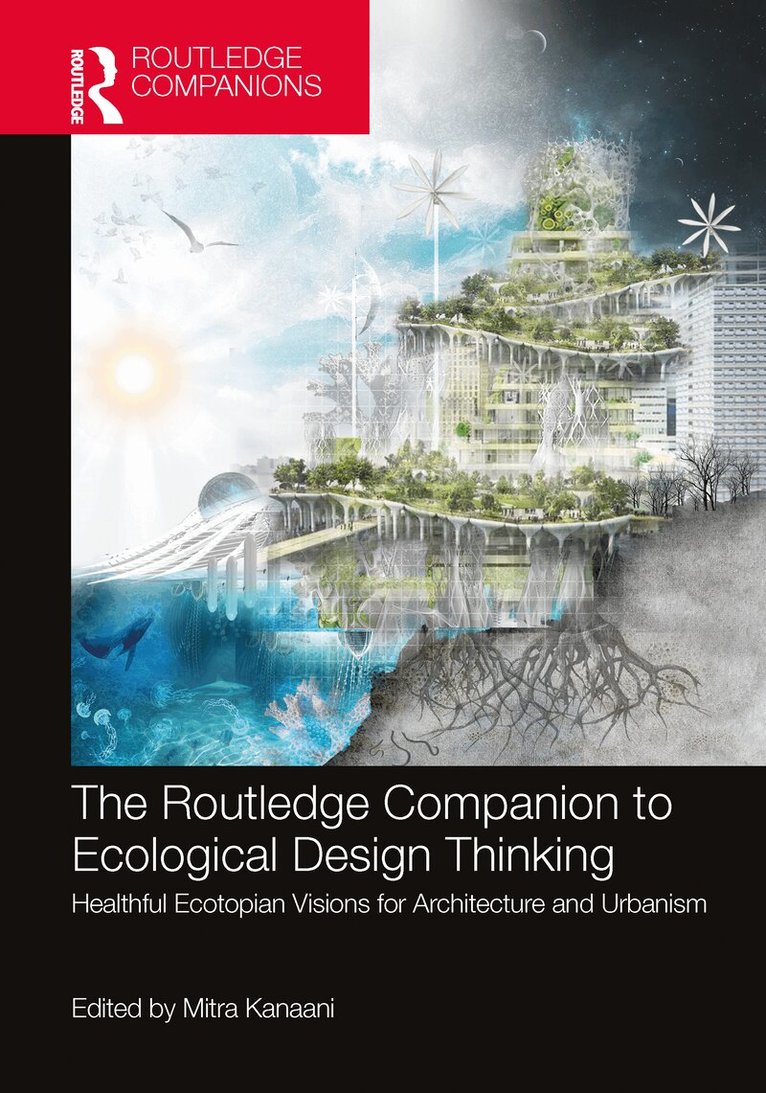
    This companion investigates the ways in which designers, architects, and planners address ecology through the built environment by integrating ecological ideas and ecological thinking into discussions of urbanism, society, culture, and design.Exploring the innovation of materials, habitats, landscapes, and infrastructures, it furthers novel ecotopian ideas and ways of living, including human-made settings on water, in outer space, and in extreme environments and climatic conditions. Chapters of this extensive collection on ecotopian design are grouped under five different ecological perspectives: design manifestos and ecological theories, anthropocentric transformative design concepts, design connectivity, climatic design, and social design. Contributors provide plausible, sustainable design ideas that promote resiliency, health, and well-being for all living things, while taking our changing lifestyles into consideration. This volume encourages creative thinking in the face of ongoing environmental damage, with a view to making design decisions in the interest of the planet and its inhabitants.With contributions from over 79 expert practitioners, educators, scientists, researchers, and theoreticians, as well as planners, architects, and engineers from the U.S., Canada, Europe, and Asia, this book engages theory, history, technology, engineering, and science, as well as the human aspects of ecotopian design thinking and its implications for the outlook of the planet.

    Produktinformation

    • Utgivningsdatum:2024-05-27
    • Mått:178 x 254 x 39 mm
    • Vikt:1 240 g
    • Format:Häftad
    • Språk:Engelska
    • Antal sidor:676
    • Förlag:Taylor & Francis Ltd
    • ISBN:9781032023908

    Utforska kategorier

    • Arkitektur inom Kultur
    • Arkitekturhistoria inom Kultur
    • Landskapsarkitektur inom Kultur

    Mer om författaren

    Mitra Kanaani is a Distinguished Professor of ACSA (DPACSA), and recipient of numerous education awards. She is a Fellow of American Institute of Architects (FAIA). Mitra has a D. Arch degree with a focus in Design Performativity, and an M. Arch degree in Architecture with a minor in structural engineering. She also holds a Master of City Planning, and a BS in Economics and BA in Musicology. She is a researcher, author, editor, architect, and activist for Education Is Not a Crime, and an appointed member of the State Architect Board of California.

    Innehållsförteckning

    • Preface by Mitra KanaaniIntroduction by Gisela LoehleinForeword by Keith PezzoliPrologue by Saskia SassenEcological Perspective Domain One: Design Manifestos and Theories in Ecological Domains - Symbiotic Trajectories Between Ecological Organisms and Creative Design Thinking: Critical Design Idealisms on Ecotopian Design Trajectories in Bio-Socio-Techno Integrative Processes1.1 Designs for a Rapidly Transforming Human Culture Thomas Fisher 1.2 Design with Nature Reconsidered: Then, Now, and Later George Dodds and Christina Leigh Geros 1.3 Ecological Prototypes for Green Construction: Linking Architecture and Ecological Engineering for Integrated Urban, Agricultural, and Ecological Land Use Defne Sunguroglu Hensel 1.4 From Evo-Devo Strategies to a Way Forward with Eco-social Evo-Devo for Generative Design Processes: Toward Extending the Polymorphism of Metabolic Architecture and the Integration of Diversities Sean Ahlquist 1.5 Digitalism in Morphogenetic Practices for Human Centric Design Thinking – Towards an Eco Animated Performative Gestalt Through Parametricism Robert R. Neumayr1.6 Systems of Systems: Architectural Atmosphere, Neuromorphic Architecture, and the Well-Being of Humans and Ecospheres Michael Arbib, Meredith Banasiak and Luis Othón Villegas Solís 1.7 Architecture Design in the Age of Artificial Intelligence: The Latent Ontology of Architectural Features Matias del Campo and Sandra Manninger 1.8 Spatial Entities of the Future: Design Through the Lens of Neuroscience Kate Jeffery and Fiona ZischEcological Perspective Domain Two: Anthropocentric Transformative Design Concepts - Anthropocentric Non-Utilitarian Economics of Wellbeing and Resilience: Habitat, Community, Human Settlements, Movement, Transportation, and Diaspora, as Socio-Organisms for Livability2.1 Ecological Urbanism for Health, Well-being, and Inclusivity: Engaging— Culture, Consciousness, and NatureFrederick Steiner 2.2 Dimensions of Urban Infill for Cities in the Global South: The Case of Rio de Janeiro, Brazil.Denise de Alcantara and Vicente del Rio2.3 Design of the Future Neighborhood – Neighborhoods Back to the Future - In Resolving the Housing Crisis and AffordabilityFrank Wolden, Michael Stepner and Mary Lydon2.4 Urban Heat Mitigation: Current and Future TrendsPoorang Piroozfar and Eric Farr2.5 Sustainability Within a Market-Based Ecological OrderPatrik Schumacher 2.6 Future of Urban Design Through Generative Design Tools: New Data Sources and Analysis Practices in Urban Mobility and Environmental Studies Gustavo Romanillos and Maider LLaguno-Munitxa2.7 Green Urban Futures: Regreening Cities to Enhance Health, Resilience, and the Urban MicroclimateSteffen Lehmann2.8. Urban Design in Search for Equilibrium: The Evolving Urban Metabolism of Sustainable Cities - Towards an Ethical and Sustainable Approach to City BuildingHoward M. Blackson IIIEcological Perspective Domain Three: The Design Connectivity Domain - Design Hybridity and Performativity in Non-Utilitarian/Utilitarianist Approaches and Views Toward Eco-Centric Environmental Behavior Transactions: Materiality, Biodiversity, Biomimetics, Energy Resiliency, and the Role of Technology3.1 Design Resiliency, Curbing Climate Change and Temporal Trajectories for the AnthropoceneMeredith Sattler 3.2 Biomorphic Intelligence: Deploying Biotechnology in Architecture for Human Health and WellbeingClaudia Pasquero and Marco Poletto 3.3 Material Ecology 1 -- Four Ecologies of Engineered Living Materials Research Martyn Dade-Robertson and Meng Zhang3.4 Material Ecology 2 -- Optimization of Daylighting Performance and Solar Heat Gain Through Adaptive Kinetic EnvelopesMoon Young Jeong, Maria Matheou, and L. Blandini3.5 Environment-Aware Behavioral Envelopes: Design Ecologies, Adaptive Geometries, and Technologies for Climate InteractionKathy Velikov and Geoffery Thün 3.6 Material Ecology 3 - Smart MaterialsEssay One: Smart Materials for Thermo-Responsive Architectural ApplicationsYomna El-Ghazi, Neveen Hamza, and Martyn Dade-Robertson3.6 Material Ecology 3 - Smart MaterialsEssay Two: Towards Passively Responsive Biomimetic ArchitectureArtem Holstov, Ben Bridgens and Graham Farmer3.6 Material Ecology 3 - Smart MaterialsEssay Three: Macro Affects from Nano Assemblies in Bacteria-Based HygromophsEmily Birch, Martyn Dade-Robertson, Ben Bridgens, and Meng Zhang3.7 Visionary Engineered Biotopes in Bringing Nature to High Levels: Towards Bioclimatic Skyscrapers – Achieving High-Comfort Low-Energy Sustainable Tall Buildings in Different Climate ZonesBrian Cody3.8 Robots in the Room, Robots Are the Room: The Future of Robotics, Architectural Design, and Domestic Routine Keith Evan Green3.9. Sublimating Tectonics of Architecture: Innovations in Creative Structural Engineering Christiane Margareta Herr3.10 Enabling Circular Economy in the AEC industry through DigitalizationEric FARR and Poorang Piroozfar3.11 Ecotopian Visions for the Purification and Healing of Ailing Ecologies Impacted by the AnthropoceneMelanie P. Hahn and Mitra Kanaani3.12 Architectural Computing and Design Optimization for Healthful Ecotopian Built environments?Yana Boeva, Thomas Wortmann, Cordula Kropp, and Achim Menges 3.13 Holocene to Anthropocene, Architectural Practice, Biomimetics in the Built Environment—Innovation in Architectural Firms PracticesAndrew Whalley Ecological Perspective Domain Four: The Climatic Design Domain - Methodologists' Epistemological Views of Ecological Design: Ecosystem Climatic Organisms and Actions; Utilizing Elements of Water, Air/Space, and Soil/Land as Concepts, Opportunities, and Challenges for Design Thinking4.1 Innovative Design Solutions for Climatic Challenges of Sea Level Rise -- Flooding & Ocean City Designs: Salty Urbanism: Towards an Adaptive Coastal Design Framework to Address Climate Change and Sea Level RiseJeffrey Huber4.2 Amphibious Buoyant Architecture – Designs for Living with Water: Floating FuturesŁukasz Piątek4.3 Design for Wildfire: Architecture as Catalyst for Virtuous not Vicious Wildfire ActivityMelissa Sterry4.4 Architecture that Bridges and Merges the Human-Made with NatureEssay One: Towards a Biometeorological Design - Architectures of the Planetary InvironmentKlaus K Loenhart4.4 Architecture that Bridges and Merges the Human-Made with NatureEssay Two: Groundscapes: The Merger of Architecture and EcologyFrederick Besancon4.5 Embedded Architectures: Charting its Traits of En Route to Architecture and Environment IntegrationMichael U. Hensel4.6 Climate-Friendly Green Infrastructure Planning and Design: The Promises, Vulnerabilities, and Remediation Design Practices for Environmental ContaminantsOliver Tiliouine and Keith Pezzoli4.7 Design for Air in the Urban Micro-Environments--How's the Air on Your Block? The Outdoor Environmental Inequality in CitiesMaider LLaguno-Munitxa 4.8 The Future of Architecture on Earth & in Space: Lessons & Synergies Essay One: The Evolution of Space Architecture & Its Potential to Inspire New Paradigms for Inhabiting Earth Elizabeth Song Lockard4.8 The Future of Architecture on Earth & in Space: Lessons & Synergies Essay Two: A Space Architecture Primer for 21st-Century Civil Architects and Future City EvolutionMadhu ThangaveluEcological Perspective Domain Five: The Social Design Domain - The Domain of Social Ecology in Using Design Tools: Equity, Diversity, Embodiment, Sustenance, Health, and Human Resiliency in Design Practices as Design Concepts5.1 Healthful Spatial Entities: The New Meaning of Healthful Measures for Building Occupants: Designers, Design, and Infection Control Dak Kopec and AnnaMarie Bliss5.2 Social Performativity in Transformative Building Typologies: Architecture’s Contribution to the Societal Well-BeingAngela Brooks 5.3 Socio-Material Capacities for Ecotopian Designs: Placing Architecture at the Nexus of Materiality, Neurodiversity, and Social Behavior--Shifting Design Agency to Activate Neuro-diversitySean Ahlquist5.4 Active Assisted Living Technology in the Context of the Built EnvironmentThomas Linner, Marc Schmailzl, Thomas Bock, Rongbo Hu, and Jörg Guttler5.5 Architectural Practice Exploring Scientific Eco-Centric Approaches for Healthful Anthropomorphic Environments -- Innovation in Architectural Practice and Research: A Design Research Philosophy of Practice Informing Sustainability, Health, and Well-BeingGensler Research - Steven Shinn 5.6 Therapeutic Spaces for Healthy Aging: Integrating Biophilic Design for Human and Environmental WellbeingTerri Peters and Ashita Parekh5.7 Biotic Jurisdictions: Transboundary Ecologies in the U.S.–Mexico BorderlandStephen Mueller and Ersela Kripa 5.8 Ecologically Performative Design Principles for Achieving Just Cities Theodore C. LandsmarkEpilogue: Architects, Artilects and Climate ChangeJim Dator