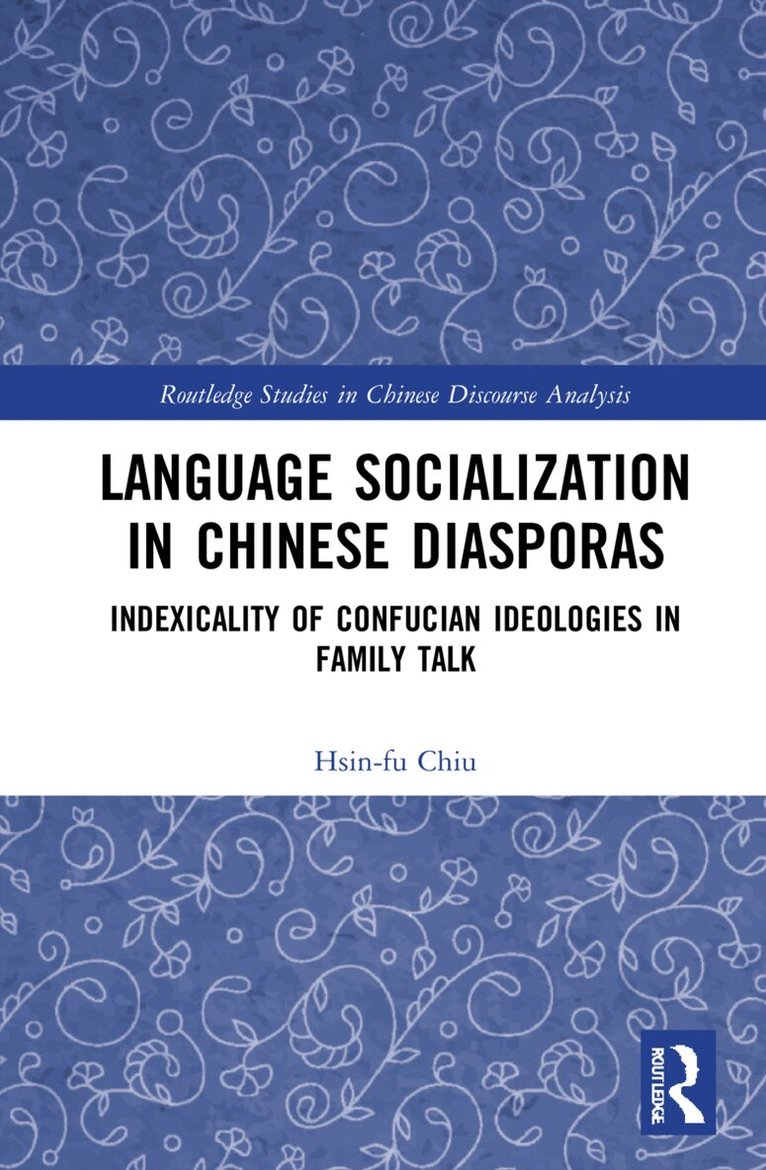
Language Socialization in Chinese Diasporas
Indexicality of Confucian Ideologies in Family Talk
2 476 kr
Beställningsvara. Skickas inom 10-15 vardagar. Fri frakt över 249 kr.
Du är på sajten för privatpersoner.
2 476 kr
Beställningsvara. Skickas inom 10-15 vardagar. Fri frakt över 249 kr.
Hsin-fu Chiu is Associate Professor of Chinese at the California State University, Los Angeles. Trained at the University of California, Los Angeles, Dr. Chiu is a conversation/discourse analyst, interactional sociolinguist, and linguistic anthropologist. For him, human sociality and cognitive processes do not exist within the individual, but rather across symbolically mediated interactions among members of a social group. To document trajectories of human development, Dr. Chiu employs a range of qualitative methods (including participation observation, sociolinguistic interviews, video-recording, and analysis of textual documents) and conducts his research on language socialization in Chinese diasporas and second/foreign language acquisition of Chinese in the classroom and beyond.
Firmly grounded in the methodologies of language socialization, conversation analysis, and Goffman’s approach to human interaction, Language Socialization in Chinese Diasporas masterfully analyzes two parenting logics used to socialize American-born children of Chinese immigrants; one is based on "authoritarian" Confucian ideology, and another is rooted in "authoritative" ideology, promoting individualistic family dynamics. In families where Confucian ideals of filial piety, obedience, and shame-oriented humility prevail, children are socialized to high interpersonal accountability to parents, as well as courses of affectionate action in the family. Care and compassion are closely integrated with structures of control. Examining classical interactional topics, such as directives in social interactions, Chiu shows how the lived and embodied practices through which families negotiate intimate social relationships are built on distinctive ethical orders. The book’s findings about the affordances of an authoritarian Confucian parental logic counters ideas about parenting ideologies prevalent in the US. With acute attention to multimodality, facing formations, and trajectories of action, Language Socialization in Chinese Diasporas provides an exemplary model for how to conduct ethnographic research closely integrating linguistic anthropology and conversation analysis. Marjorie Harness GoodwinDistinguished Research Professor of Anthropology, UCLAHsin-fu Chiu offers a rare piece of work that grounds language socialization and acculturation in ethnographically informed, multimodality-based microanalyses of everyday life activities of heritage adolescent Mandarin Chinese speakers in Southern California. This ambitious yet thoroughly empirical monograph covers a wide range of topics: how parenting styles reflect power and epistemic asymmetries and how cultural notions such as filial piety, obedience, humbleness, shame, self-esteem, harmony, kin relations, etc. manifest and are reinforced in and through the mundane activities that take place in three ethnic Chinese immigrant households and in various public spheres. Trained in conversation analysis and anthropological linguistics, Hsin-fu Chiu displays an array of skills in his painstaking analysis of the moment-by-moment unfolding of social interaction comprising multiple semiotic dimensions: lexico-grammar, prosody, visual and bodily behaviors, as well as materials in the interactional environment. This innovative book should be of great value to anyone who is interested in Chinese discourse analysis, anthropological linguistics, comparative education, heritage language development, and ethnic studies of Asian/Chinse immigrants in the US. Hongyin TaoProfessor of Chinese Language and Linguistics, University of California, Los Angeles
Lutgard Lams, Rui Zhang, Emma Lupano
Häftad, 2026
696 kr
Du är på sajten för privatpersoner.
2 476 kr
Beställningsvara. Skickas inom 10-15 vardagar. Fri frakt över 249 kr.
Hsin-fu Chiu is Associate Professor of Chinese at the California State University, Los Angeles. Trained at the University of California, Los Angeles, Dr. Chiu is a conversation/discourse analyst, interactional sociolinguist, and linguistic anthropologist. For him, human sociality and cognitive processes do not exist within the individual, but rather across symbolically mediated interactions among members of a social group. To document trajectories of human development, Dr. Chiu employs a range of qualitative methods (including participation observation, sociolinguistic interviews, video-recording, and analysis of textual documents) and conducts his research on language socialization in Chinese diasporas and second/foreign language acquisition of Chinese in the classroom and beyond.
Firmly grounded in the methodologies of language socialization, conversation analysis, and Goffman’s approach to human interaction, Language Socialization in Chinese Diasporas masterfully analyzes two parenting logics used to socialize American-born children of Chinese immigrants; one is based on "authoritarian" Confucian ideology, and another is rooted in "authoritative" ideology, promoting individualistic family dynamics. In families where Confucian ideals of filial piety, obedience, and shame-oriented humility prevail, children are socialized to high interpersonal accountability to parents, as well as courses of affectionate action in the family. Care and compassion are closely integrated with structures of control. Examining classical interactional topics, such as directives in social interactions, Chiu shows how the lived and embodied practices through which families negotiate intimate social relationships are built on distinctive ethical orders. The book’s findings about the affordances of an authoritarian Confucian parental logic counters ideas about parenting ideologies prevalent in the US. With acute attention to multimodality, facing formations, and trajectories of action, Language Socialization in Chinese Diasporas provides an exemplary model for how to conduct ethnographic research closely integrating linguistic anthropology and conversation analysis. Marjorie Harness GoodwinDistinguished Research Professor of Anthropology, UCLAHsin-fu Chiu offers a rare piece of work that grounds language socialization and acculturation in ethnographically informed, multimodality-based microanalyses of everyday life activities of heritage adolescent Mandarin Chinese speakers in Southern California. This ambitious yet thoroughly empirical monograph covers a wide range of topics: how parenting styles reflect power and epistemic asymmetries and how cultural notions such as filial piety, obedience, humbleness, shame, self-esteem, harmony, kin relations, etc. manifest and are reinforced in and through the mundane activities that take place in three ethnic Chinese immigrant households and in various public spheres. Trained in conversation analysis and anthropological linguistics, Hsin-fu Chiu displays an array of skills in his painstaking analysis of the moment-by-moment unfolding of social interaction comprising multiple semiotic dimensions: lexico-grammar, prosody, visual and bodily behaviors, as well as materials in the interactional environment. This innovative book should be of great value to anyone who is interested in Chinese discourse analysis, anthropological linguistics, comparative education, heritage language development, and ethnic studies of Asian/Chinse immigrants in the US. Hongyin TaoProfessor of Chinese Language and Linguistics, University of California, Los Angeles
Lutgard Lams, Rui Zhang, Emma Lupano
Häftad, 2026
696 kr