• Fri frakt över 249 kr
  • •
  • Snabba leveranser
  • •
  • Billiga böcker
Kundservice

Du är på sajten för privatpersoner.

Företag, bibliotek eller offentlig verksamhet?

Du handlar på classic.bokus.com, där alla dina funktioner finns intakta.
Till classic.bokus.com
Bokus logotyp. Gå till startsidan.
  • Erbjudanden
  • Nyheter
  • Student
  • Topplistor
  • Barn & ungdom
  • Bokus Play
  • E-böcker
  • Pocketböcker
  • Spel & pussel

10% rabatt på allt med kod: NYSTART10 →

Sidfot

Mina sidor

    Hjälp

    • Kundservice
    • Vanliga frågor och svar
    • Frakt och leverans
    • Retur vid ångerrätt
    • Reklamera vara
    • Betalning
    • Köpvillkor
    • Allmänna villkor
    • Information om webbplatsens tillgänglighet

    Om Bokus

    • Om oss
    • Pressrum
    • För studenter
    • För företag
    • För bibliotek och offentlig verksamhet
    • För leverantörer
    • Hållbarhet

    Populärt

    • Aktuella erbjudanden
    • Presentkort
    • Studentlitteratur
    • Nya böcker
    • Topplistor
    • Signerade böcker
    • Engelska böcker

    Inspiration

    • Boktips
    • BookTok
    • Populära bokserier
    • Barnbokskaraktärer
    • Populära författare
    Logotyp för Bokus
    Följ oss på Facebook (extern länk)Följ oss på Instagram (extern länk)Följ oss på YouTube (extern länk)Följ oss på TikTok (extern länk)
    bokus @ CookiesAnpassa cookiesIntegritetspolicyKöpvillkor
    Till Citymail hemsida (extern länk)Till Budbee hemsida (extern länk)Till Postnord hemsida (extern länk)Till Schenker hemsida (extern länk)Till Early Bird hemsida (extern länk)Till Walleys hemsida (extern länk)
    1. Data och IT
    2. Grafik och bildbehandling

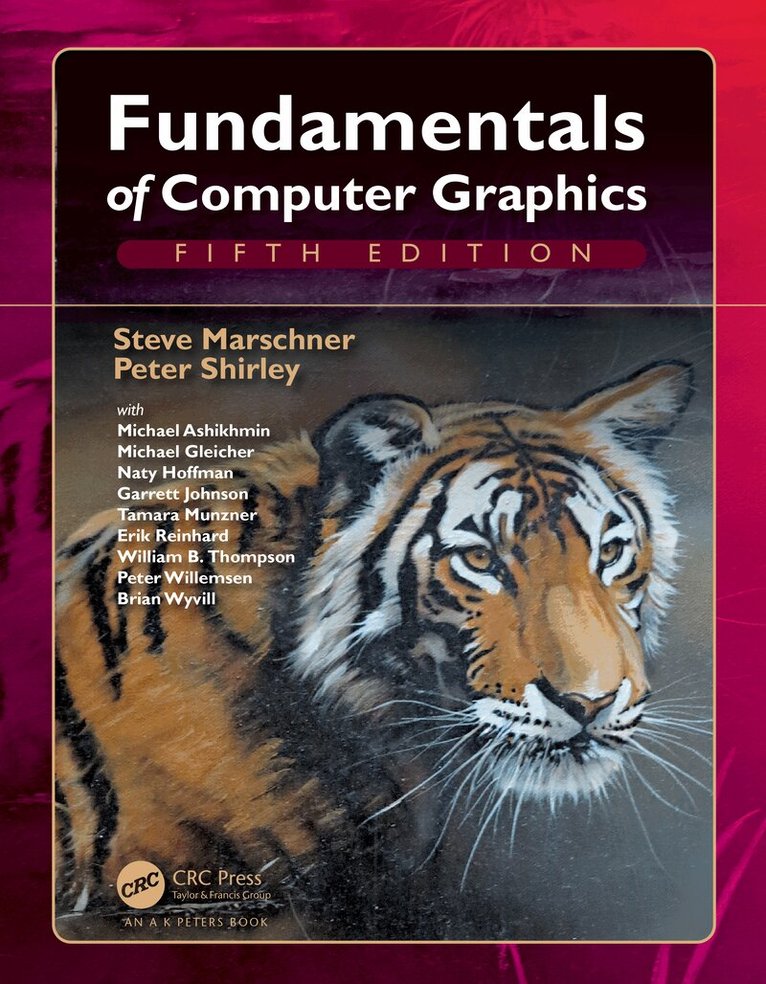
    Fundamentals of Computer Graphics

    AvSteve Marschner,Peter Shirley

    Häftad, Engelska, 2023

    860 kr

    Beställningsvara. Skickas inom 5-8 vardagar. Fri frakt över 249 kr.

    Fler format och utgåvor

    Häftad

    759 kr

    Beskrivning

    Drawing on an impressive roster of experts in the field, Fundamentals of Computer Graphics, Fifth Edition offers an ideal resource for computer course curricula as well as a user-friendly personal or professional reference.Focusing on geometric intuition, the book gives the necessary information for understanding how images get onto the screen by using the complementary approaches of ray tracing and rasterization. It covers topics common to an introductory course, such as sampling theory, texture mapping, spatial data structure, and splines. It also includes a number of contributed chapters from authors known for their expertise and clear way of explaining concepts.Highlights of the Fifth Edition Include:Major updates and improvements to numerous chapters, including shading, ray tracing, physics-based rendering, math and samplingUpdated coverage of existing topicsSeveral chapters have been absorbed and reworked to create a more natural flow to the bookThe fifth edition of Fundamentals of Computer Graphics continues to provide an outstanding and comprehensive introduction to basic computer graphic technology and theory. It retains an informal and intuitive style while improving precision, consistency, and completeness of material, allowing aspiring and experienced graphics programmers to better understand and apply foundational principles to the development of efficient code in animation, visual effects, games, visualization, advertising, and other applications

    Produktinformation

    • Utgivningsdatum:2023-03-14
    • Mått:236 x 35 x 192 mm
    • Vikt:1 852 g
    • Format:Häftad
    • Språk:Engelska
    • Antal sidor:700
    • Upplaga:5
    • Förlag:Taylor & Francis Ltd
    • ISBN:9781032122861

    Utforska kategorier

    • Grafik och bildbehandling inom Data och IT

    Mer om författaren

    Steve Marschner, Cornell University, Ithaca, New York, USAPeter Shirley, Purity LLC

    Innehållsförteckning

    • IntroductionGraphics AreasMajor ApplicationsGraphics APIsGraphics PipelineNumerical IssuesEfficiencyDesigning and Coding Graphics ProgramsMiscellaneous MathSets and MappingsSolving Quadratic EquationsTrigonometryVectorsCurves and SurfacesLinear InterpolationTrianglesRaster ImagesRaster DevicesImages, Pixels, and GeometryRGB ColorAlpha CompositingRay TracingThe Basic Ray-Tracing AlgorithmPerspectiveComputing Viewing RaysRay-Object IntersectionShadingA Ray-Tracing ProgramShadowsIdeal Specular ReflectionHistorical NotesSurface ShadingDiffuse ShadingPhong ShadingArtistic ShadingLinear AlgebraDeterminantsMatricesComputing with Matrices and DeterminantsEigenvalues and Matrix DiagonalizationTransformation Matrices2D Linear Transformations3D Linear TransformationsTranslation and Affine TransformationsInverses of Transformation MatricesCoordinate TransformationsViewingViewing TransformationsProjective TransformationsPerspective ProjectionSome Properties of the Perspective TransformField-of-ViewThe Graphics PipelineRasterizationOperations Before and After RasterizationSimple AntialiasingCulling Primitives for EfficiencySignal ProcessingDigital Audio: Sampling in 1DConvolutionConvolution FiltersSignal Processing for ImagesSampling TheoryTexture MappingLooking Up Texture ValuesTexture Coordinate FunctionsAntialiasing Texture LookupsApplications of Texture MappingProcedural 3D TexturesData Structures for GraphicsTriangle MeshesScene GraphsSpatial Data StructuresBSP Trees for VisibilityTiling Multidimensional ArraysSamplingIntegrationContinuous ProbabilityMonte Carlo IntegrationChoosing Random PointsPhysics-based RenderingPhotonsSmooth metalsSmooth dielectrics Dielectrics with subsurface scatteringA brute force photon tracerRadiometryRadiometry of ScatteringTransport EquationMaterials in practice Monte Carlo Ray Tracing CurvesCurvesCurve PropertiesPolynomial PiecesPutting Pieces TogetherCubicsApproximating CurvesSummaryComputer AnimationPrinciples of AnimationKeyframingDeformationsCharacter AnimationPhysics-Based AnimationProcedural TechniquesGroups of ObjectsUsing Graphics HardwareHardware OverviewWhat Is Graphics HardwareHeterogeneous MultiprocessingGraphics Hardware Programming: Buffers, State, and ShadersState MachineBasic OpenGL Application LayoutGeometryA First Look at ShadersVertex Buffer ObjectsVertex Array ObjectsTransformation MatricesShading with Per-Vertex AttributesShading in the Fragment ProcessorMeshes and InstancingTexture ObjectsObject-Oriented Design for Graphics Hardware ProgrammingContinued LearningColorColorimetryColor SpacesChromatic AdaptationColor AppearanceVisual PerceptionVision ScienceVisual SensitivitySpatial VisionObjects, Locations, and EventsPicture PerceptionTone ReproductionClassificationDynamic RangeColorImage FormationFrequency-Based OperatorsGradient-Domain OperatorsSpatial OperatorsDivisionSigmoidsOther ApproachesNight TonemappingDiscussionImplicit ModelingImplicit Functions, Skeletal Primitives, and Summation BlendingRenderingSpace PartitioningMore on BlendingConstructive Solid GeometryWarpingPrecise Contact ModelingThe Blob TreeInteractive Implicit Modeling SystemsComputer Graphics in GamesPlatformsLimited ResourcesOptimization TechniquesGame TypesThe Game Production ProcessVisualizationBackgroundData TypesHuman-Centered Design ProcessVisual Encoding PrinciplesInteraction PrinciplesComposite and Adjacent ViewsData ReductionExamples