• Fri frakt över 249 kr
  • •
  • Snabba leveranser
  • •
  • Billiga böcker
Kundservice

Du är på sajten för privatpersoner.

Företag, bibliotek eller offentlig verksamhet?

Du handlar på classic.bokus.com, där alla dina funktioner finns intakta.
Till classic.bokus.com
Bokus logotyp. Gå till startsidan.
  • Erbjudanden
  • Nyheter
  • Student
  • Topplistor
  • Barn & ungdom
  • Bokus Play
  • E-böcker
  • Pocketböcker
  • Spel & pussel

10% rabatt på allt med kod: NYSTART10 →

Sidfot

Mina sidor

    Hjälp

    • Kundservice
    • Vanliga frågor och svar
    • Frakt och leverans
    • Retur vid ångerrätt
    • Reklamera vara
    • Betalning
    • Köpvillkor
    • Allmänna villkor
    • Information om webbplatsens tillgänglighet

    Om Bokus

    • Om oss
    • Pressrum
    • För studenter
    • För företag
    • För bibliotek och offentlig verksamhet
    • För leverantörer
    • Hållbarhet

    Populärt

    • Aktuella erbjudanden
    • Presentkort
    • Studentlitteratur
    • Nya böcker
    • Topplistor
    • Signerade böcker
    • Engelska böcker

    Inspiration

    • Boktips
    • BookTok
    • Populära bokserier
    • Barnbokskaraktärer
    • Populära författare
    Logotyp för Bokus
    Följ oss på Facebook (extern länk)Följ oss på Instagram (extern länk)Följ oss på YouTube (extern länk)Följ oss på TikTok (extern länk)
    bokus @ CookiesAnpassa cookiesIntegritetspolicyKöpvillkor
    Till Citymail hemsida (extern länk)Till Budbee hemsida (extern länk)Till Postnord hemsida (extern länk)Till Schenker hemsida (extern länk)Till Early Bird hemsida (extern länk)Till Walleys hemsida (extern länk)
    1. Samhälle och politik
    2. Samhälle och kultur
    3. Kultur och medier
    4. Referensverk och tvärvetenskap

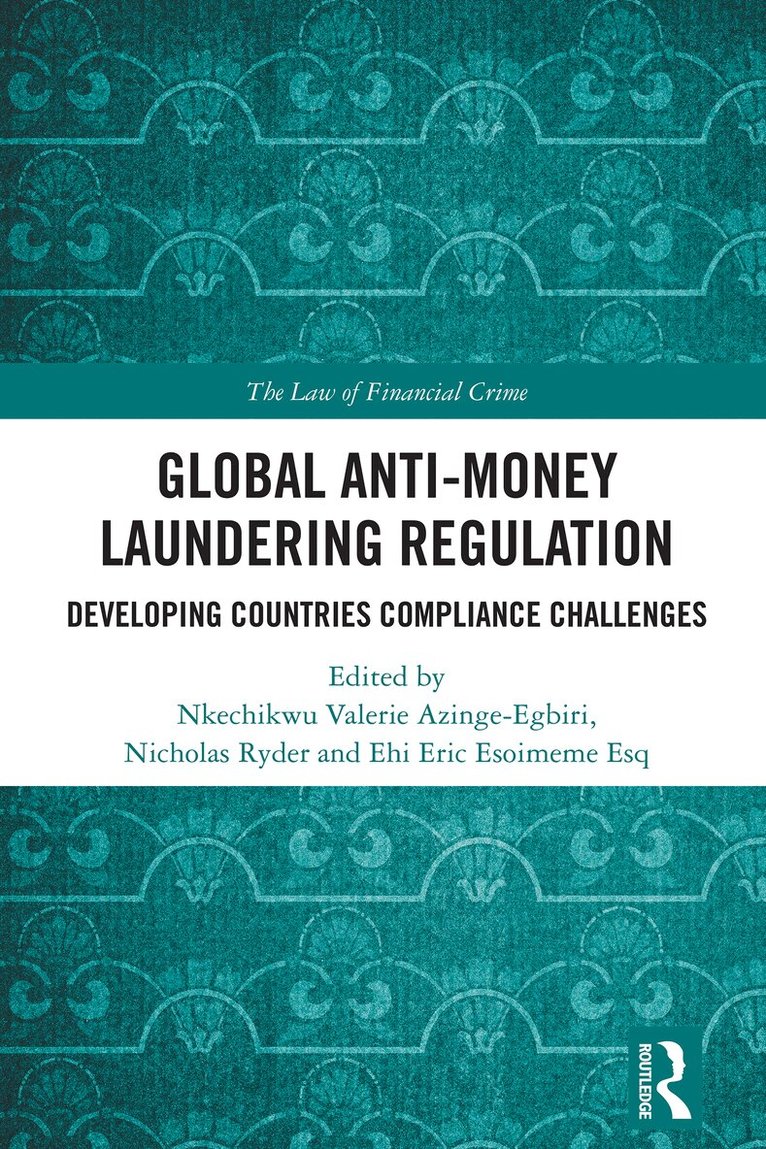
    Global Anti-Money Laundering Regulation

    Developing Countries Compliance Challenges

    AvNkechikwu Azinge-Egbiri,Nicholas Ryder

    Inbunden, Engelska, 2024

    Del i serien Law of Financial Crime

    2 227 kr

    Beställningsvara. Skickas inom 10-15 vardagar. Fri frakt över 249 kr.

    Beskrivning

    This book explores the politics of money laundering and terrorist financing (ML/TF) regulation in several countries across Africa and the Small Island States. Developed countries created the Financial Action Task Force (FATF) to combat ML/TF globally. Expectedly, the FATF’s standards mirror existing banking regulations within the G7 countries. Yet, the standards apply to all countries irrespective of the limited ML/TF risks they pose to the global economy, their weak pre-conditions for effective regulation and their non-involvement in the FATF’s framing. Still, such countries, mainly within the Global South, have worked hard to amplify their compliance with the regime due to fears of the repercussions of their non-compliance. This collection demonstrates how the global ML/TF regulation is treated as an implicitly superior legal regime where the Global South must comply irrespective of their perception of the FATF’s legitimacy challenges. It shows that beyond exogenous factors such as neo-colonialism, endogenous factors such as weak institutions and corruption undermine the compliance trajectory of the Global South. Furthermore, it analyses the unintended consequences of transplanting FATF standards into diverse legal and cultural contexts. The volume contributes to our understanding of the challenges of transplantation from the Global North and how the Global South is steering within the constraints created by the FATF. It advocates for a comprehensive understanding of the nuanced compliance challenges of developing countries. It further proposes practical solutions to address them, emphasizing the importance of risk-based understanding, accountability, capacity-building and coordination in achieving effective anti-money laundering and counter-terrorist financing measures. The collection will be essential reading for researchers, academics and policy-makers working in financial crime regulation and international economic law.

    Produktinformation

    • Utgivningsdatum:2024-11-25
    • Mått:156 x 234 x 23 mm
    • Vikt:770 g
    • Format:Inbunden
    • Språk:Engelska
    • Serie:Law of Financial Crime
    • Antal sidor:310
    • Förlag:Taylor & Francis Ltd
    • ISBN:9781032182889

    Utforska kategorier

    • Referensverk och tvärvetenskap inom Samhälle och politik
    • Finansrätt inom Juridik
    • Straffrätt: lagar inom Juridik

    Mer om författaren

    Nkechikwu Valerie Azinge-Egbiri is Lecturer in Business and Commercial Law at Lancaster University, England.Nicholas Ryder is Professor in Financial Crime at the School of Law and Politics, Cardiff University, UK.Ehi Eric Esoimeme Esq. is Professor of Business Law and Ethics at James Hope University, Lagos, Nigeria; Rudolph Kwanue University College, Liberia; and Kennedy University of Baptist, United States.

    Recensioner i media

    'The global anti-money laundering system (AML) was designed by rich countries for rich countries, and yet this same system has now been spread to almost every country in the world. How have countries in Africa and the developing world more generally coped with having to adopt AML policy designed for very different circumstances? Despite the fact that the majority of the world’s national AML systems now are in developing rather than developed countries, almost all the attention has been focused on Europe and North America. This volume is a long-overdue corrective to this fundamental bias in finally putting the AML experiences of developing countries at centre-stage. Both scholars and policy-makers need this book to properly understand how AML works, and often doesn’t work, as a genuinely global system.'Jason Sharman, Sir Patrick Sheehy Professor of International Relations, Department of Politics and International Studies, University of Cambridge'Corruption and money laundering constitute serious obstacles to the development of developing economies. International instruments do not adequately reflect the challenges that less economically developed countries experience in ensuring compliance with their provisions. This book is timely and very important to the understanding of the efforts and constraints of developing countries to combat corruption and money laundering and to also comply with international legal provisions and standards. There is a dearth of academic literature on most of the issues covered in many chapters of the book. The publication is a major contribution to the understanding of money laundering and challenges encountered in combatting them in less developed economies. The contents of the book offer significant insight and will enlighten policy-makers, law enforcement personnel, financial institutions and scholars, and highly recommended.'Etannibi E. Alemika, retired Professor of Criminology and Sociology of Law, University of Jos, Jos, Nigeria, and currently Adjunct Professor at the Faculty of Law, Humanities and Social Sciences, Walter Sisulu University, Mthatha, South Africa.

    Innehållsförteckning

    • 1. The Challenges of the Global Anti-Money Laundering and Counter-Terrorist Financing (AML/CFT) Regime for Developing Countries; 2. Uncovering Conflicts and Ambiguities In the International Anti-Money Laundering Regime Vis-à-vis African Countries; 3. GIABA: Combatting Money Laundering/Terrorism Financing in West Africa; 4. Do Things Fall Apart? (Black)listing and Its Implications for Developing Countries; 5. The mis-implementation of anti-money laundering laws and regulations: A high-level review with specific focus on the unilateral termination of customers’ bank accounts in South Africa; 6. Implications of Botswana’s Legal Culture in the Implementation of the AML/CFT Regime and Prosecution of Money Laundering/ Financial Crimes; 7. Barriers To Implementing New Technologies for AML/CFT Functions: The Case of Nigeria; 8. Challenges to AML Compliance Within Nigerian Financial Institutions; 0. The Challenge of Money Laundering by Nigeria PEPs: Beyond the Transplantation of FATF Standards; 10. The Vulnerability Of Politically Exposed Persons (PEPs) In Africa: Towards Transparency In Beneficial Ownership; 11. Can FATF’s Focus on Beneficial Ownership Aid Anti-Corruption Efforts in a ‘Low-Capacity’ Country? Challenges From the Front Line in Nigeria; 12. Suspect Wealth and the Compliance Willingness of Small States; 13. Combatting Terrorist Financing: A War Developing Countries Cannot Win?; 14. Asset recovery in developing countries: Assessing successes and failures and overcoming challenges; 15. Strategic Tools for Amplified AML/CFT Compliance in Developing Countries