• Fri frakt över 249 kr
  • •
  • Snabba leveranser
  • •
  • Billiga böcker
Kundservice

Du är på sajten för privatpersoner.

Företag, bibliotek eller offentlig verksamhet?

Du handlar på classic.bokus.com, där alla dina funktioner finns intakta.
Till classic.bokus.com
Bokus logotyp. Gå till startsidan.
  • Erbjudanden
  • Nyheter
  • Student
  • Topplistor
  • Barn & ungdom
  • Bokus Play
  • E-böcker
  • Pocketböcker
  • Spel & pussel

Må bättre, för mindre! Upp till 50% rabatt på hälsoböcker

Sidfot

Mina sidor

    Hjälp

    • Kundservice
    • Vanliga frågor och svar
    • Frakt och leverans
    • Retur vid ångerrätt
    • Reklamera vara
    • Betalning
    • Köpvillkor
    • Allmänna villkor
    • Information om webbplatsens tillgänglighet

    Om Bokus

    • Om oss
    • Pressrum
    • För studenter
    • För företag
    • För bibliotek och offentlig verksamhet
    • För leverantörer
    • Hållbarhet

    Populärt

    • Aktuella erbjudanden
    • Presentkort
    • Studentlitteratur
    • Nya böcker
    • Topplistor
    • Signerade böcker
    • Engelska böcker

    Inspiration

    • Boktips
    • BookTok
    • Populära bokserier
    • Barnbokskaraktärer
    • Populära författare
    Logotyp för Bokus
    Följ oss på Facebook (extern länk)Följ oss på Instagram (extern länk)Följ oss på YouTube (extern länk)Följ oss på TikTok (extern länk)
    bokus @ CookiesAnpassa cookiesIntegritetspolicyKöpvillkor
    Till Citymail hemsida (extern länk)Till Budbee hemsida (extern länk)Till Postnord hemsida (extern länk)Till Schenker hemsida (extern länk)Till Early Bird hemsida (extern länk)Till Walleys hemsida (extern länk)
    1. Skönlitteratur
    2. Poesi

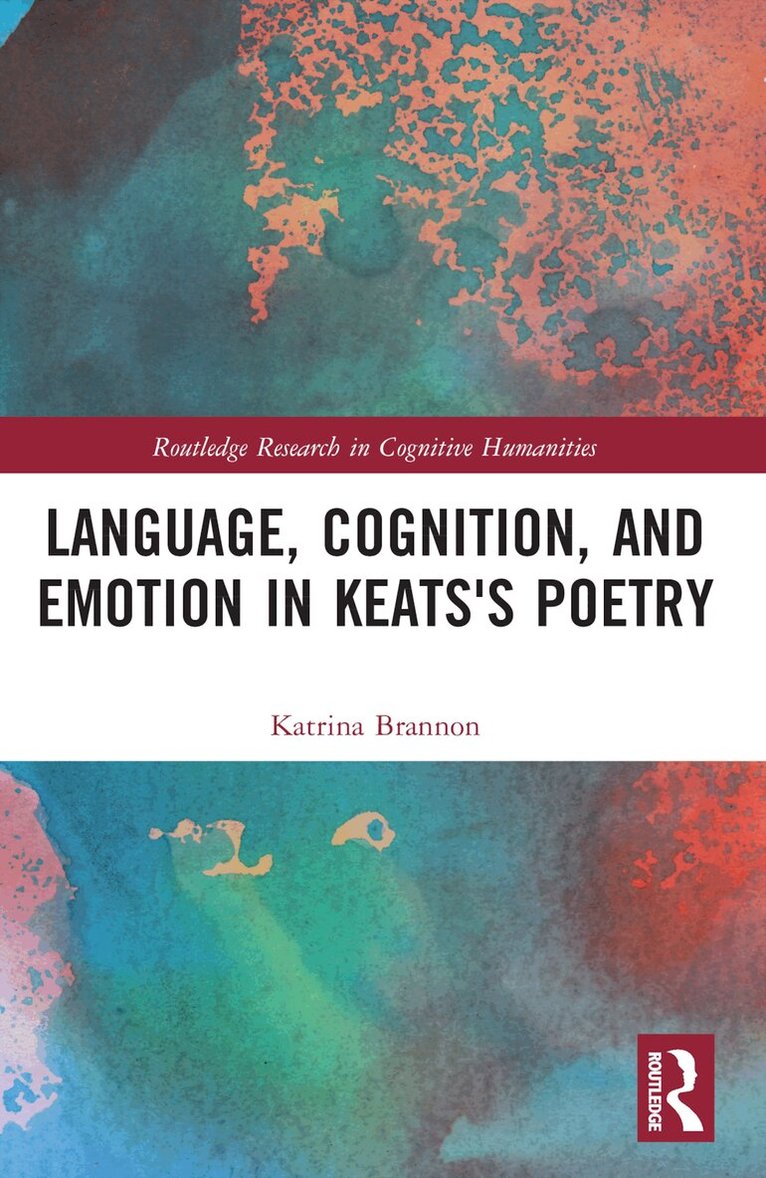
    Language, Cognition, and Emotion in Keats's Poetry

    AvKatrina Brannon

    Häftad, Engelska, 2024

    Del i serien Routledge Research in Cognitive Humanities

    718 kr

    Beställningsvara. Skickas inom 10-15 vardagar. Fri frakt över 249 kr.

    Fler format och utgåvor

    E-bok

    849 kr

    E-bok

    849 kr

    Inbunden

    2 364 kr

    Beskrivning

    Language, Cognition, and Emotion in Keats’s Poetry applies an innovative cognitive linguistic approach to the poetry of John Keats, the first of its kind to employ a cognitive-based framework to explore the expression and articulation of emotion in his work.Brannon adopts an embodied perspective to emotion, rooted in cognitive linguistics, cognitive grammar, and cognitive poetics but also works from figurative language and stylistics, in examining a selection of Keats’s poems. This approach allows for a close interrogation of the texts themselves but also the languages that compose them, comprising lexical and grammatical elements, which, when taken together, bring out the emotional saliency of Keatsian poetry. While revealing fresh insights into the work of John Keats, the book also sheds further light on the importance of cognitive approaches to poetic and grammatical analyses and how both language and the body can serve as forms of communication through which metaphors can be expressed and contextualized.This volume will appeal to students and scholars interested in cognitive linguistics, figurative language, emotion studies, cognitive science, and Anglophone poetry.

    Produktinformation

    • Utgivningsdatum:2024-08-26
    • Mått:152 x 229 x 12 mm
    • Vikt:390 g
    • Format:Häftad
    • Språk:Engelska
    • Serie:Routledge Research in Cognitive Humanities
    • Antal sidor:194
    • Förlag:Taylor & Francis Ltd
    • ISBN:9781032230924

    Utforska kategorier

    • Poesi inom Skönlitteratur
    • Språkvetenskap och lingvistik inom Språk och ordböcker

    Mer om författaren

    Katrina Brannon is Associate Professor of English Linguistics at the Université Polytechnique Hauts-de-France in Valenciennes, France. Her research interests include cognitive grammar, embodied emotion, sensorial expression, cognitive poetics and stylistics, conceptual metaphor theory, esthetics, and translation.

    Recensioner i media

    This is a beautifully complex book on John Keats’s emotionality. Katrina Brannon’s cognitive linguistic analyses reveal the many fine shades of feeling, emotion, sensitivity, mood, and desire in Keats’ oeuvre. She explains how and why language, cognition, emotion, and body are all indispensably intertwined in the poetry of one of the greatest romantic poets. Zoltán Kövecses, Emeritus Professor of Linguistics, Eötvös Loránd University, BudapestKatrina Brannon has carried out a considerable amount of research, both on linguistics and on poetry and poetics. Her approach is definitely innovative, and the whole book shows a wide-angled knowledge of cognitive theories which enables her to bring out quite vividly the linguistic, communicative and aesthetic aspects of Keats's poetry. This long-awaited book should become a landmark in poetry and cognition studies.Nathalie Vincent-Arnaud, Professor of English Stylistics and Translation Studies, Université Toulouse-Jean JaurèsKatrina Brannon’s book presents a very clear linguistic analysis of Keats’s poems, which draws on cognitive grammar and poetics, figurative language, cognitive science, philosophy, and poetry. It focuses on the expression of emotions and emotional experience in his work. It views language and the body as forms of communication through which metaphor may be expressed and conceptualized.It is an innovative book as it is currently the only monograph that takes a cognitive approach to Keats’s poetry and a welcome addition to the field of poetics and linguistics.It is a must-read for any scholar interested in Keats, poetics, conceptual metaphor or cognitive grammar.Wilfrid Rotgé, Professor of Linguistics, Sorbonne Université

    Innehållsförteckning

    • Foreword by Manuel JobertAcknowledgements1. Introduction 2. Cognitive Approaches to Poetry3. Aspect and Conceptual Metaphor: Poetic Expression and Emotion4. Emotional Force Dynamics: Causes are Forces and Modality5. Grammar and Emotion: The Metaphorical Role of Prepositions6. Emotional Time and Embodiment7. Conceptual Metonymy and the Physiological Expression of Emotion8. Conclusion