• Fri frakt över 249 kr
  • •
  • Snabba leveranser
  • •
  • Billiga böcker
Kundservice

Du är på sajten för privatpersoner.

Företag, bibliotek eller offentlig verksamhet?

Du handlar på classic.bokus.com, där alla dina funktioner finns intakta.
Till classic.bokus.com
Bokus logotyp. Gå till startsidan.
  • Erbjudanden
  • Nyheter
  • Student
  • Topplistor
  • Barn & ungdom
  • Bokus Play
  • E-böcker
  • Pocketböcker
  • Spel & pussel

10% rabatt på allt med kod NYSTART10 →

Sidfot

Mina sidor

    Hjälp

    • Kundservice
    • Vanliga frågor och svar
    • Frakt och leverans
    • Retur vid ångerrätt
    • Reklamera vara
    • Betalning
    • Köpvillkor
    • Allmänna villkor
    • Information om webbplatsens tillgänglighet

    Om Bokus

    • Om oss
    • Pressrum
    • För studenter
    • För företag
    • För bibliotek och offentlig verksamhet
    • För leverantörer
    • Hållbarhet

    Populärt

    • Aktuella erbjudanden
    • Presentkort
    • Studentlitteratur
    • Nya böcker
    • Topplistor
    • Signerade böcker
    • Engelska böcker

    Inspiration

    • Boktips
    • BookTok
    • Populära bokserier
    • Barnbokskaraktärer
    • Populära författare
    Logotyp för Bokus
    Följ oss på Facebook (extern länk)Följ oss på Instagram (extern länk)Följ oss på YouTube (extern länk)Följ oss på TikTok (extern länk)
    bokus @ CookiesAnpassa cookiesIntegritetspolicyKöpvillkor
    Till Citymail hemsida (extern länk)Till Budbee hemsida (extern länk)Till Postnord hemsida (extern länk)Till Schenker hemsida (extern länk)Till Early Bird hemsida (extern länk)Till Walleys hemsida (extern länk)
    1. Samhälle och politik
    2. Sociologi och antropologi
    3. Sociologi

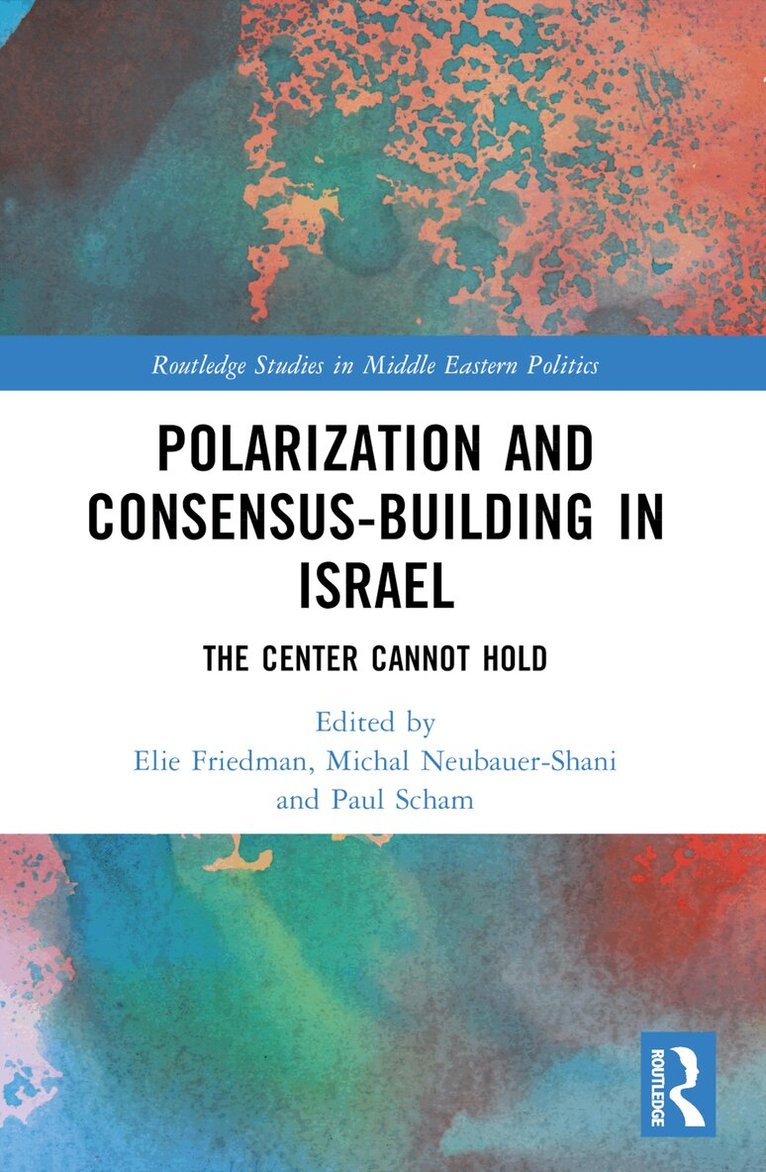
    Polarization and Consensus-Building in Israel

    The Center Cannot Hold

    AvElie Friedman,Michal Neubauer-Shani

    Häftad, Engelska, 2024

    Del i serien Routledge Studies in Middle Eastern Politics

    625 kr

    Beställningsvara. Skickas inom 10-15 vardagar. Fri frakt över 249 kr.

    Beskrivning

    This edited volume examines the most pressing social and political issues confronting Israel from a multidisciplinary perspective, focusing on the breakdown of social solidarity and the inability to formulate consensus.The contributors – encompassing political scientists, historians, communication researchers, sociologists, economists, and educators – focus on specific topics that serve as exemplary cases of various trends of consensus and polarization. These trends are examined in the context of ideological, religious, economic, national, and ethnic cleavages. In addition, this volume analyzes how political actors’ preference for “non-decision” on various issues has resulted in the maintenance of a status quo, with cleavages or conflicts being neither mitigated nor polarized. Together, this collection of articles paints a picture of Israel as a state racked by increasing polarization along ideological and religious lines. It is argued that this difficulty in determining a consensual definition of the state threatens to destroy social solidarity in Israel altogether, a climate in which “the center cannot hold.”This book is essential reading for anyone seeking to understand the major internal threats to Israel’s self-definition as a Jewish-democratic state and will also appeal to sociologists and political scientists interested in global polarization trends.

    Produktinformation

    • Utgivningsdatum:2024-11-28
    • Mått:156 x 234 x 20 mm
    • Vikt:580 g
    • Format:Häftad
    • Språk:Engelska
    • Serie:Routledge Studies in Middle Eastern Politics
    • Antal sidor:350
    • Förlag:Taylor & Francis Ltd
    • ISBN:9781032293325

    Utforska kategorier

    • Sociologi inom Samhälle och politik
    • Statsskick och politiska processer inom Samhälle och politik

    Mer om författaren

    Elie Friedman is the Head of the Communication Division at the Multidisciplinary Department of Social Sciences, Ashkelon Academic College, as well as an adjunct lecturer at Bar-Ilan University and a visiting lecturer at the University of Maryland. His interests include political discourse with an emphasis on conflict resolution and polarization processes.Michal Neubauer-Shani is a senior lecturer at the Department of Politics and Governance, and the Multidisciplinary Department of Social Sciences, Ashkelon Academic College. Her research focuses on Public Policy and State-Religion relations. She also addresses the issues of religious feminism and civics studies.Paul Scham is the Director of the Gildenhorn Institute for Israel Studies at the University of Maryland and Associate Research Professor of Israel Studies. From 2011 to 2021, he edited the Israel Studies Review and he has co-edited Shared Histories: A Palestinian–Israeli Dialogue (2005) and Shared Narratives (2011). His research interests include Israeli and Palestinian historical narratives, Hamas, Jordan, and the religious right in Israel.

    Recensioner i media

    "Ever since its establishment, Israel has faced the simultaneous influence of conflicting centripetal and centrifugal political forces. In recent years both the nature and the impact of such tendencies seem to differ dramatically from the past. This important volume provides an interesting multidisciplinary perspective on these trends, challenging certain assumptions, and providing fresh ideas for consensus-building within the context of recent emboldened polarization."Professor (Emeritus) Avraham Diskin, Department of Political Science, the Hebrew University of Jerusalem"The issue examined in this volume – processes of polarization and agreement in Israeli society – is likely the most important issue for the future of the state, certainly within the context of domestic affairs. This book offers a range of viewpoints on the subject: from issues that are experiencing increasing polarization, to issues in which the phenomenon is lessening, to issues in which a strategy of indecision between the two poles is being implemented. The volume indicates that the issues for which polarization is deepening, and those for which a strategy of indecision is being implemented, are more substantial than those in which polarization is lessening – illustrating a phenomenon of an increasing breakdown of solidarity in Israeli society. This is an important and thought-provoking volume, particularly for readers who take an active part in public debate and have the ability to impact the future of the issues examined in this book."Yair Sheleg, Research Associate at the Shalom Hartman Institute and journalist at Makor Rishon"Paul Scham, Elie Friedman, and Michal Neubauer-Shani have edited a timely, thought-provoking book theorizing the conditions that foster consensus-building in polarized societies. With fifteen contributors from six different disciplinary backgrounds, the collection presents an exciting array of perspectives examining a range of issues and institutions within Israel, each located on the tectonic fault lines of ideological, religious, economic, national, and ethnic divides within the society. This book not only deepens the understanding of Israeli politics and society but serves as a lens through which many other political cultures, each facing similar challenges of increased polarization, can be analyzed and compared."Professor Yael Aronoff, Professor of Political Science and International Relations at James Madison College; Director of the Michael and Elaine Serling Institute for Jewish Studies and Modern Israel; Serling Chair of Israel Studies, Michigan State University

    Innehållsförteckning

    • Introduction Part I: Polarization Trends 1. The Great Division: The Fateful Polarization of (Jewish) Israeli Society in the 1980s 2. The Political Polarization Surrounding the Oslo Accords and the National Religious Party in Israel 3. To Drink or to Boycott? Israel's Borders, the BDS Movement, and the Case of SodaStream 4. A Summary of the Relationships between the Popes John Paul II and Benedict XVI and the Jewish People: Closer Theological Relations, Conflicting Political Relations 5. The Two Ongoing Narratives and Current Disputes on the Affair of "The Missing Yemenite Children" in Israel 6. An Examination of the Liberal-Conservative Polarization in Mediated Discourse on Civic Studies in Israel Part II: Consensus Trends and Consensus-Building 7. Government by Consensus? A Comparison of the Alignment-Likud (1984-1988) and the Likud-Blue and White (2020) National Unity Coalitions 8. Israel’s Secular-Religious Cleavage: Postsecular Genealogies and Remedies9. The Politics of Arab Israelis: The Quest for Legitimacy 10. Adversarial Heritage as Consensus Heritage in a Jewish City: Arab Heritage Preservation in Ashkelon Part III: The Middle Ground – The Maintenance of the Status Quo 11. Israel's First Antitrust Law, the Agricultural Exemption, and the Mapai-Right Liberal Rift 12. The Controversy Surrounding Prime Minister Netanyahu’s Position Regarding the Two-State Solution – Background and Implications 13. Polarization, Integration & Moderation: The Case of Ra’am 14. When State Meets Community: Trends of Consensus and Polarization - COVID-19 and Ultra-Orthodox Society in Israel 15. Visible, Blurred or Concealed: Religion and Gender in 21st Century Textbooks