• Fri frakt över 249 kr
  • •
  • Snabba leveranser
  • •
  • Billiga böcker
Kundservice

Du är på sajten för privatpersoner.

Företag, bibliotek eller offentlig verksamhet?

Du handlar på classic.bokus.com, där alla dina funktioner finns intakta.
Till classic.bokus.com
Bokus logotyp. Gå till startsidan.
  • Erbjudanden
  • Nyheter
  • Student
  • Topplistor
  • Barn & ungdom
  • Bokus Play
  • E-böcker
  • Pocketböcker
  • Spel & pussel

10% rabatt på allt med kod: NYSTART10 →

Sidfot

Mina sidor

    Hjälp

    • Kundservice
    • Vanliga frågor och svar
    • Frakt och leverans
    • Retur vid ångerrätt
    • Reklamera vara
    • Betalning
    • Köpvillkor
    • Allmänna villkor
    • Information om webbplatsens tillgänglighet

    Om Bokus

    • Om oss
    • Pressrum
    • För studenter
    • För företag
    • För bibliotek och offentlig verksamhet
    • För leverantörer
    • Hållbarhet

    Populärt

    • Aktuella erbjudanden
    • Presentkort
    • Studentlitteratur
    • Nya böcker
    • Topplistor
    • Signerade böcker
    • Engelska böcker

    Inspiration

    • Boktips
    • BookTok
    • Populära bokserier
    • Barnbokskaraktärer
    • Populära författare
    Logotyp för Bokus
    Följ oss på Facebook (extern länk)Följ oss på Instagram (extern länk)Följ oss på YouTube (extern länk)Följ oss på TikTok (extern länk)
    bokus @ CookiesAnpassa cookiesIntegritetspolicyKöpvillkor
    Till Citymail hemsida (extern länk)Till Budbee hemsida (extern länk)Till Postnord hemsida (extern länk)Till Schenker hemsida (extern länk)Till Early Bird hemsida (extern länk)Till Walleys hemsida (extern länk)
    1. Skönlitteratur
    2. Litteraturvetenskap
    3. Litteraturvetenskap

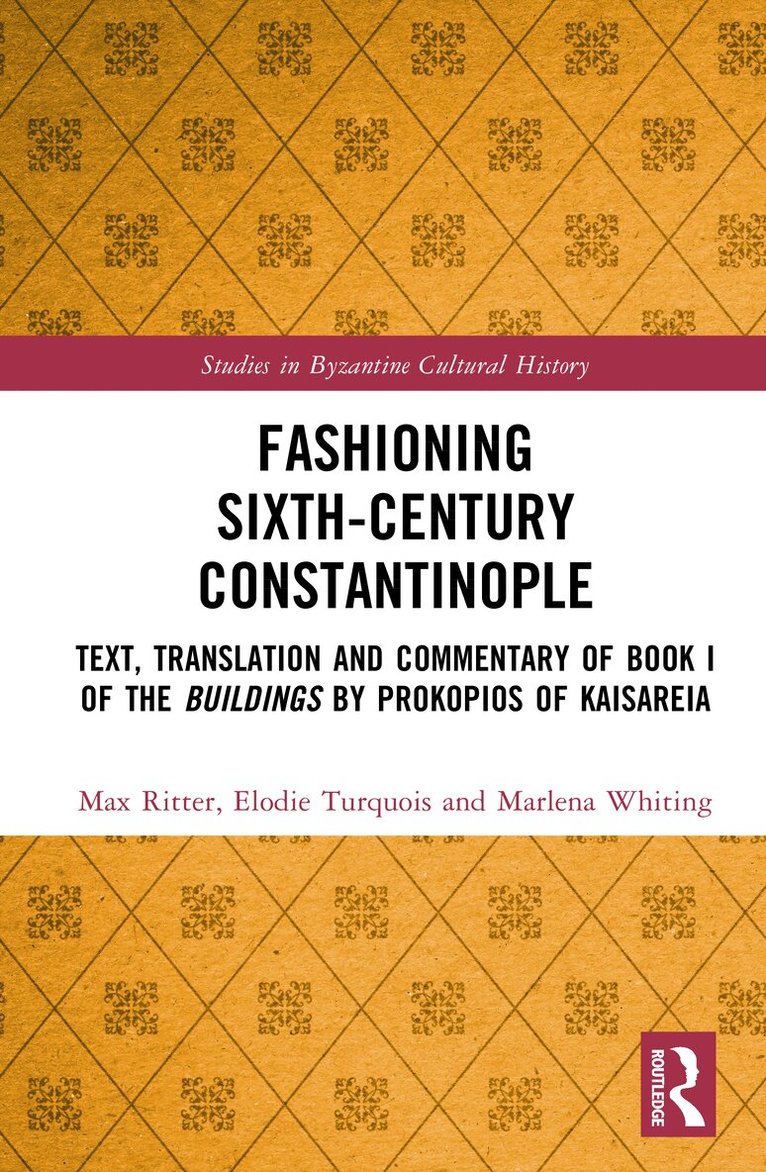
    Fashioning Sixth-Century Constantinople

    Text, Translation and Commentary of Book I of the Buildings by Prokopios of Kaisareia

    AvMax Ritter,Elodie Turquois

    Inbunden, Engelska, 2026

    Del i serien Studies in Byzantine Cultural History

    2 784 kr

    Beställningsvara. Skickas inom 10-15 vardagar. Fri frakt över 249 kr.

    Beskrivning

    The Buildings is a sixth-century text by Prokopios of Kaisareia (Caesarea Maritima) on the building works attributed to the eastern Roman emperor Justinian I (r. 527–65 CE), extolling the virtues of good rulership through praise of architecture. Book I centres on the imperial capital Constantinople: rich in its use of rhetoric and aesthetics, it portrays the emperor as a builder-patron, but also portrays the city itself as a place of beauty and delight to its inhabitants. Several of the buildings described in Book I – such as Hagia Sophia – are extant today; they and others are also documented in a range of historical sources that allow us to compare Prokopios’s account with that of his contemporaries, and to observe the legacy and changing uses of the spaces he describes into the Middle Ages.Fashioning Sixth-Century Constantinople presents an all-new English translation of Book I paired with a revised edition of the Greek text. It is accompanied by a detailed interdisciplinary commentary, informed by the respective disciplines of philology, history, archaeology and art history, but bringing a new perspective through cross-disciplinary collaboration, especially on points of technical and topographical descriptions, aiming at the most comprehensive and up-to-date commentary of the text.This book will appeal to scholars and students of Byzantine literature, history, art and archaeology, as well as those interested in the florescence of Byzantine Constantinople.This volume originates in the project ‘Procopius and the Language of Buildings’ (2018–2022), funded by the Deutsche Forschungsgemeinschaft and hosted by the Universities of Mainz and Halle-Wittenberg.

    Produktinformation

    • Utgivningsdatum:2026-02-27
    • Mått:156 x 234 x 34 mm
    • Vikt:1 180 g
    • Format:Inbunden
    • Språk:Engelska
    • Serie:Studies in Byzantine Cultural History
    • Antal sidor:530
    • Förlag:Taylor & Francis Ltd
    • ISBN:9781032407067

    Utforska kategorier

    • Litteraturvetenskap inom Skönlitteratur
    • Forntidens historia inom Historia och arkeologi

    Mer om författaren

    Max Ritter is an assistant professor at the University of Silesia in Katowice. He received his PhD in Byzantine Studies from Johannes Gutenberg-Universität Mainz, where he later continued as a postdoctoral researcher. He also held two research fellowships in Istanbul, which allowed him to engage deeply with the city’s historical landscape and integrate the perspectives of local scholars into this book. His research focuses on building culture and lived religion in Byzantium, drawing on both textual sources and material evidence. Most recently, his research shifted towards Byzantine conceptions of nature, notably focusing on marine environments.Elodie Turquois completed a doctorate in Classical Languages and Literature from the University of Oxford on materiality and visuality in Prokopios of Kaisareia and has published widely on Prokopios and the Buildings. She is an independent researcher whose work explores Late Antique literary aesthetics, the manuscript transmission of the Buildings; she uses narratology, stylistics and reception theory to approach ancient texts. Her most recent research investigates the reception of Constantinople and its late antique tradition in the writings of sixteenth-century French travellers.Marlena Whiting has a doctorate in Late Antique Archaeology from the University of Oxford, with a specialism in travel infrastructure and the built environment of monasticism and pilgrimage. Currently a researcher and lecturer at the University of Groningen, the Netherlands, she has held visiting fellowships at CBRL Amman and ANAMED in Istanbul, and has worked on archaeological projects in Jordan, Syria and Spain. Her research applies interdisciplinary approaches from social sciences (network analysis, spatial access theory) to material and textual evidence to understand historical contexts from a phenomenological perspective, with a focus on religious life and gendered lived experience.

    Innehållsförteckning

    • Foreword and IntroductionForewordNote on the EditionMain manuscripts used for this editionNote on the TranslationNote on the Archaeological CommentaryIntroductionProcopius's Buildings: Significance to ScholarshipConstantinopleConstantinople and Justinian: Context and ImageImperial Patronage in Constantinople: Norms and PracticesOther Texts on Justinian's Constructions in ConstantinopleReconstructing Late Antique Constantinople through Archaeology: Historical Development and MethodsProcopius's Biography and His Relation to ConstantinopleThe Text of the Buildings as a Historical ArtifactThe Date of the BuildingsThe Textual Transmission: Manuscripts, Abridgement and ExtractsThe Byzantine Afterlife of the BuildingsEarly modern reception of the Buildings: editions and translations before HauryThe Text as Literary ObjectThe Procopian Matrix: Style, Narrative and GenreComposition: Macro and Microstructures, Motifs, and ThemesBuildings ClassificationA Brief Note on OrientationMaps and PlansText and translation of the Buildings and chapter-by-chapter commentaryPreface: rhetorical and historical exordium, Justinian’s military, legal and religious achievements, and delayed reveal of the subject (1.1.1–19)Hagia Sophia: historical context, design elements – focus on the central space (1.1.20–49)Hagia Sophia: description of interior features – focus on the rest of the church (1.1.50–66)Hagia Sophia: two episodes of Justinian’s personal intervention (1.1.67–78)The Column of Justinian (1.2.1–12)Hagia Eirene and the hospices of the Patriarchate (1.2.13–19)The churches of the Virgin Mary at Blachernai, Pege and elsewhere in the city and its environs; the churches of Anne, Zoe, and the Archangel Michael in the city (1.3)The churches dedicated to the Apostles: SS. Peter and Paul in the Palace of Hormisdas and the church of SS. Sergius and Bacchus (1.4.1–8)The Church of the Holy Apostles: description and discovery of the relics (1.4.9–24)The churches dedicated to the martyrs Acacius, Plato, Mocius, Thyrsus, Theodore, Thecla and Theodota (1.4.25–31)Constantinople’s maritime topography (1.5)The churches on the Golden Horn: SS. Priscus and Nicholas, SS. Cosmas and Damian, and St Anthimus (1.6.1–14)St Irene at Sykai, the Forty Martyrs and Justinian’s miraculous healing (1.7)The churches on either side of the Bosporus: the churches of the Archangel Michael at Anaplous and Brochoi/Proochthoi, and a church of Mary near the latter (1.8)The Metanoia convent (1.9.1–10)The churches of the upper Bosporus (St Panteleimon, the Argyronion leprosarion, Archangel Michael at Mochadion) and more in the city (St Tryphon, SS. Menas and Menaios and St Ia) (1.9.11–18)The Augoustaion area: the Baths of Zeuxippos and the Senate House (1.10.1–9)The Chalke Gate (1.10.10–20)Arkadianai: description of the court and statue of Theodora (1.11.1–9)The water supply of the city and the Basilica Cistern (1.11.10–15)The harbours and suburban palaces at Hiereia and Joukoundianai (1.11.16–22)End of the section on Constantinople; the hospice at Stadion (1.11.23–27)The Great Palace at the time of JustinianTextual Sources for the Great PalaceArchaeological Evidence for the Great PalaceThe Topographical Context of the Great PalaceA Reconstruction of the Layout and Internal Organisation of the Great PalaceGates of the Great PalaceConclusionBibliographyList of Editions of the Buildings in Chronological OrderList of AbbreviationsPrimary SourcesSecondary Works