• Fri frakt över 249 kr
  • •
  • Snabba leveranser
  • •
  • Billiga böcker
Kundservice

Du är på sajten för privatpersoner.

Företag, bibliotek eller offentlig verksamhet?

Du handlar på classic.bokus.com, där alla dina funktioner finns intakta.
Till classic.bokus.com
Bokus logotyp. Gå till startsidan.
  • Erbjudanden
  • Nyheter
  • Student
  • Topplistor
  • Barn & ungdom
  • Bokus Play
  • E-böcker
  • Pocketböcker
  • Spel & pussel

10% rabatt på allt med kod: NYSTART10 →

Sidfot

Mina sidor

    Hjälp

    • Kundservice
    • Vanliga frågor och svar
    • Frakt och leverans
    • Retur vid ångerrätt
    • Reklamera vara
    • Betalning
    • Köpvillkor
    • Allmänna villkor
    • Information om webbplatsens tillgänglighet

    Om Bokus

    • Om oss
    • Pressrum
    • För studenter
    • För företag
    • För bibliotek och offentlig verksamhet
    • För leverantörer
    • Hållbarhet

    Populärt

    • Aktuella erbjudanden
    • Presentkort
    • Studentlitteratur
    • Nya böcker
    • Topplistor
    • Signerade böcker
    • Engelska böcker

    Inspiration

    • Boktips
    • BookTok
    • Populära bokserier
    • Barnbokskaraktärer
    • Populära författare
    Logotyp för Bokus
    Följ oss på Facebook (extern länk)Följ oss på Instagram (extern länk)Följ oss på YouTube (extern länk)Följ oss på TikTok (extern länk)
    bokus @ CookiesAnpassa cookiesIntegritetspolicyKöpvillkor
    Till Citymail hemsida (extern länk)Till Budbee hemsida (extern länk)Till Postnord hemsida (extern länk)Till Schenker hemsida (extern länk)Till Early Bird hemsida (extern länk)Till Walleys hemsida (extern länk)
    1. Samhälle och politik
    2. Politik och statsskick
    3. Politisk aktivism

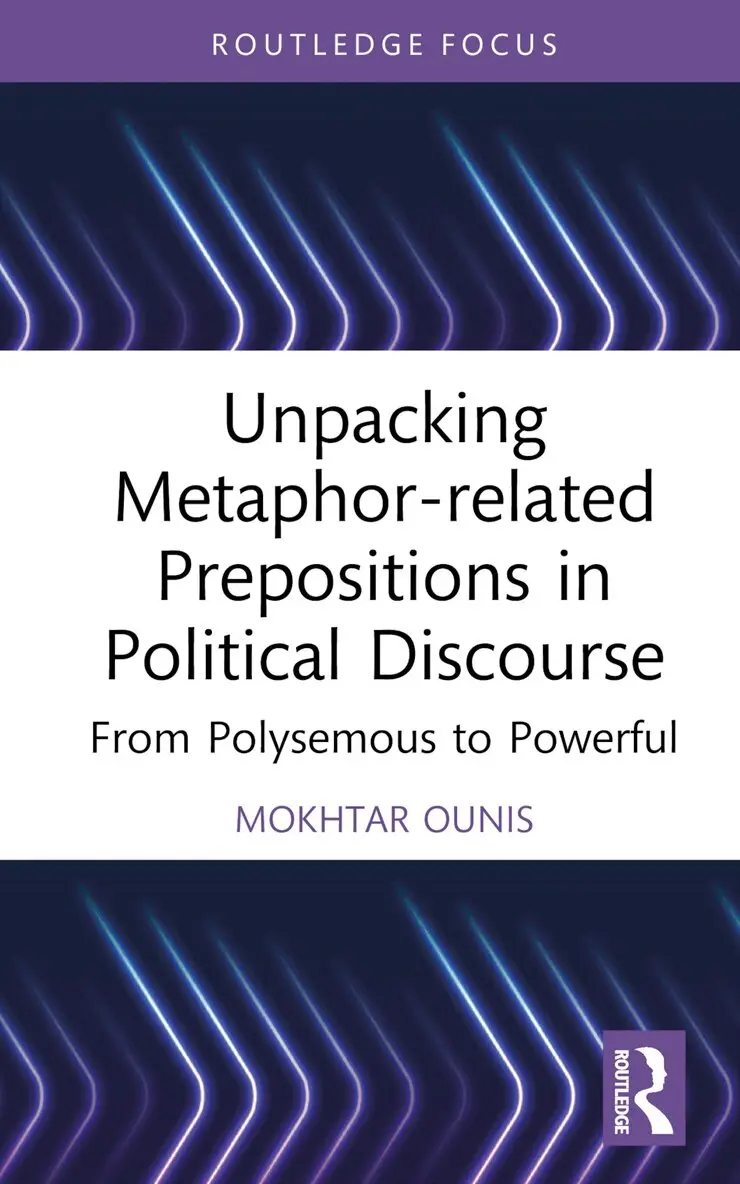
    Unpacking Metaphor-related Prepositions in Political Discourse

    From Polysemous to Powerful

    AvMokhtar Ounis

    Inbunden, Engelska, 2023

    Del i serien Routledge Research on New Waves in Pragmatics

    961 kr

    Beställningsvara. Skickas inom 10-15 vardagar. Fri frakt över 249 kr.

    Fler format och utgåvor

    E-bok

    432 kr

    E-bok

    432 kr

    Häftad

    358 kr

    Beskrivning

    This book explores the context around why English prepositions are used in figurative language more frequently than nouns and verbs, using corpus-based evidence to examine the most often used prepositions and how they are employed and for what purpose.While research on cognitive approaches to metaphor has significantly expanded in recent decades, little attention has been paid to prepositions as vehicles of figurative language, owing to their polysemous, complex, and inconsistent nature. To bridge this gap, Ounis introduces an innovative conceptual framework that integrates conceptual metaphor theory, diachronic linguistics, and discourse pragmatics. Drawing upon an extensive corpus of American presidential inaugural addresses, this book considers the linguistic, conceptual, pragmatic, and contextual dimensions of English prepositions, revealing the fascinating interplay between language, culture, and cognition.This volume will be of interest to scholars in pragmatics, metaphor studies, English language, rhetoric studies, and historical linguistics.

    Produktinformation

    • Utgivningsdatum:2023-11-27
    • Mått:138 x 216 x 15 mm
    • Vikt:360 g
    • Format:Inbunden
    • Språk:Engelska
    • Serie:Routledge Research on New Waves in Pragmatics
    • Antal sidor:108
    • Förlag:Taylor & Francis Ltd
    • ISBN:9781032431611

    Utforska kategorier

    • Politisk aktivism inom Samhälle och politik
    • Språkvetenskap och lingvistik inom Språk och ordböcker

    Mer om författaren

    Mokhtar Ounis is a linguist who earned his PhD from the University of Toulon in France, where he conducted research on the use of conceptual metaphors in political communication. He has been a faculty member at the University of Hail in Saudi Arabia for ten years, where he has taught courses in linguistics and related fields.

    Innehållsförteckning

    • ContentsPreface1. Chapter 1: Introduction 1.1. Defining key terms1.2. Scope of this study1.3. Structure of this book2. Chapter 2: Navigating Prepositions2.1. Defining prepositions2.2. Polysemy: networks and principles2.3. Cognitive grammar’s view of prepositions2.4. Prepositions’ cognitive potential2.5. Prepositions’ contextual dynamics2.6. Prepositions’ axiological framing3. Chapter 3: Metaphor: Insights from Classical and Cognitive Approaches3.1. Classical views on metaphor3.2. Cognitive view on metaphor4. Chapter 4: The Power of Prepositions in Political Discourse4.1. Political language4.2. The history of political discourse analysis4.3. The inaugural addresses and their generic properties4.4. Conceptual metaphors in political discourse4.5. The evolution trends of inaugural addresses4.6. Metaphor variation and diachronic approach5. Chapter 5: A Prepositional Portrait: Corpus and Frequency5.1. Corpus linguistics and metaphor research5.2. The Inaugural Corpus5.3. The prepositions’ frequency patterns5.4. Tracking the preposition-to-word ratio6. Chapter 6 Unpacking Metaphorical Patterns6.1. Conceptual mappings of the metaphor-related prepositions6.2. System metaphors and cross-system mapping6.3. The coherence of metaphors6.4. Prepositions and their metonymic basis6.5. Conceptual notation revisited7. Chapter 7: Beyond Spatial Metaphors7.1. The cognitive model: an overview7.2. Conceptual identity7.3. Conceptual space8. Chapter 8: Tracing Patterns of Change and Stability8.1. Metaphor variations8.2. Patterns of diachronic variations9. Chapter 9: Concluding Remarks 9.1. How are prepositions distributedin the Inaugural Corpus?9.2. What is the conceptual basis of metaphor-related prepositions?9.3. How do metaphor-related prepositions mix?9.4. Do metaphor-related prepositions reflect any systematic conceptualizations?9.5. How do metaphor-related prepositions vary across history?9.6. Final wordsIndex