• Fri frakt över 249 kr
  • •
  • Snabba leveranser
  • •
  • Billiga böcker
Kundservice

Du är på sajten för privatpersoner.

Företag, bibliotek eller offentlig verksamhet?

Du handlar på classic.bokus.com, där alla dina funktioner finns intakta.
Till classic.bokus.com
Bokus logotyp. Gå till startsidan.
  • Erbjudanden
  • Nyheter
  • Student
  • Topplistor
  • Barn & ungdom
  • Bokus Play
  • E-böcker
  • Pocketböcker
  • Spel & pussel

10% rabatt på allt med kod: NYSTART10 →

Sidfot

Mina sidor

    Hjälp

    • Kundservice
    • Vanliga frågor och svar
    • Frakt och leverans
    • Retur vid ångerrätt
    • Reklamera vara
    • Betalning
    • Köpvillkor
    • Allmänna villkor
    • Information om webbplatsens tillgänglighet

    Om Bokus

    • Om oss
    • Pressrum
    • För studenter
    • För företag
    • För bibliotek och offentlig verksamhet
    • För leverantörer
    • Hållbarhet

    Populärt

    • Aktuella erbjudanden
    • Presentkort
    • Studentlitteratur
    • Nya böcker
    • Topplistor
    • Signerade böcker
    • Engelska böcker

    Inspiration

    • Boktips
    • BookTok
    • Populära bokserier
    • Barnbokskaraktärer
    • Populära författare
    Logotyp för Bokus
    Följ oss på Facebook (extern länk)Följ oss på Instagram (extern länk)Följ oss på YouTube (extern länk)Följ oss på TikTok (extern länk)
    bokus @ CookiesAnpassa cookiesIntegritetspolicyKöpvillkor
    Till Citymail hemsida (extern länk)Till Budbee hemsida (extern länk)Till Postnord hemsida (extern länk)Till Schenker hemsida (extern länk)Till Early Bird hemsida (extern länk)Till Walleys hemsida (extern länk)
    1. Kultur
    2. Arkitektur

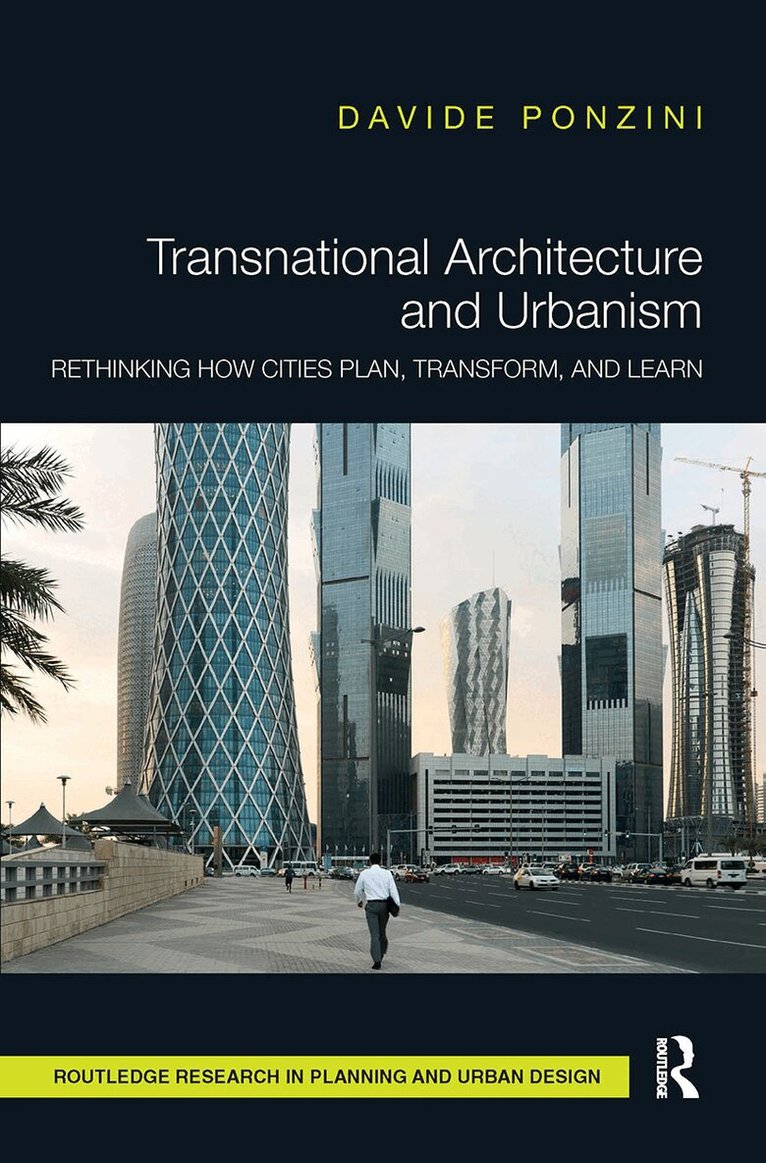
    Transnational Architecture and Urbanism

    Rethinking How Cities Plan, Transform, and Learn

    AvDavide Ponzini

    Häftad, Engelska, 2023

    Del i serien Routledge Research in Planning and Urban Design

    643 kr

    Beställningsvara. Skickas inom 10-15 vardagar. Fri frakt över 249 kr.

    Fler format och utgåvor

    Inbunden

    2 493 kr

    E-bok

    760 kr

    E-bok

    760 kr

    Beskrivning

    Transnational Architecture and Urbanism combines urban planning, design, policy, and geography studies to offer place-based and project-oriented insight into relevant case studies of urban transformation in Europe, North America, Asia, and the Middle East.Since the 1990s, increasingly multinational modes of design have arisen, especially concerning prominent buildings and places. Traditional planning and design disciplines have proven to have limited comprehension of, and little grip on, such transformations. Public and scholarly discussions argue that these projects and transformations derive from socioeconomic, political, cultural trends or conditions of globalization. The author suggests that general urban theories are relevant as background, but of limited efficacy when dealing with such context-bound projects and policies.This book critically investigates emerging problematic issues such as the spectacularization of the urban environment, the decontextualization of design practice, and the global circulation of plans and projects. The book portends new conceptualizations, evidence-based explanations, and practical understanding for architects, planners, and policy makers to critically learn from practice, to cope with these transnational issues, and to put better planning in place.

    Produktinformation

    • Utgivningsdatum:2023-01-21
    • Mått:156 x 234 x 17 mm
    • Vikt:500 g
    • Format:Häftad
    • Språk:Engelska
    • Serie:Routledge Research in Planning and Urban Design
    • Antal sidor:320
    • Förlag:Taylor & Francis Ltd
    • ISBN:9781032474458

    Utforska kategorier

    • Arkitektur inom Kultur
    • Regional planering inom Naturvetenskap och teknik
    • Geografi inom Naturvetenskap och teknik

    Mer om författaren

    Davide Ponzini is Associate Professor of Urban Planning at Politecnico di Milano. He has also been a visiting scholar at Yale, Johns Hopkins, Columbia University, and Sciences Po Paris and Visiting Professor at TU Munich. His research activity focuses on planning theory, urban and cultural policy, and contemporary architecture. He is co-author (with the photographer Michele Nastasi) of Starchitecture, and co-editor (with Harvey Molotch) of The New Arab Urban: Gulf Cities of Wealth, Ambition, and Distress.

    Recensioner i media

    "Critical urban scholarship at its best, Transnational Architecture and Urbanism is a thoughtful and balanced approach – deeply embedded in the literature and replete with examples – to the transnational flows of ideas about cities and buildings. This is urban theory as it is meant to be written."Robert Beauregard, Professor Emeritus, Columbia University"The subtitle of this book is Rethinking How Contemporary Cities Plan, Transform and Learn, and this is exactly what it delivers. A tight conceptual framework effectively organises a critical analysis of the ubiquitous and homogenizing forces of urban globalization through a series of case studies. Ponzini’s conclusion that ‘contextual learning’ by architects and urban planners, focusing less on the global (though not ignoring it) and more on the local, presents a timely and formidable challenge to the whole community of urbanists and architects who build in cities. With its rich complement of images, this book achieves that unusual but much sought after goal - a text that students, academic researchers, professionals, and indeed anyone interested in cities will find informative, intellectually provocative, visually exciting, and readable."Leslie Sklair, London School of Economics

    Innehållsförteckning

    • List of figuresList of tablesIntroduction PART I – Transnational architecture and urbanism1 The transnational transformations of contemporary cities 1.1 Ubiquitous and homogenizing forces of urban globalization?1.2 Global spread and local transplants: past and recent examples1.3 Contemporary urban narratives, models and projects1.4 City forms and transnational projects: pressing issues and questions2 Looking for (urban) troubles across disciplines 2.1 The architecture/city nexus: old criticisms and contemporary reductions to absurdity2.2 Forms of contemporary urban development: Manhattanism, bigness and the generic post-metropolis2.3 Glocal urban competition and growth machines 2.4 Contemporary architectural and urban knowledge is part of the problem3 A Conceptual framework for usable knowledge in contemporary cities 3.1 Projects and built forms3.2 Glocal places and contexts3.3 Transnational agents and networks3.4 Transnational urban processes3.5 Analyzing transnational projects through their mobilities, circulation, and transfer3.6 A conceptual framework for usable knowledge, not for general urban theories4 Critical approach and pragmatic attitude4.1 Long-term global mapping and urban analysis: forms, agents and process4.2 The case study method and its limits in investigating transnational issues4.3 Methods for critically understanding transnational architecture and urbanism PART II – Critical issues 5 Spectacularization of contemporary architecture and the urban environment 5.1 Architecture in the society of spectacle5.2 Urban politics and the economies of spectacle5.3 Transnational cultural facilities and their urban expectations: the Guggenheim spectacles5.4 The city wonders in the world: supertall skyscrapers5.5 The Burj Khalifa in Downtown Dubai and beyond5.6 Placing urban spectacles6 Urban personification and the mobilities of global experts6.1 Archistars, urbanistars and other transnational elites6.2 The "New York by Gehry" building and other personifications6.3 Hadid’s, Libeskind’s and Isozaki’s projects and the poor planning of Milan’s CityLife6.4 Mobilities of urbanistars and planning consultancy groups6.5 Transnational experts and local landings7 Decontextualization of architectural and urban design 7.1 Economic and symbolic competitions in a financialized urban world 7.2 Transnational design firms’ strategies in contemporary cities7.3 The transnational trajectories of Broadway Malyan’s firm and projects7.4 Transnational urban development and the disconnect of its design8 Plan circulation and complex transfers 8.1 New York’s High Line Elevated Park and its transnational circulation 8.2 The circulation of a master plan from Vancouver’s False Creek to Dubai Marina and beyond8.3 Transferring an urban complex: from Abu Dhabi’s Central Market to Abu Dhabi Plaza in Astana9 Transfer of megastructures and buildings 9.1 Singapore’s new landmark transferred to Chongqing9.2 From Barcelona’s Poblenou to Doha’s West Bay: the take-off and landing of an iconic skyscraper9.3 Understanding the qualities of transnational places and projects 10 Homogenization of central places and urban landscapes 10.1 Homogenization in contemporary cities10.2 Five ways of comprehending urban homogenization 10.3 Transnational geographies and dynamics of urban homogenizationPART III – Conclusions11 Planning, learning and dealing with transnational architecture and urbanism 11.1 Varied relevance of local planning and the legitimization crisis of urban and design knowledge11.2 A state of unlearning: speed, scale and de-politicization of urban planning and architectural design11.3 The little room for maneuvering and for making better places12 How can urban planners, designers and policy makers cope with these issues? 12.1 Contextual learning from transnational plans and projects12.2 Less about transnational narratives, more about local problems12.3 Critical paths for research and practice across urban design, planning and policy makingReferences Indexes