• Fri frakt över 249 kr
  • •
  • Snabba leveranser
  • •
  • Billiga böcker
Kundservice

Du är på sajten för privatpersoner.

Företag, bibliotek eller offentlig verksamhet?

Du handlar på classic.bokus.com, där alla dina funktioner finns intakta.
Till classic.bokus.com
Bokus logotyp. Gå till startsidan.
  • Erbjudanden
  • Nyheter
  • Student
  • Topplistor
  • Barn & ungdom
  • Bokus Play
  • E-böcker
  • Pocketböcker
  • Spel & pussel

10% rabatt på allt med kod: NYSTART10 →

Sidfot

Mina sidor

    Hjälp

    • Kundservice
    • Vanliga frågor och svar
    • Frakt och leverans
    • Retur vid ångerrätt
    • Reklamera vara
    • Betalning
    • Köpvillkor
    • Allmänna villkor
    • Information om webbplatsens tillgänglighet

    Om Bokus

    • Om oss
    • Pressrum
    • För studenter
    • För företag
    • För bibliotek och offentlig verksamhet
    • För leverantörer
    • Hållbarhet

    Populärt

    • Aktuella erbjudanden
    • Presentkort
    • Studentlitteratur
    • Nya böcker
    • Topplistor
    • Signerade böcker
    • Engelska böcker

    Inspiration

    • Boktips
    • BookTok
    • Populära bokserier
    • Barnbokskaraktärer
    • Populära författare
    Logotyp för Bokus
    Följ oss på Facebook (extern länk)Följ oss på Instagram (extern länk)Följ oss på YouTube (extern länk)Följ oss på TikTok (extern länk)
    bokus @ CookiesAnpassa cookiesIntegritetspolicyKöpvillkor
    Till Citymail hemsida (extern länk)Till Budbee hemsida (extern länk)Till Postnord hemsida (extern länk)Till Schenker hemsida (extern länk)Till Early Bird hemsida (extern länk)Till Walleys hemsida (extern länk)
    1. Samhälle och politik
    2. Sociologi och antropologi
    3. Sociologi

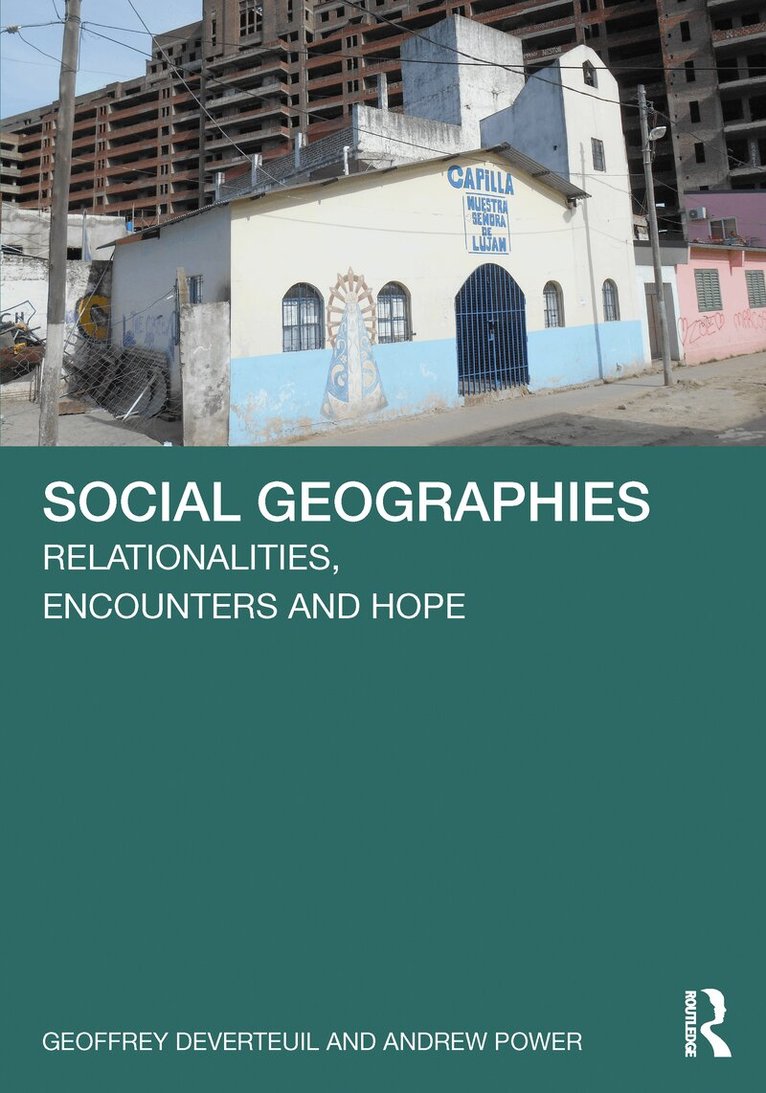
    Social Geographies

    Relationalities, Encounters and Hope

    AvGeoffrey DeVerteuil,Andrew Power

    Häftad, Engelska, 2026

    625 kr

    Beställningsvara. Skickas inom 10-15 vardagar. Fri frakt över 249 kr.

    Fler format och utgåvor

    Inbunden

    2 423 kr

    Beskrivning

    This timely exploration of social geography reveals how inequality and justice unfold across interconnected scales around the globe. Through embodied, relational encounters, the book unpacks how everyday spaces shape who we are and what we might become. Grounded in care and hope, it invites readers to imagine fairer futures and remain committed to meaningful, long-term change.The text offers a dynamic, case-driven and sometimes image-driven exploration of pressing social issues in our increasingly unequal, post-pandemic world. Designed for student engagement, the book provides real-world case studies that span the globe, critical concepts and thought-provoking questions to help readers analyse injustice, build conceptual 'toolkits', and imagine routes toward meaningful social change. Rather than offering easy answers, this book equips readers with flexible, practical frameworks – encouraging selective, critical thinking to better understand and communicate complex social problems. Ideal for classroom use and independent study, it empowers students to connect theory with action and to think like geographers committed to justice. The book also includes Engagement Questions, encouraging readers to reflect on the subject of the chapter and the wider topics within the field of social geography.This book is essential reading for students of social and political geography, and allied fields of urban, health and well-being and political geographies.

    Produktinformation

    • Utgivningsdatum:2026-01-30
    • Mått:178 x 254 x 20 mm
    • Vikt:680 g
    • Format:Häftad
    • Språk:Engelska
    • Antal sidor:348
    • Förlag:Taylor & Francis Ltd
    • ISBN:9781032540443

    Utforska kategorier

    • Sociologi inom Samhälle och politik
    • Geografi inom Naturvetenskap och teknik

    Mer om författaren

    Geoff DeVerteuil is Professor of Social Geography at Cardiff University, in the School of Geography and Planning.Andrew (Andy) Power is Professor of Geography at the School of Geography and Environmental Science at University of Southampton.

    Recensioner i media

    "Fresh, insightful and highly accessible, this book brings Social Geography to life through personal stories and vibrant visuals. It encourages deep reflection on human connections, shared encounters and the profound search for hope amidst the challenges of our complex world. Essential for any student seeking to truly understand their social landscape."Julie MacLeavy, Professor of Economic Geography, University of Bristol"An accessible and engaging guide to social geographies today. With examples and case studies from across the globe, this book brings key topics to life – from housing and inequality to care and citizenship. A brilliant resource for students looking to connect theory with the pressing issues shaping our world."David Conradson, University of Canterbury

    Innehållsförteckning

    • Lists of figures List of tables List of boxes PrefaceAcknowledgements PART 1 - Foundations of the Textbook and a Relational Social GeographyChapter 1 – Introduction1.1 Social Geographies in our contemporary times: Themes of the Social, Inequality and Social Justice1.2 Crosscutting threads: Relationality and encounter 1.3 The Structure of the Book 1.4 Moving Forward: Pedagogic Approach 1.5 The geographies of this bookChapter 2: Everyday Spaces of Difference, Identity and Inequality2.1 Geographies of Difference, Production and Social Reproduction 2.2 Identity and Intersectionality 2.3 From Difference to Inequality: Distributional and Recognitional Understandings 2.4 From Inequality to Inequity: Spatial Expressions 2.5 ConclusionsChapter 3. The State, Citizenship and Rights3.1 Introduction 3.2 The State and Governance 3.3 Citizenship and the Evolution of Rights 3.4 Geographies of Rights 3.5 Civil rights emerge amid contested geographies of citizenship 3.6 Tracing the Spaces of Exception in 'Ordinary' Everyday Lived Citizenship 3.7 ConclusionChapter 4: Geographies of State Support and Welfare4.1 Social Justice Theories of State Support 4.2 Defining the Welfare State 4.3 The Welfare State Across the World 4.4 A Welfare State Divided and 'Reformed' 4.5 Localising and materialising encounters with the welfare state: street-level bureaucracy and contact zones 4.6 The post-welfare state alongside the pandemic expansion 4.7 ConclusionsChapter 5: Geographies of Care and Voluntarism5.1 Geographies of Care 5.2 Care and Social Infrastructure 5.3 The voluntary sector 5.4 Philanthropy 5.5 ConclusionsPART 2 – The Social Geographies of Spaces of EncounterChapter 6: Geographies of Youth and Intersectionality6.1 The Social Construction of Youth 6.2 Intersectionality and (Stigmatised) Youth 6.3 Contemporary Geographies of Youth and the Spaces of Encounter 6.4 ConclusionsChapter 7: Social Geographies of Race7.1 Race and Social Geography: Definitions, Segregation and Early Interventions 7.2 Race and Social Geography Today: Social and Spatial Constructions 7.3 Race and Social Geography: Emerging Topics in the 2020s 7.4 Case Study: Immigration in the UK since 2000 7.5 Conclusions Chapter 8: Poverty and Marginality8.1 Social Geography and Poverty 8.2 Stigmatisation, invisibility and marginalisation 8.3 Marginality and the racialised American ghetto 8.4 Marginality, waste and excess 8.5 Case study of the poor, racialised and marginalised: Photo essay of homeless service hubs in Los Angeles 8.6 Precarity and the perpetual hustle 8.7 ConclusionsChapter 9: Disability and Caregiving9.1 Disability and the Social Geographies of Care 9.2 Disability and the Historical Geography of Care 9.3 Challenging Social and Spatial Exclusion of Disabled People 9.4 Caregivers in/by the Community 9.5 A Geography of Carers 9.6 Conclusions Chapter 10: Mental Health and Addiction10.1 Introduction 10.2 Mental Health and Social Geography 10.3 The social geographies of stigmatising mental ill-health 10.4 A societal view on managing stigmatising mental ill-health 10.5 In-between encounters: The social geographies of addiction 10.6 Conclusions: Mundane mental health during and after the pandemic Chapter 11: The Housing Crisis: Homelessness, Gentrification and Generation Rent11.1 Home, Housing and Security 11.2 The Housing Crisis and Housing Precarity 11.3 The Decline of Public (Social) Housing 11.4 Housing Crisis in Action: Platform economies and mega-events 11.5 Signs and Outcomes of a Housing Crisis: The State and the 1% 11.6 Signs and Outcomes of the Housing Crisis: Gentrification 11.7 Signs and Outcomes of a Housing Crisis: Homelessness 11.8 'Generation Rent' and Wealth Inequality 11.8 ConclusionsChapter 12 Gender and Sexuality12.1: Introduction 12.2: Gender Inequality: politics and work 12.3 Hegemonic and Contested Geographies of Masculinity 12.4 Gendered and sexed geographies beyond binaries 12.5 ConclusionsPART 3. Geographies of Hope for Social JusticeChapter 13 Geographies of Alternative Spaces, Resilience and Slow/Quiet Activism13.1: Social Encounters with Quiet Activism 13.2: The commons 13.3: Counterpublics, Safe Spaces and Counter-places 13.4: Resilience 13.5: Abolition Geographies 13.6: Conclusions and shifting encounters with activism and social justiceChapter 14: Geographies of Resistance and Direct Action14.1 Introduction 14.2 Public Space, Protest and Occupation 14.3 Unpacking Public Space and Protest 14.4 Case Study: Resistance and The Emergence of the Disabled People's Movement 14.5 Moving beyond parochial accounts of public space and protest 14.6 Going too far? The case of social unrest 14.7 Spaces for activists and hope 14.8 ConclusionsChapter 15: ConclusionsTowards a more hopeful framing?