• Fri frakt över 249 kr
  • •
  • Snabba leveranser
  • •
  • Billiga böcker
Kundservice

Du är på sajten för privatpersoner.

Företag, bibliotek eller offentlig verksamhet?

Du handlar på classic.bokus.com, där alla dina funktioner finns intakta.
Till classic.bokus.com
Bokus logotyp. Gå till startsidan.
  • Erbjudanden
  • Nyheter
  • Student
  • Topplistor
  • Barn & ungdom
  • Bokus Play
  • E-böcker
  • Pocketböcker
  • Spel & pussel

10% rabatt på allt med kod: NYSTART10 →

Sidfot

Mina sidor

    Hjälp

    • Kundservice
    • Vanliga frågor och svar
    • Frakt och leverans
    • Retur vid ångerrätt
    • Reklamera vara
    • Betalning
    • Köpvillkor
    • Allmänna villkor
    • Information om webbplatsens tillgänglighet

    Om Bokus

    • Om oss
    • Pressrum
    • För studenter
    • För företag
    • För bibliotek och offentlig verksamhet
    • För leverantörer
    • Hållbarhet

    Populärt

    • Aktuella erbjudanden
    • Presentkort
    • Studentlitteratur
    • Nya böcker
    • Topplistor
    • Signerade böcker
    • Engelska böcker

    Inspiration

    • Boktips
    • BookTok
    • Populära bokserier
    • Barnbokskaraktärer
    • Populära författare
    Logotyp för Bokus
    Följ oss på Facebook (extern länk)Följ oss på Instagram (extern länk)Följ oss på YouTube (extern länk)Följ oss på TikTok (extern länk)
    bokus @ CookiesAnpassa cookiesIntegritetspolicyKöpvillkor
    Till Citymail hemsida (extern länk)Till Budbee hemsida (extern länk)Till Postnord hemsida (extern länk)Till Schenker hemsida (extern länk)Till Early Bird hemsida (extern länk)Till Walleys hemsida (extern länk)
    1. Samhälle och politik
    2. Samhälle och kultur
    3. Kultur och medier
    4. Referensverk och tvärvetenskap

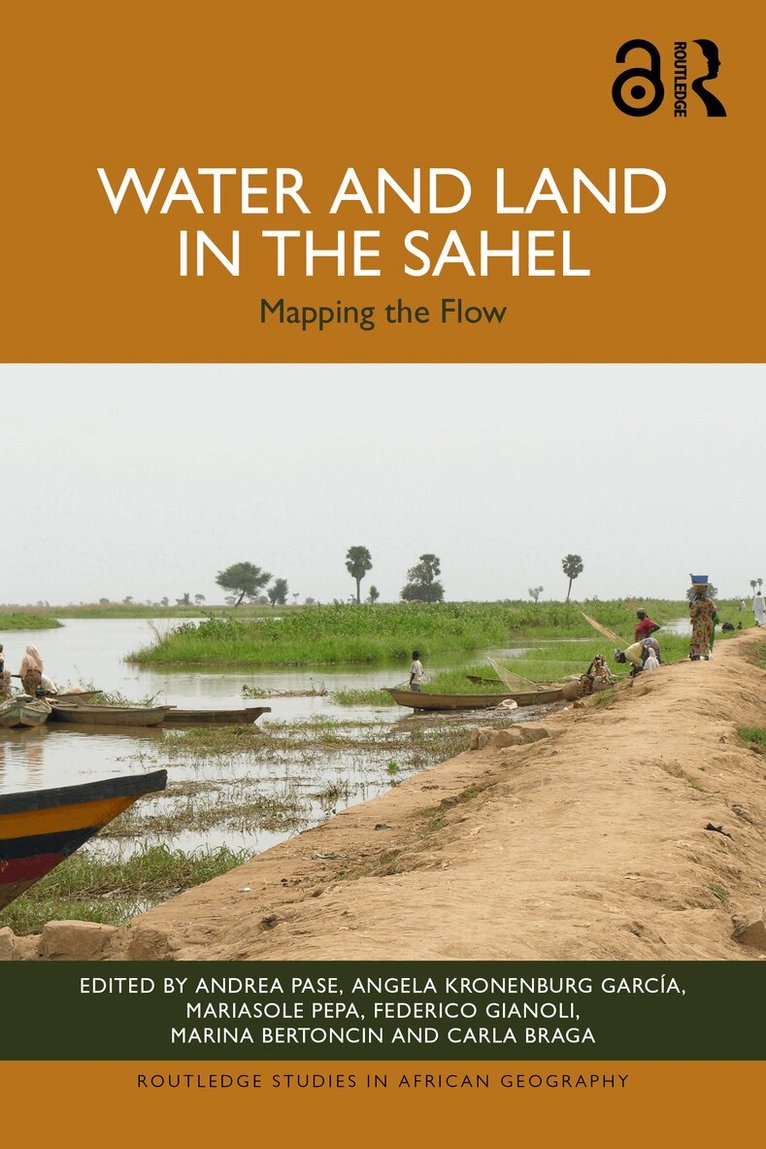
    Water and Land in the Sahel

    Mapping the Flow

    AvAndrea Pase,Angela Kronenburg García

    Inbunden, Engelska, 2025

    Del i serien Routledge Studies in African Geography

    2 421 kr

    Beställningsvara. Skickas inom 10-15 vardagar. Fri frakt över 249 kr.

    Beskrivning

    Drawing on over thirty years of research, this book investigates the intermingling of land and water in the Sahel, analysing landscapes defined by the ebb and flow of rainfall, flooding and population movements, as well as environmental, political and social crises.Exploring both the seasonal flooding of rivers around the Nile, Chari-Logone, Niger and Senegal, as well as agricultural irrigation projects such as dams, canals and pumping stations, the book examines the different narratives related to water and land in the Sahel. It combines fieldwork research with remote sensing, big data and GIS mapping to outline the ever-changing interplay between land and water in the region. Beyond this, the book also reinterprets the colonial and post-colonial legacies of large-scale irrigation projects and the geopolitical interests which defined them.Supported by an Open Access website with a WebGIS and further maps and analysis, this book is an essential read for policy makers and development practitioners in the region, as well as for researchers and scholars across the fields of geography, history, political science, sustainable development and African studies.The Open Access version of this book, available at www.taylorfrancis.com, has been made available under a Creative Commons Attribution-No Derivatives (CC-BY-ND) 4.0 license.

    Produktinformation

    • Utgivningsdatum:2025-06-06
    • Mått:156 x 234 x 27 mm
    • Vikt:930 g
    • Format:Inbunden
    • Språk:Engelska
    • Serie:Routledge Studies in African Geography
    • Antal sidor:396
    • Förlag:Taylor & Francis Ltd
    • ISBN:9781032551227

    Utforska kategorier

    • Referensverk och tvärvetenskap inom Samhälle och politik
    • Internationell ekonomi inom Ekonomi och Ledarskap
    • Geografi inom Naturvetenskap och teknik

    Mer om författaren

    Andrea Pase is a full professor of geography at the University of Padua. In the Sahel, his research interests concern territorial processes linked to water seen both as common resource and as the basis for the modernization of agriculture.Angela Kronenburg García holds postdoctoral fellowships at UCLouvain (F.R.S.-FNRS) and the University of Padua. She is also affiliated with the University Eduardo Mondlane. As an anthropologist, she conducts research on the intersection of religious and land-tenure change, and on pastoralism, milk and social change in Kenya as well as on energy transition, anticipation and graphite.Mariasole Pepa is a postdoc researcher at the University of Padua and an affiliate researcher at CEDEJ-Khartoum. She is interested in the transformation in the Sahel through the lenses of water and land as well as exploring alternative methodologies to research approaches, ethics, and practices.Federico Gianoli is a geographer specialized in GIS and Geoinformatics, focusing on open-source data in spatial analysis. As a consultant for the Joint Research Centre (JRC-EC), he conducts research on land degradation and productivity dynamics. He’s also pursuing a PhD on these topics at the University of Seville, Spain.Marina Bertoncin is an honorary professor of geography at the University of Padua. In Sahelo-Sudanese Africa her research interests concern the geography of the hydraulic territorialisation with a focus on the role of the irrigation projects for the local development (Lake Chad basin, Nile, Niger and Senegal River regions).Carla Braga is associate professor of Anthropology at the Faculty of Arts and Social Sciences of University Eduardo Mondlane in Mozambique. Her research interests cover decolonial readings of knowledge production about Africa, onto-epistemic dimensions of the current planetary crisis, nature governance and health.

    Recensioner i media

    "This is a brave book that collaboratively experiments with methods to look at land and water as essential resources during occurring and past crises. Operating with the notion of 'polycrisis' it criticizes using 'crisis' as spectacle; instead, the authors carefully apply long-term cartography and local experience to reflect on ways of dealing with insecurities caused by climate change, pandemics, famine and war, but also political decision making and international prescriptions. Thorough research and an eye and ear for the complexities around these essential topics make this book an essential read for everyone who wants to deepen their understanding of geographic, social and cultural ways of dealing with changes in the Sahel Region."Andrea Behrends, Professor of Anthropology, University of Leipzig, Germany."Based on solid, in-depth, multi-year field research and a fruitful interdisciplinary dialogue between anthropology, geography and other social sciences, as well as between European and Sahelian researchers, this book offers an up-to-date re-reading of the Sahel and the ecological, economic and social dynamics and tensions that run through it, offering critical cartographic, interpretations and innovative keys to keep the focus on a territory in which we seem to have lost our compass and need to find our way back into a post-colonial pluriverse. A reSahelient read, to find new routes between water and land."Egidio Dansero, Professor of Political and Economic Geography, University of Turin, Italy."An ambitious and original book on the multiple crises of the Sahel, examined from the perspective of the water-land relationship and from a wide range of perspectives: from ecological rhythms to development, from the long-term to current health and security issues, from social representations to public modernisation policies. Drawing on 30 years of research and mixed methods (field surveys, remote sensing, GIS), the 17 chapters, ranging from general overviews to localised case studies, weave the complexity of the material into the unity of Sahelian issues. An impressive achievement."Géraud Magrin, Professor of Geography, University of Paris 1 Panthéon-Sorbonne, France."Water is an extremely important topic, looking at drylands and particularly the Sahel. This book is a must-read for those who are interested in the backgrounds to the polycrisis in the Sahel and in drylands in general. Based on decade-long engagement with the region, it provides us with in-depth insights from a variety of disciplinary perspectives on the role of water and its connections with the daily lives of the Sahelians, political economy and conflict. It shows that our ‘solutions’ failed and that we need to refresh our look at the region and critically examine our narratives and prejudices about this amazingly complex world."Han van Dijk, Professor, Sociology of Development and Change Group, Wageningen University, The Netherlands.

    Innehållsförteckning

    • INTRODUCTION: Perspectives on water and land in the Sahel: facing polycrisis 1: Setting the scene. Unfulfilled futures. One hundred years of large-scale irrigation projects in the Sahel PART I: Contextual issues 2: Environmental crisis narratives in the Sahel and the solutions they call for: The case of Lake Chad 3: Layered crises: climate change, water insecurity and irrigation in the Sahel 4: The “glocal” nature of jihadist insurgencies? Conflict, space, land, and resources in the Sahel PART II: Cartographic sketches of the Sahel 5: Defining the Sahel. B-ordering an area study 6: Land degradation and the Convergence of Evidence in the Sahel 7: Troubled waters 8: Shapes of the water: the rectangle and the circle. A tentative survey on irrigation in the Sahel 9: Interlude. The Sahel in historical atlases (1493–1789) Interlude: Sahel in historical cartography PART III: Complicated muddles of water and land 10: Sudan: a 'picture' of irrigation spaces before April 15th 2023 11: Traces of irrigation: Some recent developments in the Chadian region 12: The production of land insecurity and conflict in the Sourou valley (Burkina Faso) PART IV: Connections, rights and conflicts 13: Land and water rights in the Niger Inner Delta: between negotiation and conflict 14: Ségou(s), the Niger and the other side of the river: how water tells the city in the Sahel 15: Changing patterns of resource conflicts in the Logone floodplains (Cameroon/Chad). Between actors’ practices and development narratives PART V: Towards a fluid research agenda 16: COVID-19, polycrisis and metamorphosis: A reflection on doing collaborative research in, on and with the Sahel 17: Ways of being-knowing and doing with water and land in Africa