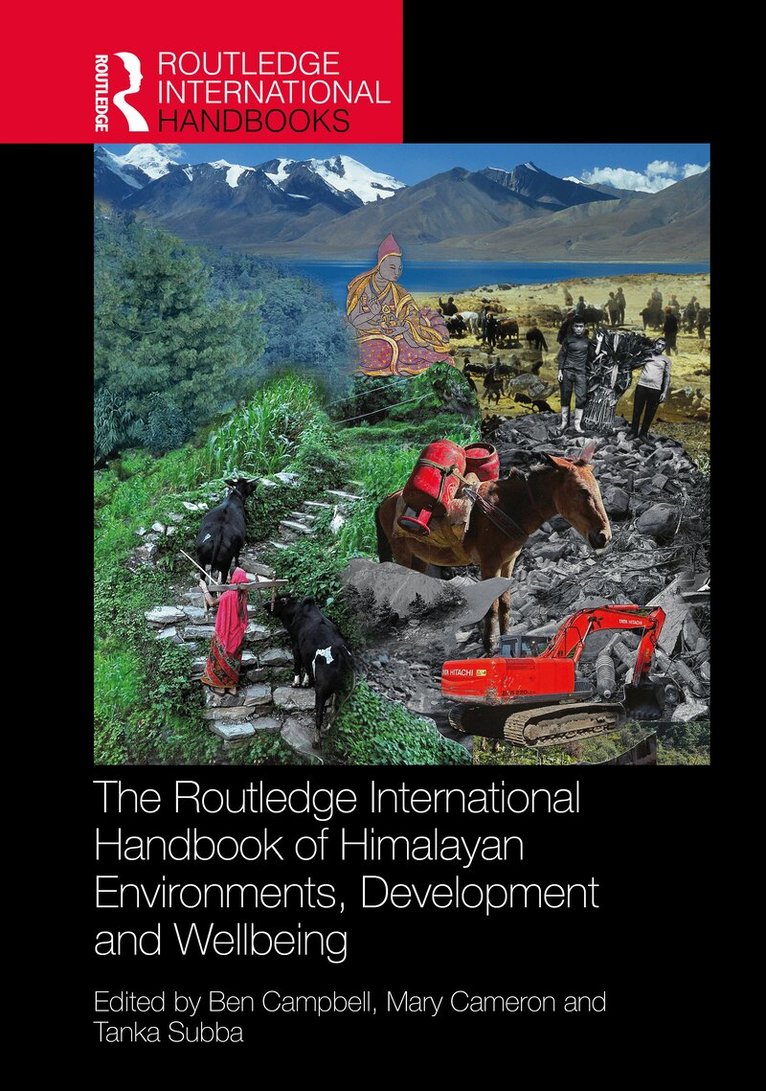
Routledge International Handbook of Himalayan Environments, Development and Wellbeing
Tanka Subba, Mary Cameron, Ben Campbell
925 kr
Du är på sajten för privatpersoner.
3 682 kr
Beställningsvara. Skickas inom 10-15 vardagar. Fri frakt över 249 kr.
Ben Campbell is Senior Lecturer in Anthropology, Durham University, UK. He traveled in 1976 into Himalayan spaces between Kashmir, Nepal and Darjeeling, starting his research career learning Tamang in Nepal in 1988. He directs an MA program on Sustainability, Energy and Development, and his book about the impact of nature conservation on Indigenous environmental knowledge and practice in a Tamang-speaking community is Living Between Juniper and Palm: Nature, Culture and Power in the Himalayas (2013).Mary Cameron is a writer and socio-environmental activist whose research in Nepal explores human-nature engagements, Ayurvedic medicine, and gender and caste. From 1992 to 2021, she was Professor of Anthropology, and directed gender studies programs at Florida Atlantic University and Auburn University, USA. She received three Fulbright grants; alumni, leadership and teaching awards; and numerous other grants. She authored Three Fruits: Nepali Ayurvedic Doctors on Health, Nature, and Social Change (2019) and the award-winning On the Edge of the Auspicious: Gender and Caste in Nepal (1998).Tanka B. Subba is Visiting Professor at the Department of Humanities & Social Sciences, Indian Institute of Technology, Gandhinagar, and Ombudsperson of Darjeeling Hills University. Earlier, from 2012 to 2017, he served as Vice-Chancellor of Sikkim University. He received such awards as the Homi Bhabha Fellowship (Mumbai), Dr. Panchanan Mitra Lectureship and R.P. Chanda Centenary Medal for 2015 (Asiatic Society, Kolkata), DAAD Guest professorship at the Free University of Berlin, and Baden-Wuerttemberg Fellowship at the South Asian Institute, Heidelberg University. He has authored and edited 18 books and published over 80 articles on various issues related to the Eastern Himalayas.
"The volume is a precious guide for navigating in the complexities of human-environment relationships within the Himalayan range, during the Anthropocene era. It brings together contributions from a remarkable group of scholars to explore social, political, cultural and historical ecologies in light of the recent changes that define this era, particularly with regard to migration, water and forest resources and wellbeing.”Marie Lecomte-Tilouine, CNRS Senior Researcher, LAS, Collège de France, Paris"An excellent regional handbook by a global community of scholars, sharing deep knowledge and deep personal engagement with the Himalayas. The stories told inhabit the spaces between environmental catastrophe narratives and Shangri-la. The approach and frames of reference are innovative, compelling and highly recommended."Edward Simpson, Executive Dean of the Faculty of Arts and Social Sciences, Lancaster University, UK"In 1989, in The Himalayan Dilemma Ives and Messerli challenged the widely accepted view that Himalayan ecosystems were degrading irreversibly as a result of uncontrolled development. Thirty-five years later the Routledge Handbook of Himalayan Environments, Development and Wellbeing is poised to provide new challenges to thinking about interactions between environment, development and wellbeing in this amazingly diverse region. The nearly sixty chapters include a discussion of what some might consider surprising findings about increasing forest cover in Nepal. They also include rethinking of social and environmental transitions such as urbanisation and transitions to reduced family size. The focus is on complex transitions rather than simplified unilinear change. There are chapters that consider the impacts and opportunities provided by social media and others that look at the synergies between scientific and traditional knowledge systems and much more. The book is deeply interdisciplinary, covers much of the geographic and cultural diversity of the region and defaults in cultural relativism (as one of the editors writes). Anyone with a passion for the Himalayas will find this a challenging and exciting book."Robert Fisher, Tropical Forests and People Research Centre, University of the Sunshine Coast, Queensland, Australia; School of Geosciences, University of Sydney"This collection displays the richness and diversity of scholarship on the Himalayas. It could not be more timely, as climate crisis, economic speculation, and new political alignments force Himalayan peoples to reckon with unprecedented change. Critical scholars from across the social sciences and humanities will surely find it essential reading."Sarah Besky, Professor of the Anthropology of Work, ILR School, and Director, South Asia Program, Einaudi Center for International Studies, Cornell University"This Handbook is a collection of cutting-edge studies exploring how the penetration of the 21st century economy and technology have profoundly disrupted human-environmental relations, the theory and practice of development, and the well-being of the region’s people. A highlight of the book is the ways the authors present the ambiguity of these changes and the range of possible futures. In addition, that half the authors/co-authors of the collection are from the Himalayan region enriches the analyses and expands the interpretations of the topics of the book."John Metz, Associate Professor, North Kentucky University, USA"The editors are to be congratulated on bringing together a stellar array of contributions. Every specialist of the region will want to have this collection of vital case studies on their shelves. More importantly, every NGO and government office responsible for, or working in, the region should have it to hand as an indispensable reminder of the sheer diversity of Himalayan people’s experiences of the environment, the state, culture, and wellbeing in a time of rapid climatic change."David N. Gellner FBA, editor of Borderland Lives in Northern South Asia"This is an exceptionally valuable collection of essays that sheds critical light on the complex and important reality of the Himalaya region. The interdisciplinary contributions to this handbook effectively challenge reductionist, sensationalist, and orientalist perspectives on the mountains. By focusing on the experiences of people whose lives are entangled in the environment, and who are implicated in development projects from the ground up, this collection provides deep insights on how to look at, but also beyond, crises and catastrophes. To look beyond is to better understand the nature of wellbeing in a place that well reflects the intimate challenges of living in the Anthropocene."Joseph Alter, Professor of Anthropology and Director, Asian Studies Center, University of Pittsburgh. Author of Yoga in Modern India: The Body between Science and Philosophy"There is a demographic churning underway across the Himalaya. Variegated lifestyles are being lost even as glaciers retreat, permafrost lets go, groundwater is depleted, hill terraces go fallow, and cultures see a breathless, unprecedented transformation. Breakneck ecological change feeds human bewilderment and distress. Only diverse disciplines and voices can do justice to all that is happening across the 2500 km of the Himalayan arc, which is why this volume is valuable. It helps the world understand the challenges facing societies and ecologies of our mountains."Kanak M. Dixit, journalist, activist, founding editor of Himal Southasian"An important resource for thinking about constellations of struggle and hope across the entire Himalayan region, the Handbook invites readers to envision environmental and social transformations as they are known, seen, and felt from a multitude of locations. This collection usefully resists reducing the historical complexity of places and problems into singular stories of crisis and its causes."Stacy Leigh Pigg, anthropology professor, Simon Fraser University"Drawing on the deep scholarly engagement of contributors across the Himalayan region, this first-ever Handbook of its kind presents fresh insights into environmental change, human resilience, and socio-ecological transformation happening in the region. Embracing post-colonial sensibility and celebrating intellectual diversity, it provides locally grounded and rich accounts of the complex dynamics between environments, communities, and development in one of Earth's most critical zones. The volume offers critical insights into the possibilities for adaptation, transformation, and human well-being in times of rapid socio-environmental change across the region."Hemant Ojha, Institute for Study and Development Worldwide (IFSD), Australia, and author of 'Climate Risks to Urban Water Security in the Asia-Pacific Region: Emerging Responses and Lessons'
Tanka Subba, Mary Cameron, Ben Campbell
925 kr
Tanka Subba, Mary Cameron, Ben Campbell
925 kr
Ben Campbell
Häftad
260 kr
Mary Cameron, Lena Lorenz
Inbunden, 2013
1 715 kr