• Fri frakt över 249 kr
  • •
  • Snabba leveranser
  • •
  • Billiga böcker
Kundservice

Du är på sajten för privatpersoner.

Företag, bibliotek eller offentlig verksamhet?

Du handlar på classic.bokus.com, där alla dina funktioner finns intakta.
Till classic.bokus.com
Bokus logotyp. Gå till startsidan.
  • Erbjudanden
  • Nyheter
  • Student
  • Topplistor
  • Barn & ungdom
  • Bokus Play
  • E-böcker
  • Pocketböcker
  • Spel & pussel

10% rabatt på allt med kod: NYSTART10 →

Sidfot

Mina sidor

    Hjälp

    • Kundservice
    • Vanliga frågor och svar
    • Frakt och leverans
    • Retur vid ångerrätt
    • Reklamera vara
    • Betalning
    • Köpvillkor
    • Allmänna villkor
    • Information om webbplatsens tillgänglighet

    Om Bokus

    • Om oss
    • Pressrum
    • För studenter
    • För företag
    • För bibliotek och offentlig verksamhet
    • För leverantörer
    • Hållbarhet

    Populärt

    • Aktuella erbjudanden
    • Presentkort
    • Studentlitteratur
    • Nya böcker
    • Topplistor
    • Signerade böcker
    • Engelska böcker

    Inspiration

    • Boktips
    • BookTok
    • Populära bokserier
    • Barnbokskaraktärer
    • Populära författare
    Logotyp för Bokus
    Följ oss på Facebook (extern länk)Följ oss på Instagram (extern länk)Följ oss på YouTube (extern länk)Följ oss på TikTok (extern länk)
    bokus @ CookiesAnpassa cookiesIntegritetspolicyKöpvillkor
    Till Citymail hemsida (extern länk)Till Budbee hemsida (extern länk)Till Postnord hemsida (extern länk)Till Schenker hemsida (extern länk)Till Early Bird hemsida (extern länk)Till Walleys hemsida (extern länk)
    1. Samhälle och politik
    2. Samhälle och kultur

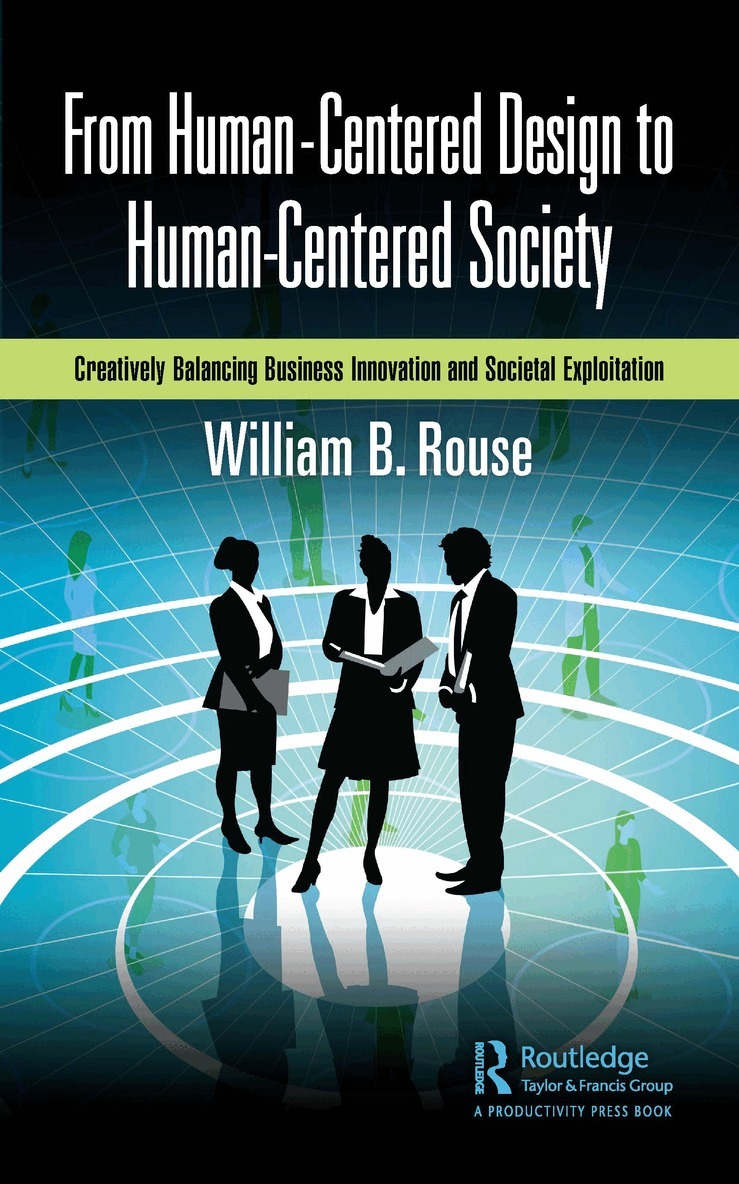
    From Human-Centered Design to Human-Centered Society

    Creatively Balancing Business Innovation and Societal Exploitation

    AvWilliam B. Rouse

    Häftad, Engelska, 2024

    512 kr

    Beställningsvara. Skickas inom 10-15 vardagar. Fri frakt över 249 kr.

    Fler format och utgåvor

    E-bok

    604 kr

    E-bok

    605 kr

    Inbunden

    2 056 kr

    Beskrivning

    A human-centered society creatively balances investments in sources of innovation, while also governing in a manner that eventually limits exploitation by originators once innovations have proven their value in the marketplace, broadly defined to include both private and public constituencies. The desired balance requires society to invest in constituencies to be able to create innovations that provide current and future collective benefits, while also assuring society provides laws, courts, police, and military to protect individual rights to life, liberty, and the pursuit of happiness. The balance addresses collectivism vs. individualism. Collectivism emphasizes the importance of the community. Individualism, in contrast, is focused on the rights and concerns of each person. Unity and selflessness or altruism are valued traits in collectivist cultures; independence and personal identity are central in individualistic cultures. Collectivists can become so focused on collective benefits that they ignore sources and opportunities for innovation. Individualists can tend to invest themselves, almost irrationally, in ideas and visions, many of which will fail, but some will transform society. Collectivists need to let individualists exploit their successful ideas. Individualists need to eventually accept the need to provide collective benefits. This book addresses the inherent tension underlying the pursuit of this balance. It has played a central role in society at least since the Industrial Revolution (1760–1840). Thus, the story of this tension, how it regularly emerges, and how it is repeatedly resolved, for better or worse, is almost a couple of centuries old. Creating a human-centered society can be enabled by creatively enabling this balance. Explicitly recognizing the need for this balance is a key success factor. This book draws upon extensive experiences within the domains of transportation and defense, computing and communications, the Internet and social media, health and wellness, and energy and climate. Balancing innovation and exploitation takes varying forms in these different domains. Nevertheless, the underlying patterns and practices are sufficiently similar to enable important generalizations.

    Produktinformation

    • Utgivningsdatum:2024-01-31
    • Mått:152 x 229 x 18 mm
    • Vikt:320 g
    • Format:Häftad
    • Språk:Engelska
    • Antal sidor:194
    • Förlag:Taylor & Francis Ltd
    • ISBN:9781032611730

    Utforska kategorier

    • Samhälle och kultur inom Samhälle och politik
    • Affärsutveckling inom Ekonomi och Ledarskap

    Mer om författaren

    William B. Rouse is a Research Professor in the McCourt School of Public Policy at Georgetown University, as well as a Senior Fellow in the office of the Senior Vice President for Research, Professor Emeritus, and former Chair of the School of Industrial and Systems Engineering at the Georgia Institute of Technology, and Principal at Curis Meditor, a firm focused on the health of people, processes, organizations, and society.His research focuses on understanding and managing complex public-private systems such as healthcare delivery, higher education, transportation, and national security, with emphasis on the mathematical and computational modeling of these systems for the purpose of policy design and analysis.Rouse has written hundreds of articles and book chapters, and has authored many books, including most recently Transforming Public-Private Ecosystems (Oxford, 2022), Failure Management (Oxford, 2021), Computing Possible Futures (Oxford, 2019), Universities as Complex Enterprises (Wiley, 2016), Modeling and Visualization of Complex Systems and Enterprises (Wiley, 2015), Understanding and Managing the Complexity of Healthcare (MIT Press, 2014), Economic Systems Analysis and Assessment (Wiley, 2011), People and Organizations: Explorations of Human-Centered Design (Wiley, 2007), Essential Challenges of Strategic Management (Wiley, 2001) and the award-winning Don’t Jump to Solutions (Jossey-Bass, 1998). He has edited or co-edited numerous books including Perspectives on Complex Global Challenges (Wiley, 2016), Engineering the System of Healthcare Delivery (IOS Press, 2010), The Economics of Human Systems Integration (Wiley, 2010), Enterprise Transformation: Understanding and Enabling Fundamental Change (Wiley, 2006), Organizational Simulation: From Modeling & Simulation to Games & Entertainment (Wiley, 2005), the best-selling Handbook of Systems Engineering and Management (Wiley, 1999, 2009), and the eight-volume series Human/Technology Interaction in Complex Systems (Elsevier).Among many advisory roles, he has served as Chair of the Committee on Human Factors (now Board on Human Systems Integration) of the National Academies, a member of the advisory committee for the Division of Behavioral and Social Sciences and Education of the National Academies, a member of the U.S. Air Force Scientific Advisory Board, and a member of the DoD Senior Advisory Group on Modeling and Simulation. He has been designated a lifetime National Associate of the National Research Council and National Academies. Rouse is a member of the National Academy of Engineering and has been elected a fellow of four professional societies -- Institute of Electrical and Electronics Engineers (IEEE), the International Council on Systems Engineering (INCOSE), the Institute for Operations Research and Management Science (INFORMS), and the Human Factors and Ergonomics Society (HFES).Rouse received his B.S. from the University of Rhode Island, and his S.M. and Ph.D. from the Massachusetts Institute of Technology.

    Innehållsförteckning

    • Chapter 1. A Central Tension Chapter 2. Innovators & Exploiters Chapter 3. Transportation & Defense Chapter 4: Computers & Communications Chapter 5: Internet & Social Media Chapter 6: Health & Wellness Chapter 7: Energy & Climate Chapter 8: Creating the Balance