Russian Social Thought in the 19th Century
Ananta Kumar Giri, Artem A. Uldanov, Arnab Roy Chowdhury, Sergey Parkhomenko, Deirdre Ruscitti Harshman
Häftad, 2025
584 kr
Du är på sajten för privatpersoner.
AvAnanta Kumar Giri,Ananta K. Giri
2 138 kr
Beställningsvara. Skickas inom 10-15 vardagar. Fri frakt över 249 kr.
Ananta Kumar Giri is the Founding Honorary Executive Trustee of Vishwaneedam Centre for Asian Blossoming, Puducherry and Chennai and a former professor at the Madras Institute of Development Studies, Chennai, India. He has taught and done research in many universities in India and abroad. He has an abiding interest in social movements and cultural change; criticism, creativity, and contemporary dialectics of transformation; theories of self, culture, and society; and creative streams in education, philosophy, and literature. Professor Giri has written, edited, co-edited, and translated more than six dozen books in Odia and English, including Global Transformations: Postmodernity and Beyond (1998), Knowledge and Human Liberation: Towards Planetary Realizations (2013), Bahudhara Barnabiva (Splendrous Beauty of the Plural, 2021), The Calling of Global Responsibility: New Initiatives in Justice, Dialogues and Planetary Realizations (2023), Rethinking Satyagraha: Truth, Travel and Translation (Editor, 2025), Cultivating Gardens of God: A Paradigm Shift in Faith (Editor, 2025), Contemporary Contributions to Critiques of Political Economy (Editor, Routledge, 2024), Social Healing (2023), Cultivating Integral Development (2023), Corporate Spiritual Responsibility (Co-Editor, 2026) and Quest for Planetary Well-Being: Essays in Honor of MV Nadkarni (Co-Editor, 2026).
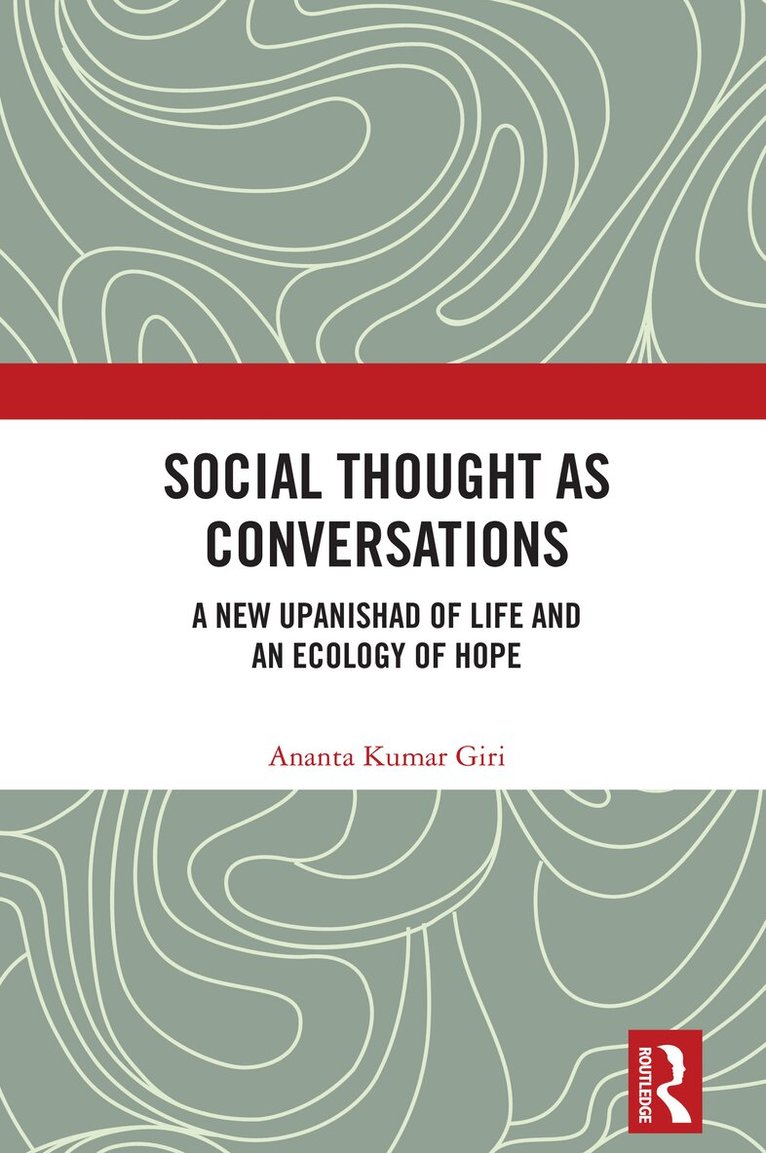
The power of Social Thought as Conversations brings to mind the wonderful saying of Antonio Machado, shared by Paulo Freire and Myles Horton as “We make the road by walking.” Ananta Kumar Giri’s deep, rich scholarship exemplifies this thinking, seeking conversations in social thought and those “habits of the heart” Robert Bellah so carefully examined in his work. It is an astonishing life that Ananta has led with enduring, powerful conversations with some of the great thinkers of our time. A book for the ages, ending on what seems now an impossibility, but which Ananta has given us much inspiration for: an ecology of hope. Bravo, Professor Giri!!- David Blake Willis, Filelding Gradute University, Santa Barbara, USAThis extraordinary volume about conversation—that criss-crosses religious, ethnic, national, and cultural lines—inspires such conversation by being an endlessly multi-valent conversation. Ananta Kumar Giri records thoughts and contacts that traverse places—mountains, valleys, rivers, oceans;topographical and political borders—and time’s own parameters to walk with and talk with minds and hearts that govern the paths of past and future. The lucky readers who join this conversational journey will find themselves rewarded in a manner reminiscent of the birds who joined the Hoopoe in his conversational journey in the magnificent classic by the mystical poet, Attar: in the palace of the Simurgh viewing a mirror reflecting all of them. Giri challenges and invites us to revel in the joy of internal vision—and, to mix metaphors, to unfurl further branches to the enduring family tree that this book has planted, watered, and nourished in ongoing growth.- Ori Z Soltes, Georgetown University, USAAnanta Kumar Giri has gifted the world with a timely work of high erudition. Underscoring "conversation" as a necessary missing link in social thought, the book performs a repairing of our thinking in the 21st century.- Sabelo J.Ndlovu-Gatsheni, Professor/Chair of Epistemologies, The Global South with Emphasis on Africa at the University of Bayreuth, Germany. Author of Beyond the Coloniality of Internationalism: Reworlding the World from the Global South.With his latest publication, Ananta Kumar Giri deepens his continuing probe into human and superhuman dimensions. Again we can eagerly anticipate his reflections. He is uniquely equipped to combine anthropology, philosophy, and experience as well as Eastern and Western queries. I for one am grateful and rather amazed at his contribution.- James Peacock, past president American Anthropological Association and Professor Emeritus of Anthropology, University of North Carolina at Chapel Hill, USA.In his new book, Ananta Kumar Giri masterfully takes the reader on a tour to the depth of Indian philosophy by elucidating the general backgrounds of philosophical thought, equally manifested in Eastern and Western philosophy. Guiding this tour is in a sense a natural task for Giri because he himself as a philosopher is integrating the East and West in his numerous works for already several decades.- Dmitri M. Bondarenko, Russian Academy of Sciences, Moscow, Russian FederationAnanta Kumar Giri infuses the personal with the political, giving voice to those often silenced or ignored. By visiting and conversing with leaders and victims in the struggles for food justice, social justice, and earth justice, Giri develops an expansive methodology that transcends disciplines. This brave approach combines philosophy, sociology, and poetry. Bravo!- Christopher Kay Chapple, Loyola Mary Mount University, Los Angeles, USAOne of the most poignant sequences of wording here -- reiterated at the end -- bodies forth the book as a multiple. Is a book not itself a library? And so too whatever are our thoughts. This volume is a veritable library of thought, full of movement, life, tenderness, clear-sightedness, not to speak of ethical and critical acumen, precisely because its multiple sources of truth are elicited through the constant company of others. - Dame Marilyn Strathern, Girton College, University of Cambridge, United KingdomThis excellent book is based on the idea that open, honest dialogue is important. Giri writes "Conversations bring us near as we seat together and learn together. This is the spirit of Upanishad-sitting near and conversing together." I agree completely. When applied beyond just the more tradition Vedantic views we can use the idea of Upanishadic-conversing to the kind of experience I had when I met Vinoba Bhave. One does not have to accept a specific theology to nevertheless benefit a great deal from reading this book. Ananta Giri has had a great deal of experience and is intellectually prepared to benefit from universal dialogue and scientific thinking. If we can think of the largely secular field of sociology as an Upanishadic dialogue that illuminates not only sociology as an academic pursuit but also the Upanishads as relevant for the 21st century. Giri also writes: "Social thought as conversation creates fields and circles of learning and encounters in which we take part as seekers and learners rather than as carriers of apriori hierarchies of knowledge..." and that is not just true for European sociological theory but also for Indic-centric or Sinitic-centric privileging of knowledge. Just as medical science, chemistry and biology are not restricted to any one language or culture, Upanishadic dialogue is for the whole world. Dialogue and empirically-based theorizing are necessary for progress in solving many of the world's problems. Beyond that, keeping an open mind about various worldviews and theological convictions is absolutely necessary as well. This provocative book will help greatly to improve that kind of wissenschaftliches dialogue. This excellent book is based on the idea that open, honest dialogue is important. Giri writes "Conversations bring us near as we seat together and learn together. This is the spirit of Upanishad-sitting near and conversing together." I agree completely. When applied beyond just the more tradition Vedantic views we can use the idea of Upanishadic-conversing to the kind of experience I had when I met Vinoba Bhave. One does not have to accept a specific theology to nevertheless benefit a great deal from reading this book. Ananta Giri has had a great deal of experience and is intellectually prepared to benefit from universal dialogue and scientific thinking. If we can think of the largely secular field of sociology as an Upanishadic dialogue that illuminates not only sociology as an academic pursuit but also the Upanishads as relevant for the 21st century. Giri also writes: "Social thought as conversation creates fields and circles of learning and encounters in which we take part as seekers and learners rather than as carriers of apriori hierarchies of knowledge..." and that is not just true for European sociological theory but also for Indic-centric or Sinitic-centric privileging of knowledge. Just as medical science, chemistry and biology are not restricted to any one language or culture, Upanishadic dialogue is for the whole world. Dialogue and empirically-based theorizing are necessary for progress in solving many of the world's problems. Beyond that, keeping an open mind about various worldviews and theological convictions is absolutely necessary as well. This provocative book will help greatly to improve that kind of wissenschaftliches dialogue.- Hans J I Bakker, University of Guelph, CanadaAnanta Kumar Giri’s Social Thought as Conversations: A New Upanishad of Life and an Ecology of Hope, his latest in an impressive line of books and edited collections, is a quite extraordinary work. It reflects perfectly his committed engagement in vivacious and thoughtful social scientific practice over the past two decades, as he presents it, but it is simultaneously much more than that. Its unconventional format signifies a unique contribution. Not only does it open an inspiring world from a fecund Indian perspective but, more broadly, it also advocates urgently on behalf of the Global South and global mutuality, cooperation and co-creation.- Piet Strydom, University College Cork, Ireland
Ananta Kumar Giri, Artem A. Uldanov, Arnab Roy Chowdhury, Sergey Parkhomenko, Deirdre Ruscitti Harshman
Häftad, 2025
584 kr
Annifrid Lilja, Björn Lilja
Kartonnage, 2026
229 kr
Kristin Hannah
Pocket, 2025
99 kr
Francesca Giannone
Pocket, 2026
99 kr