• Fri frakt över 249 kr
  • •
  • Snabba leveranser
  • •
  • Billiga böcker
Kundservice

Du är på sajten för privatpersoner.

Företag, bibliotek eller offentlig verksamhet?

Du handlar på classic.bokus.com, där alla dina funktioner finns intakta.
Till classic.bokus.com
Bokus logotyp. Gå till startsidan.
  • Erbjudanden
  • Nyheter
  • Student
  • Topplistor
  • Barn & ungdom
  • Bokus Play
  • E-böcker
  • Pocketböcker
  • Spel & pussel

10% rabatt på allt med kod: NYSTART10 →

Sidfot

Mina sidor

    Hjälp

    • Kundservice
    • Vanliga frågor och svar
    • Frakt och leverans
    • Retur vid ångerrätt
    • Reklamera vara
    • Betalning
    • Köpvillkor
    • Allmänna villkor
    • Information om webbplatsens tillgänglighet

    Om Bokus

    • Om oss
    • Pressrum
    • För studenter
    • För företag
    • För bibliotek och offentlig verksamhet
    • För leverantörer
    • Hållbarhet

    Populärt

    • Aktuella erbjudanden
    • Presentkort
    • Studentlitteratur
    • Nya böcker
    • Topplistor
    • Signerade böcker
    • Engelska böcker

    Inspiration

    • Boktips
    • BookTok
    • Populära bokserier
    • Barnbokskaraktärer
    • Populära författare
    Logotyp för Bokus
    Följ oss på Facebook (extern länk)Följ oss på Instagram (extern länk)Följ oss på YouTube (extern länk)Följ oss på TikTok (extern länk)
    bokus @ CookiesAnpassa cookiesIntegritetspolicyKöpvillkor
    Till Citymail hemsida (extern länk)Till Budbee hemsida (extern länk)Till Postnord hemsida (extern länk)Till Schenker hemsida (extern länk)Till Early Bird hemsida (extern länk)Till Walleys hemsida (extern länk)
    1. Naturvetenskap och teknik
    2. Geovetenskap
    3. Miljövetenskap och miljöpolitik

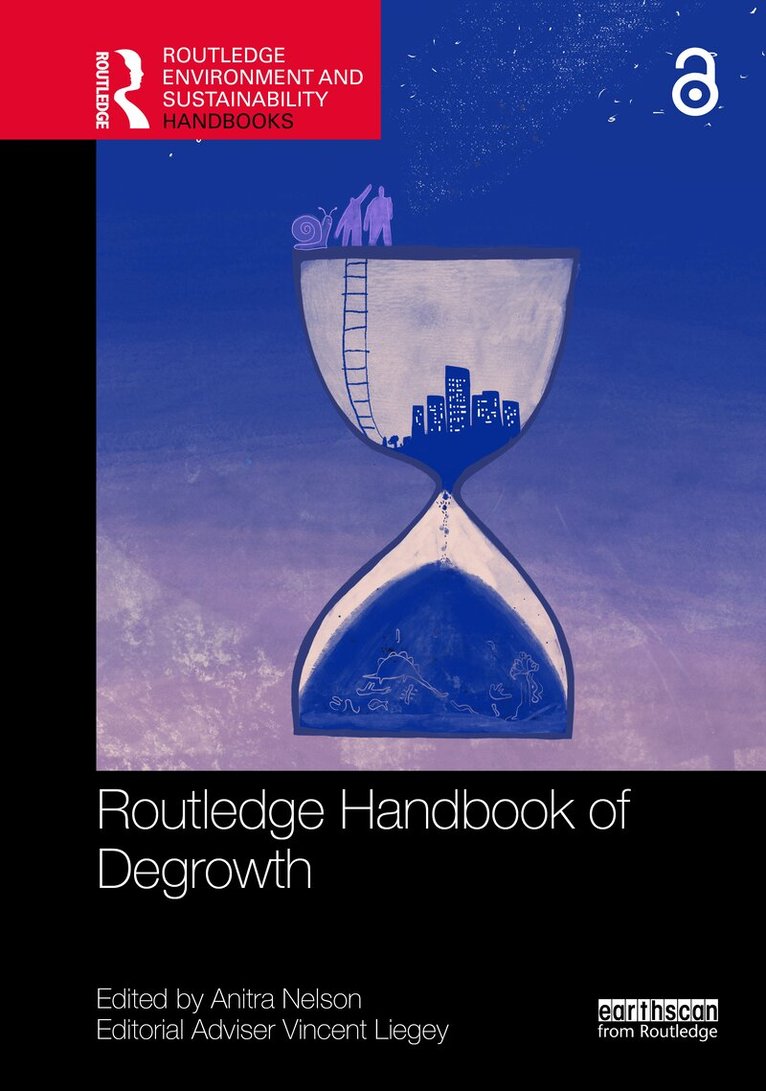
    Routledge Handbook of Degrowth

    AvAnitra Nelson

    Inbunden, Engelska, 2025

    Del i serien Routledge Environment and Sustainability Handbooks

    3 656 kr

    Beställningsvara. Skickas inom 10-15 vardagar. Fri frakt över 249 kr.

    Beskrivning

    This handbook takes stock of ‘degrowth’, a concept and movement gaining increasing visibility in the 2020s. Contributors explain contexts for degrowth’s significance, elaborate its diverse history and detail its unique approaches, practices, challenges and potential futures. Part I sets the ecological, economic and political contexts framing degrowth’s evolution as a significant concept for societies facing the challenges of deepening socio-political inequities and ecological unsustainabilities. Part II identifies themes characterising degrowth movements in a sample of distinctive countries, starting with its origins in France. Part III shows degrowth ‘concepts in action’, explaining in practical ways the meanings of terms such as ‘conviviality’, ‘degrowth doughnut’, ‘frugal abundance’, ‘commoning’ and ‘defashioning’. Part IV offers analyses and forward-looking imaginaries for degrowth from the perspectives of distinctive agents, agendas and theoretical frameworks. Contributors engage with topics such as ecofeminist futures, utopian thought and show how degrowth is necessary to address poverty.Highly experienced and knowledgeable contributors from varied scholarly and practitioner fields address a range of strategic, activist, policy and research questions in this handbook. Grounded in empirical cases, they identify significant social and ecological challenges, relevant to students, researchers, activists, policymakers and practitioners at various levels within the wide range of fields in which degrowth can be applied.

    Produktinformation

    • Utgivningsdatum:2025-07-17
    • Mått:174 x 246 x 35 mm
    • Vikt:2 160 g
    • Format:Inbunden
    • Språk:Engelska
    • Serie:Routledge Environment and Sustainability Handbooks
    • Antal sidor:504
    • Förlag:Taylor & Francis Ltd
    • ISBN:9781032645247

    Utforska kategorier

    • Miljövetenskap och miljöpolitik inom Naturvetenskap och teknik
    • Miljöekonomi inom Ekonomi och Ledarskap

    Mer om författaren

    Anitra Nelson is an activist scholar and Honorary Principal Fellow at the Informal Urbanism Research Hub (InfUr-), University of Melbourne (Australia). Among numerous degrowth publications, she is co-editor of Housing for Degrowth: Principles, Models, Challenges and Opportunities (2018) and Food for Degrowth: Perspectives and Practices (2021) collections, and co-author of Exploring Degrowth: A Critical Guide (2020). See https://anitranelson.info/Vincent Liegey is an engineer, interdisciplinary researcher and lecturer on degrowth. He has co-authored several books on degrowth including Exploring Degrowth: A Critical Guide (2020, Pluto Press), and Décroissance, Fake or Not (2022, Tana Editions). He is one of the coordinators of the international degrowth conferences and of Cargonomia, a centre for research and experimentation on degrowth in Budapest.

    Recensioner i media

    "The pluriverse of degrowth is beautifully synthesized in this book. A must-have."Kohei Saito, Professor of Philosophy, University of Tokyo, author of bestseller Down: How Degrowth Communism Can Save the Earth (2024)"We stand at a crossroads. Or to be honest, a little farther, on the path to chaos. But we still have choice. Embracing strategy and practice, this handbook on degrowth comes just in time to open horizons. I can’t wait for it to be translated into French!"Corinne Morel Darleux, essayist – Être heureux avec moins (2023)"The Routledge Handbook of Degrowth is an essential and inspiring resource for anyone seeking to understand the history, diversity, and transformative potential of the degrowth movement. Anitra Nelson and Vincent Liegey have assembled a groundbreaking collection that will guide researchers, activists, and policymakers alike."Giorgos Kallis, ICREA professor at ICTA, Autonomous University of Barcelona, author of degrowth classics, such as In Defence of Degrowth (2017) Degrowth (2018), Limits (2019)"As glaciers are melting and Los Angeles is destroyed by raging fires, struggling for a world beyond capitalist development and growth has never been more urgent. The Routledge Handbook of Degrowth is a rich, enlightening, comprehensive guide towards it. Definitely a must read."Silvia Federici, Hofstra University (New York), author of classic Caliban and the Witch (2004)"The Routledge Handbook of Degrowth deftly diagnoses the disease of global growthism, and brims with a plenitude of inspiring living examples, challenges, complexities and possibilities for a future of convivial, relational joy that we know is possible."Helena Norberg-Hodge, esteemed author, filmmaker and founding director of Local Futures"Routledge Handbook of Degrowth is a landmark publication. It not only consolidates degrowth's status as a serious intellectual and political project but also expands its horizons by engaging with decolonial, feminist, and ecological justice perspectives. For pedagogy, the book offers rich material for courses in environmental studies, political economy, and sustainability transitions. For policymakers, it provides conceptual tools to rethink well-being beyond GDP. For researchers, it opens avenues for comparative studies of degrowth practices and imaginaries. Most importantly, it challenges readers to reimagine futures rooted not in accumulation but in sufficiency, solidarity, and conviviality."Sarkar, R. & Goyal, E., (2025) “Review of Anitra Nelson, with editorial adviser Vincent Liegey. 2025. Routledge Handbook of Degrowth”, Journal of Political Ecology 32(1). doi: https://doi.org/10.2458/jpe.10133"In a world where growth has become a prison rather than a promise, the Routledge Handbook of Degrowth offers something increasingly rare: hope grounded in analysis, vision tempered by realism, and a roadmap drawn by those already walking the path.Whether that path leads to transformation or remains a marginal alternative depends not on this handbook alone, but on the movements, communities, and individuals willing to ask: What if enough is actually enough?"Illuminem Book Reviews"The Routledge Handbook of Degrowth is an essential resource for anyone beginning to engage with degrowth theories and practices, as well as for readers who remain skeptical of the concept’s validity and relevance (with Chap. 26 on poverty reduction offering particularly valuable responses to common critiques). It also serves as an accessible resource for undergraduate and graduate courses, with several chapters in Part I working well as standalone class readings. The volume is equally useful for readers already familiar with degrowth who wish to delve deeper into its nuances and explore its applications across various fields. Taken together, these chapters provide a comprehensive view of how degrowth manifests in practice and how its ideas connect across sectors and geographies to envision and articulate cohesive, alternative futures."Giulia Belotti & Holly Caggiano (09 Dec 2025): The Routledge Handbook of degrowth,, Urban Research & Practice, DOI: 10.1080/17535069.2025.2602026“More than 20 years after the term ‘degrowth’ was coined, this book represents a clear effort to provide an insight into the numerous discussions revolving around it, as well as their translations into various prefigurative practices around the world. What stands out is the editors’ ability to orchestrate an indirect dialogue between different authors and ultimately integrate them into an overview of possible future directions for the movement, research, and politics, reflecting on the complex and hostile context in which they operate ...”Anna Pagani, Buildings and Cities

    Innehållsförteckning

    • Part I. The current growth conjuncture 1. Degrowth has come of age 2. Fossilised metabolism: The social ecology of capitalist growth 3. Unequal uses of Earth 4. Capitalist crisis and affective alternatives Part II. Degrowth: Origins and steppingstones 5. The French origins and pillars of degrowth 6. Degrowth in Italy: Early beginnings, political disputes and a plural social movement 7. Postwachstum: German roots and currents of degrowth 8. A Catalan way towards degrowth 9. Accidental degrowth practices: Illustrations from Czechia 10. Greece: Real-existing degrowth and its challenges 11. Degrowth’ and the implications of English language hegemony 12. Latin American indigenous perspectives meet degrowth 13. Degrowth in an African periphery: From necrocapitalism to a pluriverse of nowtopias Part III. Degrowth practices: Concepts in action 14. Conviviality and commoning 15. Autonomy and freedom in individual to societal transformation 16. The degrowth doughnut 17. Frugal abundance: Meaning in practice in an Icelandic village 18. Defining defashion: A manifesto for degrowth 19. Degrowth: Health and healthcare 20. Holistic care economies: Degrowth ways of provisioning and the Global East 21. The pedagogy of degrowth and the political ecology of technology 22. Mapping the spectrum of degrowth work 23. Reimagining collaboration: Degrowth practitioners, scholars and activists Part IV. Degrowth futures: Perspectives and strategies 24. Twenty years of degrowth: What has been achieved? 25. Roles of utopian thought in a degrowth transformation 26. Growth, degrowth and poverty reduction 27. Imperial and solidary modes of living: Alternatives to eco-imperialism 28. Prefigurative degrowth politics: Decolonisation and the nonaligned movement 29. Ecofeminist and decolonial feminist degrowth futures 30. Fostering degrowth in men: Beyond masculinity and the gender binary 31. Degrowth, urbanisation and spatial planning 32. Degrowth-aligned commoning organisations 33. Ecosocialism and degrowth 34. Beyond growth: Beyond divisions 35. Degrowth: Future research directions