• Fri frakt över 249 kr
  • •
  • Snabba leveranser
  • •
  • Billiga böcker
Kundservice

Du är på sajten för privatpersoner.

Företag, bibliotek eller offentlig verksamhet?

Du handlar på classic.bokus.com, där alla dina funktioner finns intakta.
Till classic.bokus.com
Bokus logotyp. Gå till startsidan.
  • Erbjudanden
  • Nyheter
  • Student
  • Topplistor
  • Barn & ungdom
  • Bokus Play
  • E-böcker
  • Pocketböcker
  • Spel & pussel

10% rabatt på allt med kod: NYSTART10 →

Sidfot

Mina sidor

    Hjälp

    • Kundservice
    • Vanliga frågor och svar
    • Frakt och leverans
    • Retur vid ångerrätt
    • Reklamera vara
    • Betalning
    • Köpvillkor
    • Allmänna villkor
    • Information om webbplatsens tillgänglighet

    Om Bokus

    • Om oss
    • Pressrum
    • För studenter
    • För företag
    • För bibliotek och offentlig verksamhet
    • För leverantörer
    • Hållbarhet

    Populärt

    • Aktuella erbjudanden
    • Presentkort
    • Studentlitteratur
    • Nya böcker
    • Topplistor
    • Signerade böcker
    • Engelska böcker

    Inspiration

    • Boktips
    • BookTok
    • Populära bokserier
    • Barnbokskaraktärer
    • Populära författare
    Logotyp för Bokus
    Följ oss på Facebook (extern länk)Följ oss på Instagram (extern länk)Följ oss på YouTube (extern länk)Följ oss på TikTok (extern länk)
    bokus @ CookiesAnpassa cookiesIntegritetspolicyKöpvillkor
    Till Citymail hemsida (extern länk)Till Budbee hemsida (extern länk)Till Postnord hemsida (extern länk)Till Schenker hemsida (extern länk)Till Early Bird hemsida (extern länk)Till Walleys hemsida (extern länk)
    1. Samhälle och politik
    2. Politik och statsskick
    3. Offentlig förvaltning

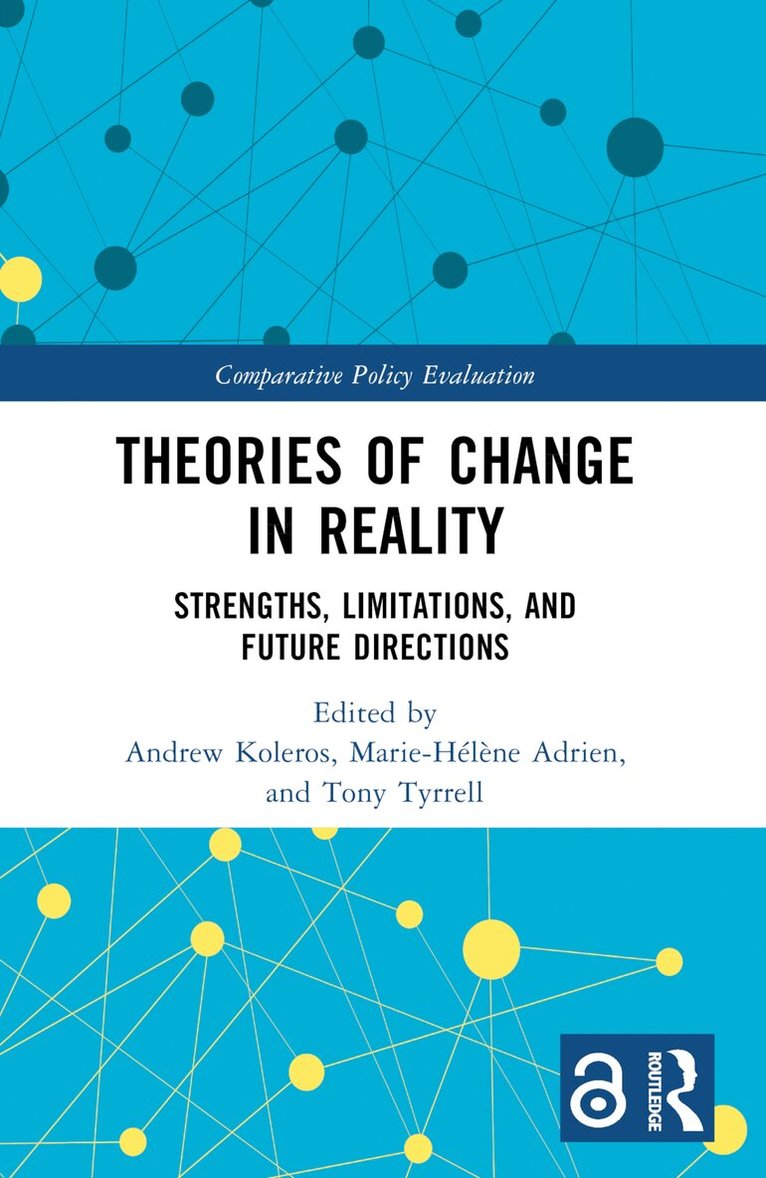
    Theories of Change in Reality

    Strengths, Limitations and Future Directions

    AvAndrew Koleros,Marie-Hélène Adrien

    Häftad, Engelska, 2025

    Del i serien Comparative Policy Evaluation

    681 kr

    Beställningsvara. Skickas inom 10-15 vardagar. Fri frakt över 249 kr.

    Beskrivning

    For over 50 years, evaluators have used theories of change to articulate the causal logic underpinning how an intervention is intended to bring about a desired change. From its origins in programme evaluation, the approach has been adopted more widely for purposes from program design to program management. As theories of change continue to be used for multiple purposes, it is an opportune moment for the evaluation community—where the approach originated—to provide their perspective on the strengths and limitations of the approach and its future directions. To provide these perspectives, we asked nearly 30 of the world’s leading evaluators and programme theorists to provide a short essay on the past, present, and future of theories of change. This book presents their insights organized into five main themes: the use of theories of change in broader public policy contexts; using theories of change to establish causality; developing theories of change reflective of multiple stakeholder perspectives; using theories of change to understand wider societal change processes; and applying theories of change approaches for multiple purposes. By sharing these diverse perspectives, the book aims to both provide evaluators and emerging programme theorists with critical perspectives to inform future practice.The Open Access version of this book, available at www.taylorfrancis.com, has been made available under a Creative Commons Attribution-Non Commercial-No Derivatives (CC-BY-NC-ND) 4.0 license.

    Produktinformation

    • Utgivningsdatum:2025-10-26
    • Mått:152 x 229 x 16 mm
    • Vikt:540 g
    • Format:Häftad
    • Språk:Engelska
    • Serie:Comparative Policy Evaluation
    • Antal sidor:266
    • Förlag:Taylor & Francis Ltd
    • ISBN:9781032669625

    Utforska kategorier

    • Offentlig förvaltning inom Samhälle och politik
    • Referensverk och tvärvetenskap inom Samhälle och politik

    Mer om författaren

    Andrew Koleros is a Principal Researcher at Mathematica with 20 years of experience in designing and delivering mixed-methods evaluations and programme monitoring, evaluation and learning systems for both small-scale and largescale social and economic development projects. He brings particular expertise in using theory-based approaches that integrate complexity concepts and systems thinking into programme and evaluation design processes to address complex societal problems from safe and affordable housing to youth employment to advancing health equity. He obtained his master’s in public health from the Tulane School of Public Health and Tropical Medicine. He has published on his work in designing theory-based evaluation approaches in the American Journal of Evaluation, the Canadian Journal of Programme Evaluation and in multiple practitioner settings. He is a member of the American Evaluation Association, the European Evaluation Society, and the Canadian Evaluation Society.Marie-Hélène Adrien is a senior evaluation practitioner and researcher with 35 years of experience in evaluating the performance of programmes and institutions financed by bilateral and multilateral agencies and philanthropies around the globe. Dr. Adrien is a former CEO of the consulting firm Universalia Management Group in Montreal and was the President of the International Development Evaluation Association (IDEAS), as well as a professor of practice at the International Development Studies Program of McGill University.Tony Tyrrell is an independent consultant with more than 25 years’ experience in evaluation and related fields. Tony’s early experience in evaluation was with the European Social Fund Evaluation Unit where he produced influential evaluations on various subjects including early school leaving and local development. He later worked with a number of private consulting firms on strategic, policy, and programme evaluation and on performance management. More recently he spent six years with the Independent Evaluation Group at the World Bank Group (WBG). Tony now works as an independent consultant with various clients including the WBG, the Asian Development Bank, various governments, and private consultancies. He holds an MSc in Management (Organisation Behavior), and an MA in English Literature. Tony was co-editor (with Burt Perrin) of another book in this series, Changing Bureaucracies (2021).

    Innehållsförteckning

    • ForewordEmily Gates and Kathy Chau RohnPart 1. Introduction Andrew Koleros, Marie-Hélène Adrien, and Tony TyrrellPart 2. Considerations in Using Theories of Change to Establish Causality2. Theories of Change between Critical Thinking and Social PracticesPeter Dahler-Larsen 3. Setting the Stage for Contribution ClaimsThomas Delahais 4. Using Theories of Change to Assess Causality in a Policy Change ContextCarlisle Levine 5. How Deep is your Ontology? How a Little Ontological Thinking Can Strengthen How Evaluators Use Theories of ChangeTom Ling 6. My Perspective on Theories of ChangeMarkus Palenberg Part 3. Using Theories of Change to Understand Wider Social Change Processes 7. Theory of Change for Sustainable BusinessJens Anderson 8. Upcycling TOC for Impact Investment and Early-Stage VenturesPenny Hawkins and Zazie Tolmer 9. Strategy-level Theories of Change Require a Focus on Systems Change: An Actor-Based Approach can HelpAndrew Koleros 10. Evaluating the use of Artificial Intelligence and Big Data (ai/bd) in Policy Making: Unpacking Black-Boxes and Testing White-BoxesFrans Leeuw 11. Developing, Representing and Using Theories of Change for Interventions in Complex Systems Patricia RogersPart 4. Adapting Theories of Change for Use in Broader Public Policy Contexts 12. Theories of Change in Evaluation of Local Government ReformsKurt Houlberg and Olaf Rieper 13. Theories-of-Change and the Evaluation of Sustainable Impact: Moving beyond Simplicity in Development CooperationPeter van der Knapp 14. Use of Theory of Change as a Management Tool for Government Multi-year Development Plans: The Case of Brazil’s Federal PPALycia Lima and Marina Lafer 15. Theories of Change in Complex Macro Public Sector Planning Settings in Africa: How Useful are They?Candice Morkel 16. Simple Heuristics for Drafting Theories of Change: A Case of Behavioral Insights into Food WasteKarol Olejniczak and Igor Lyubashenko Part 5. Applying Theories of Change Approaches for Multiple Purposes 17. The Law of the Instrument: Would you Rather be a Theory or a Nail?Gordon Freer 18. 3ie: A ‘Balloon-Squeezing’ Approach to the Theory of ChangeMarie Gaarder 19. Integrating Theories of Change in Program Management and DeliveryMark Oldenbeuving 20. Theories of Change: Who Needs Them? or: What Evaluators Can Learn from OperaBurt Perrin 21. How to Ensure No-one Uses Your Theory of Change: Lessons from the Front Lines of ToC Facilitation and Possibilities for RenewalMary Tangelder22. Why do we have ToCs of the Program Intervention but not of the Intervention that is the Evaluation?Bob WilliamsPart 6. Developing Theories of Change Reflective of Multiple Stakeholder Perspectives 23. Participatory Explorations of Alternative Futures: Using Narrative Theories of ChangeRick Davies, Lara Mani and Tom Hobson 24. Constructing a Living Theory of Change in Fragile Contexts: Grounded on Context, Problem and EvidenceHur Hassnain 25. Flipping the Script on Program Theories: Advancing Towards Transformative Theories of ChangeSebastian Lemire 26. Theory Based Evaluation Approaches Can Enable Online Project SuccessSteve Montague, Heloise Emdon and Eva Grabinski 27. Theory of Change as a Tool for Tracking Intensive Family Program Developments in WhitetownJane Mulcahey, Catherine Naughton and Sean Redmond ConclusionsAndrew Koleros, Marie-Hélène Adrien, and Tony Tyrrell