• Fri frakt över 249 kr
  • •
  • Snabba leveranser
  • •
  • Billiga böcker
Kundservice

Du är på sajten för privatpersoner.

Företag, bibliotek eller offentlig verksamhet?

Du handlar på classic.bokus.com, där alla dina funktioner finns intakta.
Till classic.bokus.com
Bokus logotyp. Gå till startsidan.
  • Erbjudanden
  • Nyheter
  • Student
  • Topplistor
  • Barn & ungdom
  • Bokus Play
  • E-böcker
  • Pocketböcker
  • Spel & pussel

Må bättre, för mindre! Upp till 50% rabatt på hälsoböcker

Sidfot

Mina sidor

    Hjälp

    • Kundservice
    • Vanliga frågor och svar
    • Frakt och leverans
    • Retur vid ångerrätt
    • Reklamera vara
    • Betalning
    • Köpvillkor
    • Allmänna villkor
    • Information om webbplatsens tillgänglighet

    Om Bokus

    • Om oss
    • Pressrum
    • För studenter
    • För företag
    • För bibliotek och offentlig verksamhet
    • För leverantörer
    • Hållbarhet

    Populärt

    • Aktuella erbjudanden
    • Presentkort
    • Studentlitteratur
    • Nya böcker
    • Topplistor
    • Signerade böcker
    • Engelska böcker

    Inspiration

    • Boktips
    • BookTok
    • Populära bokserier
    • Barnbokskaraktärer
    • Populära författare
    Logotyp för Bokus
    Följ oss på Facebook (extern länk)Följ oss på Instagram (extern länk)Följ oss på YouTube (extern länk)Följ oss på TikTok (extern länk)
    bokus @ CookiesAnpassa cookiesIntegritetspolicyKöpvillkor
    Till Citymail hemsida (extern länk)Till Budbee hemsida (extern länk)Till Postnord hemsida (extern länk)Till Schenker hemsida (extern länk)Till Early Bird hemsida (extern länk)Till Walleys hemsida (extern länk)
    1. Samhälle och politik
    2. Politik och statsskick
    3. Statsvetenskap och politisk teori

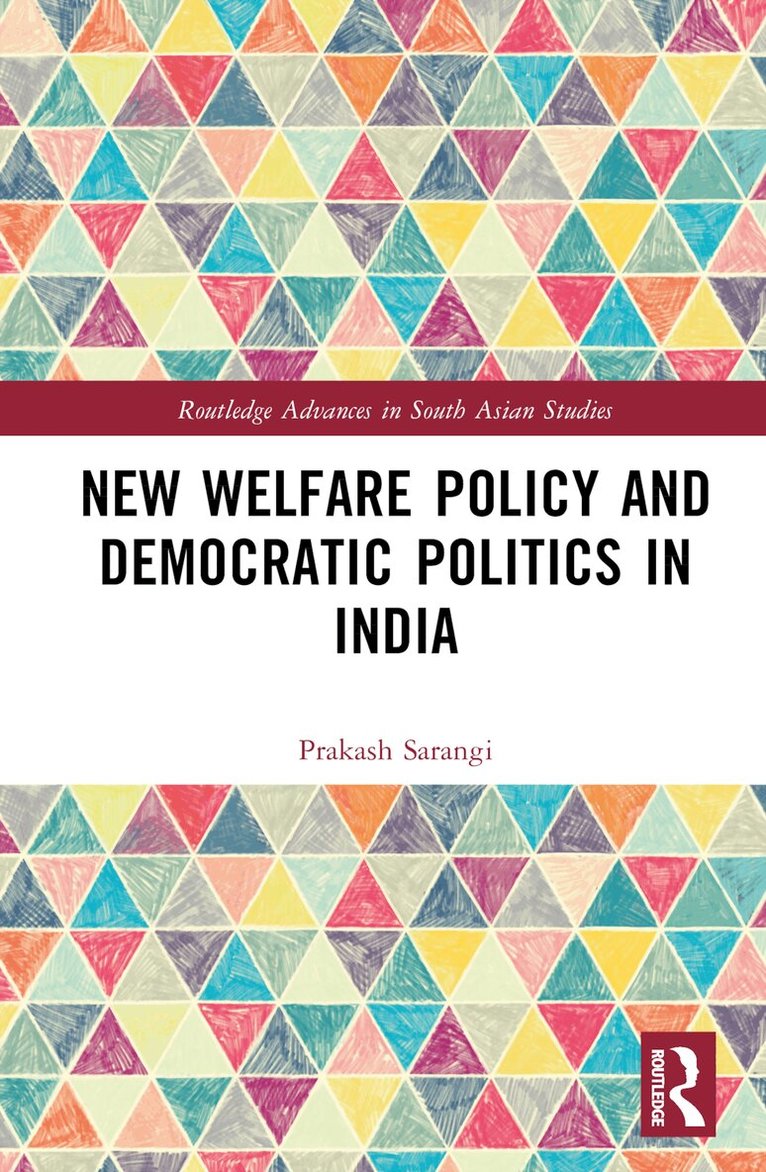
    New Welfare Policy and Democratic Politics in India

    AvPrakash Sarangi

    Inbunden, Engelska, 2024

    Del i serien Routledge Advances in South Asian Studies

    2 421 kr

    Beställningsvara. Skickas inom 10-15 vardagar. Fri frakt över 249 kr.

    Fler format och utgåvor

    Häftad

    681 kr

    E-bok

    805 kr

    E-bok

    805 kr

    Beskrivning

    New Welfare Policy and Democratic Politics in India offers an analysis of India’s welfare policy during the last couple of decades. It looks at how welfare policy making is viewed as a function of party competition and voter mobilization, showing a gradual transformation of political clients into entitled citizens through which democratic politics in India has redefined its contemporary welfare discourse.The book argues that political parties formulate policies in order to respond to the voices of citizens and shows that a new welfare architecture emerged in India, characterized as responsive welfare. India has witnessed a sharp rise in such voices, which have been disadvantaged by a globalizing market. The size and vulnerability of this group has made them politically significant and electorally salient. These welfare aspirants have found a new political space through political parties to negotiate and assert their claims on the state, creating a milestone in India’s democratic politics trajectory, in the form of entitlement-based welfare policy. The book compares and evaluates the implications of these new welfare policies in the contexts of two governments: the Congress-led government during 2009-2014 and the BJP-led government during 20014-2019. The empirical data reveal remarkable similarities in their electoral pledges, policy outputs, policy outcomes and accountability towards citizens. These findings indicate significant convergence in their welfare policies, sans ideology or ethnic support base. It also reveals that the ideological differences among the two major parties do not prevent remarkable continuities in the formulation and implementation of welfare policies during their incumbencies, thus allowing for a bipartisan acceptance of a citizen-centric welfare policy.Offering a new analysis to understand this citizen-party-policy linkage in the formulation of welfare policy in India, the book presents a macro analysis of India’s interface between democratic politics and welfare policy. It will be of interest to researchers in the fields of the politics of welfare, democratisation in changing societies, comparative politics and Indian and South Asian Studies and Asian Politics.

    Produktinformation

    • Utgivningsdatum:2024-06-11
    • Mått:156 x 234 x 15 mm
    • Vikt:453 g
    • Format:Inbunden
    • Språk:Engelska
    • Serie:Routledge Advances in South Asian Studies
    • Antal sidor:182
    • Förlag:Taylor & Francis Ltd
    • ISBN:9781032744605

    Utforska kategorier

    • Statsvetenskap och politisk teori inom Samhälle och politik
    • Socialt arbete och välfärd inom Samhälle och politik

    Mer om författaren

    Prakash Sarangi is a former Professor of Political Science, University of Hyderabad, India, and a former Vice-Chancellor, Ravenshaw University, India. His academic interests revolve around democratic theory and practice and his publications include Political Exchange and Public Policy, Essays on India’s Political Economy and Liberal Theories of State: Contemporary Perspectives.

    Recensioner i media

    "A timely contribution to democratic theory and public policy, this work takes the discourse on welfare and welfare state into a new stage where the idea of 'responsive welfare' is presented as integral to democratic politics and economic development providing a tool to the citizens to assess competing electoral promises by parties."-- Professor Manoranjan Mohanty, University of Delhi and Council for Social Development, India“The conceptual link between democratic politics and welfare policies is the core argument of this book. Sarangi’s succinct analysis of India’s vibrant political process shows how party competition links citizenship to the entitlement to welfare. This elegant and closely argued book is a timely corrective to the chorus of ‘democracy backsliding’ in India.”– Professor Subrata K Mitra, Heidelberg University, Heidelberg, Germany

    Innehållsförteckning

    • Preface; Chapter 1: Introduction; Chapter 2: Welfare discourses in India; Chapter 3: Expansion of Welfare Aspirants in India at the Turn of the Century; Chapter 4: Convergence of Welfare Pledges by the Congress and the BJP: 2009-2019 Chapter 5: Welfare Policy Output 2009-19; Chapter 6: Welfare Policy Outcomes 2009-2019; Chapter 7: Responsiveness and Accountability; Chapter 8: Conclusion; Appendices; Index