• Fri frakt över 249 kr
  • •
  • Snabba leveranser
  • •
  • Billiga böcker
Kundservice

Du är på sajten för privatpersoner.

Företag, bibliotek eller offentlig verksamhet?

Du handlar på classic.bokus.com, där alla dina funktioner finns intakta.
Till classic.bokus.com
Bokus logotyp. Gå till startsidan.
  • Erbjudanden
  • Student
  • Topplistor
  • Barn & ungdom
  • Bokus Play
  • E-böcker
  • Ljudböcker
  • Pocketböcker
  • Spel och pussel

5% studentrabatt – använd koden KURSBOK27 →

Sidfot

Mina sidor

    Hjälp

    • Kundservice
    • Vanliga frågor och svar
    • Frakt och leverans
    • Retur vid ångerrätt
    • Reklamera vara
    • Betalning
    • Köpvillkor
    • Allmänna villkor
    • Information om webbplatsens tillgänglighet

    Om Bokus

    • Om oss
    • Pressrum
    • För studenter
    • För företag
    • För bibliotek och offentlig verksamhet
    • För leverantörer
    • Hållbarhet

    Populärt

    • Aktuella erbjudanden
    • Presentkort
    • Studentlitteratur
    • Nya böcker
    • Topplistor
    • Signerade böcker
    • Engelska böcker

    Inspiration

    • Boktips
    • BookTok
    • Barnbokskaraktärer
    • Populära författare
    Logotyp för Bokus
    Följ oss på Facebook (extern länk)Följ oss på Instagram (extern länk)Följ oss på YouTube (extern länk)Följ oss på TikTok (extern länk)
    bokus @ CookiesAnpassa cookiesIntegritetspolicyKöpvillkor
    Till Citymail hemsida (extern länk)Till Budbee hemsida (extern länk)Till Postnord hemsida (extern länk)Till Schenker hemsida (extern länk)Till Early Bird hemsida (extern länk)Till Walleys hemsida (extern länk)
    1. Naturvetenskap och teknik
    2. Teknik och industri
    3. Elektronik och kommunikationer

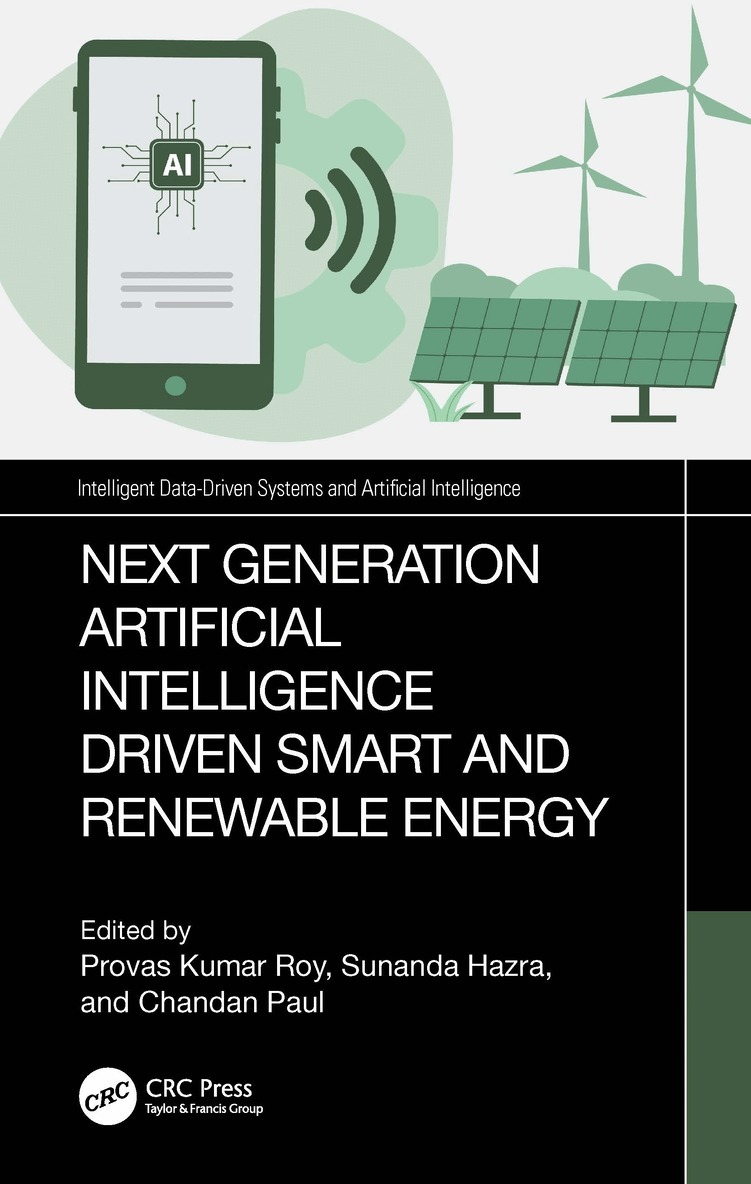
    Next-Generation Artificial Intelligence Driven Smart and Renewable Energy

    AvProvas Kumar Roy,Sunanda Hazra

    Inbunden, Engelska, 2025

    Del i serien Intelligent Data-Driven Systems and Artificial Intelligence

    1 460 kr

    Beställningsvara. Skickas inom 10-15 vardagar. Fri frakt över 249 kr.

    Beskrivning

    To provide for a sustainable future, the potential synergies at the dynamic intersection of renewable energy (RE) incorporated with smart energy and artificial intelligence (AI) must be exploited. RE is crucial to preserve the environment. Energy involving various systems must be optimized and assessed to provide better performance. However, the design and development of RE systems remains a challenge. Advanced optimization techniques, AI, and machine learning (ML) plays a crucial role in implementing the latest innovative research in the field of renewable energy-integrated electrical systems. This book also describes the practical challenges encountered, and the solutions and future scope to be adopted. Applications of a variety of advanced optimization and AI techniques in the design and development of RE-integrated systems are discussed to provide new solutions in the RE domain.Key features:Discusses modern modeling/control approaches for improving renewable energy integrating artificial intelligence-driven power systemsDescribes the principles and methods of renewable energy generation technologies, and an analysis of their implementation, management, and optimization, and related economic advantagesPresents critical information on the technological design and policy issues that must be taken into considered while implementing a smart gridExplains of the metaheuristic optimization algorithm for complex electrical systems, and the whale optimization algorithm-based multi-objective hydrothermal schedulingCovers the electric vehicle charging station in the distribution network, and transient stability constraint optimal power flow problem using chaotic quasi-oppositional chemical reaction optimizationThe topics covered including microgrids, wind power, solar photo voltaic (PV), optimal power flow (OPF), grid connected inverter, electric vehicle, combined heat and power economic dispatch, FACTS tools for smart energy, harmonic impedance of a salient pole synchronous generator (HI), maximum power point tracking (MPPT) and advanced optimization techniques. Next Generation Artificial Intelligence-Driven Smart and Renewable Energy is ideal for academicians, practitioners, teachers, engineers, industry professionals, researchers, and students in diverse fields, including electrical engineering, electronics and communications engineering, energy, and environmental engineering.

    Produktinformation

    • Utgivningsdatum:2025-07-06
    • Mått:156 x 234 x 16 mm
    • Vikt:560 g
    • Format:Inbunden
    • Språk:Engelska
    • Serie:Intelligent Data-Driven Systems and Artificial Intelligence
    • Antal sidor:196
    • Förlag:Taylor & Francis Ltd
    • ISBN:9781032761565

    Utforska kategorier

    • Elektronik och kommunikationer inom Naturvetenskap och teknik
    • Energiteknik inom Naturvetenskap och teknik
    • Artificiell intelligens inom Data och IT

    Mer om författaren

    Provas Kumar Roy received the BE degree in Electrical Engineering from R.E. College, Durgapur, Burdwan, India in 1997; ME degree in Electrical Machine from Jadavpur University, Kolkata, India in 2001 and Ph.D. from NIT Durgapur in 2011. Presently he is working as Professor at the department of Electrical Engineering, Kalyani Government Engineering College, Kalyani, India. He has published more than 140 research papers in international journals, 65 conferences paper, 15 book chapters and Scopus citation is nearly 4700 with H-index of 40. His field of research interest includes Economic Load Dispatch, Optimal Power flow, FACTS, Unit Commitment, Radial Distribution System, State Estimation, Automatic Generation Control, Power System Stabilizer and Evolutionary computing techniques. He has supervised 12 Ph.D. scholars in the domain of the power system analysis with high penetration of renewable energy, image processing. He has been placed among “World Ranking of top 2% Scientists” for last three consecutive years in the field of Energy by Stanford University scientists. He has been awarded many times with outstanding reviewer awards, top scientist awards, top peer reviewer awards, best paper awards. He has also contributed as committee member of several national and international conferences. He is a member of the Institute of Engineers and Indian Society of Technical Education (ISTE). He is a regular reviewer of leading journals including Elsevier, IET and IEEE Transactions/journals.Sunanda Hazra received the Ph.D. degree in Electrical Engineering. He is presently associated with Electrical Engineering Department of Haldia Institute of Technology, Haldia, W.B, India. He has ten years of teaching experience. He has published around 20 research papers in International Journals and conference records. His research interest includes load dispatch, hydrothermal scheduling, renewable energy, optimization techniques, etc. He has been awarded with Young Scientist from VD Good Technology Factory in 2021. He has reviewed few research works submitted to National/International Journals. He has attended & organized several short-term courses/faculty development programmes. He is a member of IEI.Chandan Paul received B. Tech degree in Electrical Engineering from Dr. B. C. Roy Engineering College, Durgapur (under West Bengal University of Technology), India, in 2006 and an M. Tech degree from National Institute of Technology, Durgapur, West Bengal, India in Electrical Engineering (specialisation of Electrical System) in 2012. He obtained PhD in Electrical Engineering from IIT (ISM) Dhanbad in 2022. He has eight Journals published in reputed SCI and Scopus indexed Journals. His area of research includes hydro-thermal scheduling, optimal power flow, combined heat and power dispatch and evolutionary algorithms. He has three international journals. He is working as an Assistant Professor in the Department of Electrical Engineering, Dr. B.C. Roy Engineering College, Durgapur, India

    Innehållsförteckning

    • 1. Renewable Energy: Opportunities, Applications, and Future Scope of Artificial Intelligence and Internet of Things. 2. Machine Learning-Enhanced Maximum Power Point Tracking for Solar Modules in Photovoltaic Systems. 3. An Alternative Approach to the Modeling of Harmonic Impedance of a Salient Pole Synchronous Generator. 4. Neuro-Fuzzy Based Optimization Techniques. 5. OPF Incorporating FACTS Tools with Renewable Energy by GWA. 6. Solving of Combined Heat and Power Economic Dispatch Problem Using Evolutionary Technic Considering Prohibited Operating Zone. 7. Integrated Modeling and Fabrication of Electric Vehicle for Multi-Criteria Framework-Based Racing Frontier Ecosystems. 8. Application of Artificial Intelligence in Wind Energy Generation. 9. Governing and Empowering Independent Power Producers in South Africa. 10. DQ Current Control Strategies for Single-Phase Grid-Connected Inverter. 11. Chaotic Quasi-Oppositional Differential Search Algorithm for Transient Stability Constraint Optimal Power Flow Problem. 12. Illuminating the Path to a Sustainable Future by Harnessing AI-Powered Renewable Energy Systems.